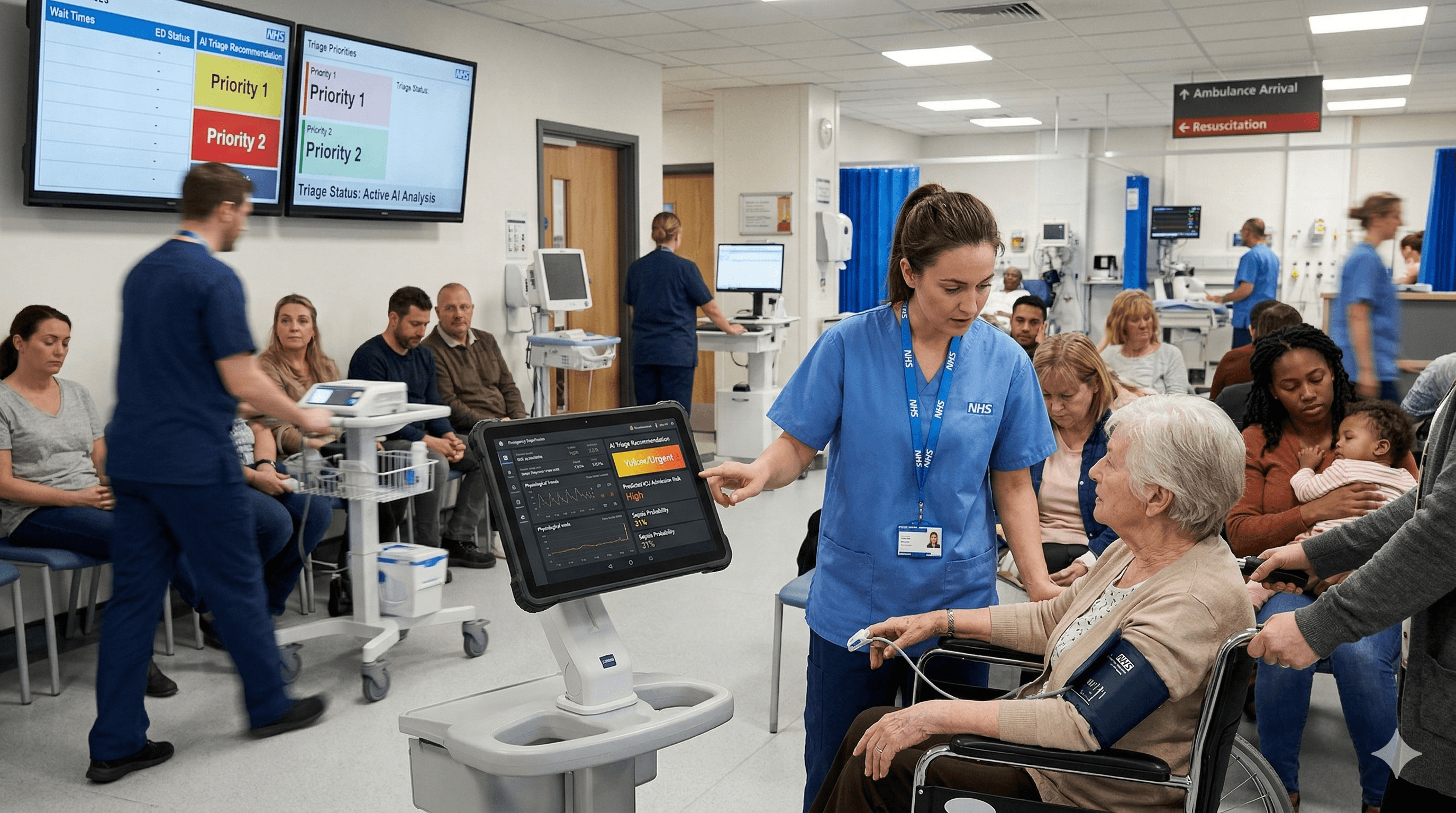
Key takeaways
- AI-driven ED triage uses machine learning to analyse real-time patient data (vital signs, presenting complaint, medical history) and generate triage recommendations — supplementing, not replacing, clinical judgement.
- A landmark study in NEJM AI (174,648 ED visits across three sites) found that implementing an AI-informed triage clinical decision support tool was associated with improved identification of critical care patients (78.8% → 83.1%) and reduced median time from arrival to initial care area by 33% (12 → 8 minutes).
- ML models consistently outperform conventional triage scoring systems (such as the Emergency Severity Index) in predictive accuracy for hospital admission, ICU admission, and mortality — according to multiple systematic reviews.
- Key technologies include NLP (interpreting unstructured chief complaints and clinician notes), supervised ML (predicting outcomes from structured data), and real-time physiological monitoring (integrating vital sign trends into triage scoring).
- The NHS context: The Royal College of Emergency Medicine has highlighted ED overcrowding as a patient safety crisis. AI triage tools like PATCHS (primary care), Ada Health, and Klinik are already being piloted in UK settings. The Tony Blair Institute has proposed an "AI Navigation Assistant" for every citizen.
- Challenges are significant: algorithmic bias (models trained on one population may underperform on another), clinician trust (EM nurses show more scepticism than technologists), data quality, regulatory classification, and the ethical question of automated prioritisation.
- For EM clinicians wanting guideline-grounded clinical reference alongside triage decisions — checking sepsis criteria, paediatric fever pathways, or chest pain management — iatroX provides free, instant access to UK national guidelines on any device.
The triage problem
Emergency department triage exists to answer a deceptively simple question: who needs to be seen first?
The standard approach globally — whether using the Manchester Triage System (UK), Emergency Severity Index (US), or Australasian Triage Scale — relies on a trained clinician (usually a nurse) conducting a rapid assessment of the patient's presenting complaint, vital signs, and clinical appearance, then assigning a priority category. The system is structured, protocol-driven, and has served EDs for decades.
But it has fundamental limitations:
Subjectivity: Different nurses triage the same patient differently. Studies consistently show inter-rater variability in triage scoring, particularly for mid-acuity patients (ESI level 3) who represent the largest volume and the most ambiguous clinical presentations.
Cognitive load: During peak hours and mass casualty events, triage nurses are making rapid decisions under extreme pressure, often with incomplete information. Fatigue, distraction, and time pressure degrade decision quality.
Limited data integration: A human triage assessment typically uses the presenting complaint, a brief set of vital signs, and a visual impression. It does not routinely integrate the patient's full medical history, medication list, previous ED visits, or longitudinal vital sign trends — information that is often available in the EHR but inaccessible in the 2-minute triage encounter.
The volume problem: NHS EDs saw 25.5 million attendances in 2023–24. The Royal College of Emergency Medicine has repeatedly warned that overcrowding is a patient safety crisis, with avoidable deaths linked to delays in assessment and treatment.
AI-driven triage aims to address all four of these limitations.
The evidence: what the research shows
The NEJM AI study
The most significant evidence for AI-informed ED triage comes from a multisite quality improvement study published in NEJM AI. The study evaluated an AI-informed triage clinical decision support (CDS) tool across three EDs, comparing 83,404 pre-intervention visits with 91,244 post-intervention visits (174,648 total).
Key findings:
- Improved critical care identification: The proportion of patients requiring critical care who were correctly assigned high-acuity triage (ESI level 1 or 2) increased from 78.8% to 83.1% (p < 0.001).
- Reduced time to care: Median time from arrival to initial care area decreased by 33% (12 minutes → 8 minutes).
- Reduced overall ED time: Median time to ED disposition decreased by 4.2% (190 → 182 minutes) and time to ED departure by 6.1% (311 → 292 minutes).
- Redistribution of acuity: Low-acuity (ESI 4/5) visits increased by 48.2%, while mid-acuity (ESI 3) visits decreased by 18.7% — suggesting the AI helped correctly downgrade patients who were being over-triaged by the conventional system.
- Human-AI synergy: Nurses who showed high agreement with the AI CDS recommendations performed better than the AI alone, while those with low agreement performed worse. This highlights the importance of implementation and training — the AI is most effective when clinicians trust and engage with it, rather than ignoring or overriding it reflexively.
Systematic review evidence
A comprehensive scoping review of 29 primary studies found that:
- ML models consistently demonstrated superior discrimination compared to conventional triage systems for predicting hospital admission, ICU admission, and mortality.
- AI integration yielded significant enhancements in predictive accuracy, disease identification, and risk assessment.
- ML accurately determined the necessity of hospitalisation for patients requiring urgent attention.
- ML improved resource allocation and quality of patient care, including predicting length of stay.
A separate narrative review covering 2015–2024 literature confirmed these findings while highlighting persistent challenges: data quality issues, algorithmic bias, clinician trust, and ethical concerns as significant barriers to widespread adoption.
How AI triage works: the technology
Natural Language Processing (NLP)
The presenting complaint — "chest pain," "shortness of breath," "my child has a fever and won't eat" — is the single most important piece of information at triage. NLP models parse these unstructured text descriptions (from triage notes, patient self-report, or ambulance handover) and extract clinically relevant features: symptom type, severity, duration, associated symptoms, and red flags.
Advanced NLP can interpret context and nuance that keyword matching cannot. "Chest pain worse on exertion in a 55-year-old smoker" triggers a very different risk profile from "chest pain after eating in a 22-year-old" — and NLP models can capture these distinctions.
Supervised machine learning
The core triage prediction task — "given this patient's data, what is the probability of ICU admission / emergency surgery / death within 24 hours?" — is a supervised classification problem. Models are trained on historical ED data (vital signs, demographics, presenting complaint, medical history, laboratory results, and outcomes) and learn to predict which patients are truly high-risk.
Common model architectures include gradient-boosted trees (XGBoost, LightGBM), random forests, and increasingly, deep learning models that can integrate heterogeneous data types (structured vitals + unstructured text + temporal trends).
Real-time physiological integration
The next frontier is integrating continuous vital sign monitoring into the triage algorithm. Rather than a single set of vitals taken at the triage desk, AI models can incorporate trends from wearable monitors, ambulance telemetry, or continuous ED monitoring — detecting deterioration trajectories that a snapshot assessment would miss.
The UK landscape: what is happening now
Primary care triage AI
While ED triage AI is still emerging, primary care triage AI is already deployed at scale in the UK:
- PATCHS: A medical-device-grade triage tool developed from the University of Manchester, used for patient self-triage before GP contact. It has published evaluations and a registered clinical trial.
- Ada Health: An AI symptom assessment tool used for patient-facing triage and clinician decision support. Studies show it achieves comparable accuracy to telephone and nurse triage for ED determinations.
- Klinik: A triage and patient-flow tool used in NHS primary care settings. One real-world study found it did not miss any urgent cases when used in emergency settings.
These tools are shaping the pipeline of patients who reach the ED — by triaging patients earlier, they may reduce inappropriate ED attendance and ensure that those who do arrive are more accurately pre-classified.
The NHS AI Navigation Assistant proposal
The Tony Blair Institute for Global Change has proposed that the UK government commit to developing an AI Navigation Assistant for every citizen — an integrated triage and care-navigation tool that would direct patients to the right service (self-care, pharmacy, GP, urgent care, or ED) before they present at the emergency department. While still a policy proposal, it reflects the direction of travel for NHS digital strategy.
NHSE and the MHRA
Any AI triage tool deployed in the NHS must comply with:
- DTAC (Digital Technology Assessment Criteria)
- MHRA medical device regulations — an AI tool that determines triage category is likely to be classified as a medical device
- NICE Evidence Standards Framework for digital health technologies
- DCB 0129/0160 clinical safety case management
Challenges and limitations
Algorithmic bias
AI triage models are only as equitable as the data they are trained on. If training data over-represents certain demographics or under-represents others, the model may systematically undertriage or overtriage specific patient groups. This is particularly concerning for:
- Ethnic minorities: Vital sign norms (e.g., oxygen saturation thresholds) differ across ethnic groups, and historical data may embed systemic biases in care patterns.
- Women: Cardiac presentations in women are more frequently atypical, and models trained predominantly on male presentations may miss female-pattern emergencies.
- Children and elderly: Physiological parameters and normal ranges differ significantly from the adult populations that dominate most training datasets.
Clinician trust
Research consistently shows that EM nurses — the primary users of triage tools — approach AI with more scepticism than technologists or administrators. A 2026 Frontiers in Digital Health study found that even AI "enthusiasts" among medical practitioners were substantially more reserved about ED triage AI than non-medical professionals. This trust gap is not irrational — it reflects legitimate concerns about accountability, transparency, and the complexity of triage decisions that go beyond vital signs (e.g., assessing a patient's social circumstances, safeguarding concerns, or the "gut feeling" of an experienced nurse).
The NEJM AI study demonstrated that the AI worked best when nurses engaged with it — but some nurses consistently overrode the AI's recommendations. Implementation must include training, explanation, and a culture that treats the AI as a decision support tool, not an authority.
The accountability question
If an AI triages a patient as low-acuity and that patient subsequently deteriorates, who is responsible? The nurse who accepted the recommendation? The hospital that deployed the system? The vendor that built the algorithm? This question is not yet fully resolved in UK or US regulatory frameworks.
Data quality
AI triage models depend on accurate input data. In a busy ED, vital signs may be measured hastily, presenting complaints may be recorded incompletely, and medical history may be unavailable. The aphorism "garbage in, garbage out" applies with particular force in triage, where the stakes of a wrong classification are immediate and potentially fatal.
Where iatroX fits: clinical knowledge alongside triage decisions
AI triage tools help determine who gets seen first. They do not tell the clinician what to do next.
Once a patient is triaged — whether by a human nurse, an AI system, or a combination — the clinical team needs to make management decisions: investigations, treatment, referral, or discharge. This is where clinical decision support tools matter.
iatroX provides EM clinicians with free, instant access to UK national guidelines for the conditions most commonly encountered in the ED:
- Sepsis guidelines: Rapid access to the NEWS2 scoring criteria, red flag symptoms, and NICE-recommended sepsis management pathway.
- Fever in under-5s: The NICE traffic light system for assessing febrile children — critical for paediatric triage decisions.
- Low back pain and sciatica: Red flags, investigation thresholds, and referral criteria.
- Cellulitis and erysipelas: Eron classification and management pathway.
- Ask iatroX: Any clinical question, answered instantly with NICE/CKS/SmPC/emc citations.
- Brainstorm: AI-assisted differential diagnosis — particularly useful for undifferentiated presentations in the ED where the initial working diagnosis is uncertain.
For EM trainees preparing for MRCEM or FRCEM examinations, iatroX Quiz provides adaptive, curriculum-mapped question banks with spaced repetition — turning daily ED experience into structured exam preparation.
The AI triage tool decides the queue. iatroX helps you manage the patient once they are in front of you.
Practical recommendations for EM clinicians
-
Stay informed: AI triage is coming to your ED — probably within the next 2–3 years if it has not arrived already. Understanding the technology, its strengths, and its limitations will make you a better clinical leader during implementation.
-
Engage with pilots: If your Trust is evaluating an AI triage tool, volunteer to participate. The NEJM AI study showed that clinicians who engaged with the AI performed better than those who ignored it.
-
Maintain clinical judgement: AI triage is a decision support tool, not a decision-maker. The nurse's clinical assessment — including the "soft" signals that AI cannot yet capture (patient appearance, affect, social context) — remains essential.
-
Advocate for equity: Ask vendors about bias testing, demographic performance data, and whether the model has been validated on a population similar to yours. Insist on transparency.
-
Use complementary tools: AI triage handles prioritisation. For clinical management, use guideline-grounded tools like iatroX (free, MHRA-registered) to ensure your clinical decisions are aligned with current evidence and national recommendations.
Related reading on iatroX
- AI symptom checkers decoded: a tech guide to Ada, Ubie Health, and DxGPT
- Ubie, Docus, Ada: AI symptom checker UK guide
- AI differential diagnosis tools: a UK clinician guide 2026
- AI in healthcare 2026: trends — UK, US, Canada, Australia
- MHRA AI regulation and the Commission call for evidence 2026
- AI tools for paramedics: UK prehospital and primary care
- NHS AI scribes 2025: a compliant buyer's guide
- Sepsis guidelines on iatroX
- Fever under 5s on iatroX