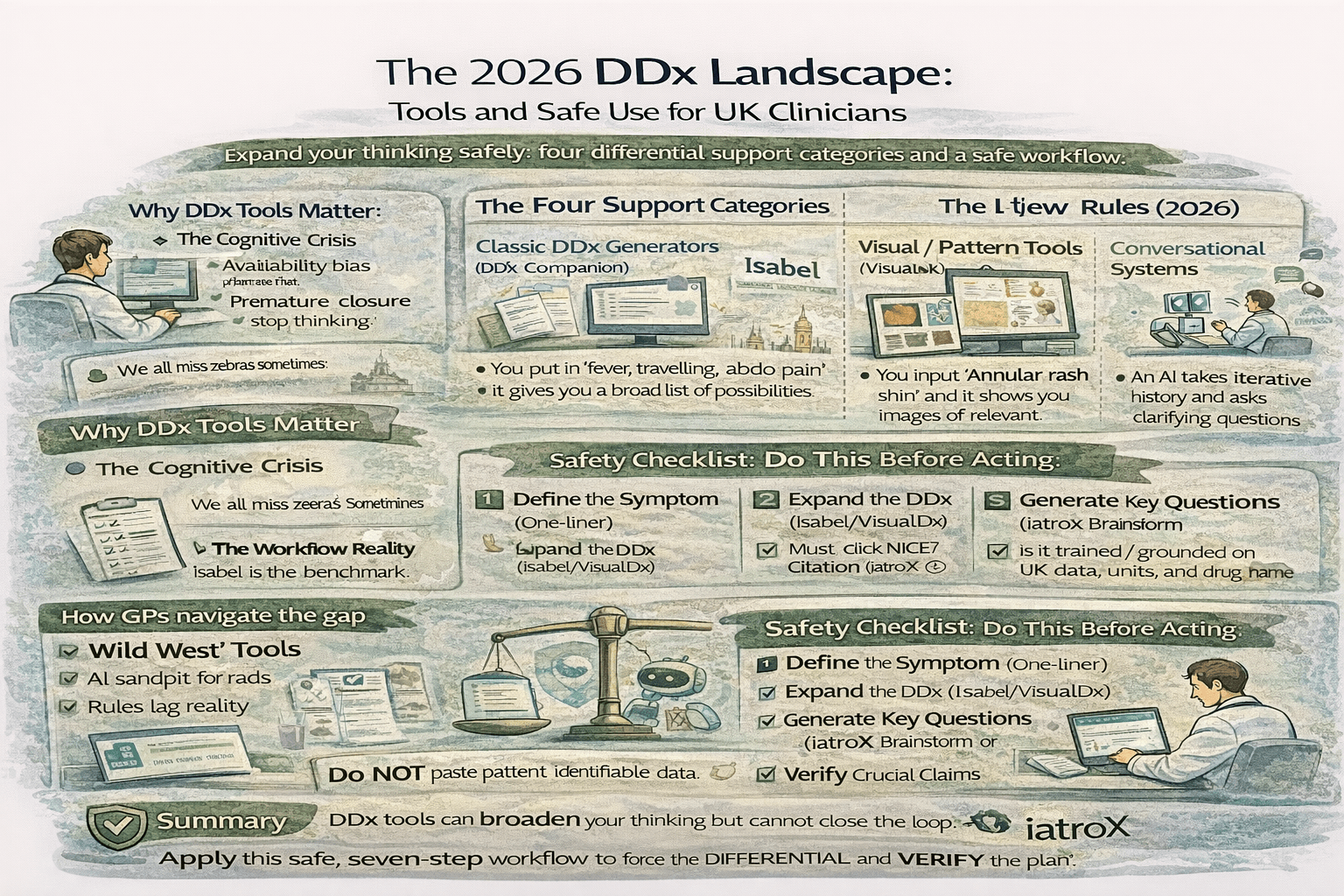
In a 10-minute consultation, the most dangerous moment is "premature closure." You hear "cough," you think "viral URTI," and you stop thinking.
AI tools for differential diagnosis (DDx) are exploding in popularity because they promise to solve this cognitive trap. But for the UK clinician, the landscape is confusing. Is Isabel still the gold standard? Is Google’s AMIE actually available? Is it safe to paste a history into DxGPT?
This guide breaks down the 2026 DDx landscape, categorises the tools that actually work, and provides a safe workflow for using them without risking your GMC licence.
Why “DDx tools” are exploding again
The resurgence of DDx tools isn't just about better AI; it's about the "cognitive load" crisis in primary care.
- The Cognitive Problem: We are all prone to availability bias (diagnosing what we saw yesterday) and premature closure (stopping at the first likely answer).
- The Workflow Problem: With 10-minute slots and complex comorbidities, we simply don't have the mental bandwidth to run a "full diagnostic sieve" for every patient. AI acts as a "cognitive forcing function"—a second pair of eyes that forces you to consider the "zebra" you might have missed.
The 4 categories of DDx support (and what each is good for)
Don't just look for a "diagnostic AI." Choose the specific tool for the specific gap in your reasoning.
1. Classic DDx Generators (Checklist Expansion)
- Tool: Isabel (DDx Companion).
- What it does: You enter key features (e.g., "Abdo pain, travelling, fever"), and it generates a long list of possibilities ranked by "Red Flag" and "Common."
- Verdict: Excellent for the "Stuck" moment. It doesn't tell you the answer; it tells you what you haven't thought of. Recent evaluations show it includes the final diagnosis in the top list in ~95% of real cases.
2. Visual / Pattern Tools (“Looks Like”)
- Tool: VisualDx.
- What it does: A "visual differential builder." You input "Annular rash on shin" and it shows you a grid of verified medical images (Erythema Nodosum, Ringworm, Granuloma Annulare) to compare against your patient.
- Verdict: The gold standard for dermatology and ophthalmology. It replaces the "textbook description" with visual reality.
3. LLM-Based DDx Assistants (Reasoning Engines)
- Tool: DxGPT.
- What it does: You paste a (de-identified) case vignette, and it returns a ranked differential with reasoning (e.g., "Consider Kawasaki because of the 5-day fever and rash").
- Verdict: Powerful for complex, multisystem cases (e.g., Paediatrics/Genetics). Note: DxGPT explicitly positions itself as decision support, not a medical device.
4. Conversational Diagnostic Research Systems
- Tool: Google AMIE (and similar research models).
- What it does: An AI that performs "active history taking," asking iterative questions to narrow the differential.
- Verdict: While research shows strong performance in controlled settings, these are generally not yet available for open clinical use in the NHS. They represent the future of "AI OSCEs," not today's clinic.
The safety reality (what the literature suggests)
Before you rely on these tools, understand the evidence limitations.
- Clinician vs Consumer: Systematic reviews repeatedly flag that consumer-facing symptom checkers are often inaccurate and risk-averse (triaging everyone to A&E). Do not confuse "patient symptom checkers" with "clinician decision support."
- Modest Gains: Studies (e.g., in BMJ Quality & Safety) suggest that while DDx support improves accuracy, the effect size is modest.
- Timing Matters: The tools work best when used early (to broaden the hypothesis generation) rather than late (to confirm a bias).
The UK clinician workflow that makes DDx tools safe
Do not let the AI drive. Use this 7-step protocol to keep the human in the loop.
- Define the Problem Representation: Write a one-line summary first (e.g., "45F with acute RUQ pain and fever post-fatty meal").
- Use a DDx Expander: Input this one-liner into your tool (e.g., iatroX Brainstorm or Isabel) to broaden your thinking.
- Use a Question Generator: Ask the tool: "What 3 questions would best discriminate between the top 2 diagnoses?"
- Identify Don’t-Miss Conditions: Scan the list specifically for Red Flags (e.g., Aortic Dissection, Meningitis).
- Decide Tests/Referral Thresholds: Use the tool to check "What is the gold standard test for [Diagnosis X]?"
- Verify Decision-Critical Claims: If the tool suggests a rare condition, check the criteria on NICE CKS.
- Document: "Differential considered: X, Y, Z. Safety-netting provided for [Red Flag]."
Where iatroX fits
Most DDx tools give you a list. iatroX Brainstorm gives you a pathway.
iatroX Brainstorm is explicitly designed to walk you through the diagnostic arc step-by-step:
- History: It suggests targeted questions to ask.
- Differential: It offers a ranked list based on UK epidemiology.
- Investigations: It suggests the specific NHS-appropriate tests to rule in/out.
- Management: It links you to the relevant guidelines.
It is "Structured Reasoning" rather than just a "List Generator"—keeping the clinician accountable while reducing the cognitive load of the blank page.
Summary for UK Clinicians In 2026, the safest way to use AI for differential diagnosis is as a cognitive forcing function: use it to broaden your DDx, generate discriminating questions, and surface red flags — then verify decision-critical recommendations against trusted sources and apply clinical judgement.
FAQ
Which AI tool is best for differential diagnosis for doctors? For lists/checklists, Isabel is the established leader. For visual conditions (skin/eye), VisualDx is superior. For reasoning through complex cases, iatroX Brainstorm or DxGPT (used with caution) offers the best structured support.
Is DxGPT regulated? DxGPT is generally positioned as "clinical decision support" or an educational tool, not a regulated medical device for diagnosis. It should never replace clinical judgement.
Does Isabel improve diagnostic accuracy? Yes, studies have shown it can improve diagnostic accuracy, particularly by reducing "premature closure" and ensuring important rare diagnoses are considered.
How should GPs use DDx tools safely in the UK? Use them early to generate ideas, but always verify the management plan against NICE CKS or current UK medicines information. Never input patient identifiable data (Name, NHS Number) into cloud-based AI tools.