The regulatory landscape for AI in UK healthcare is about to shift from "guidance" to "governance."
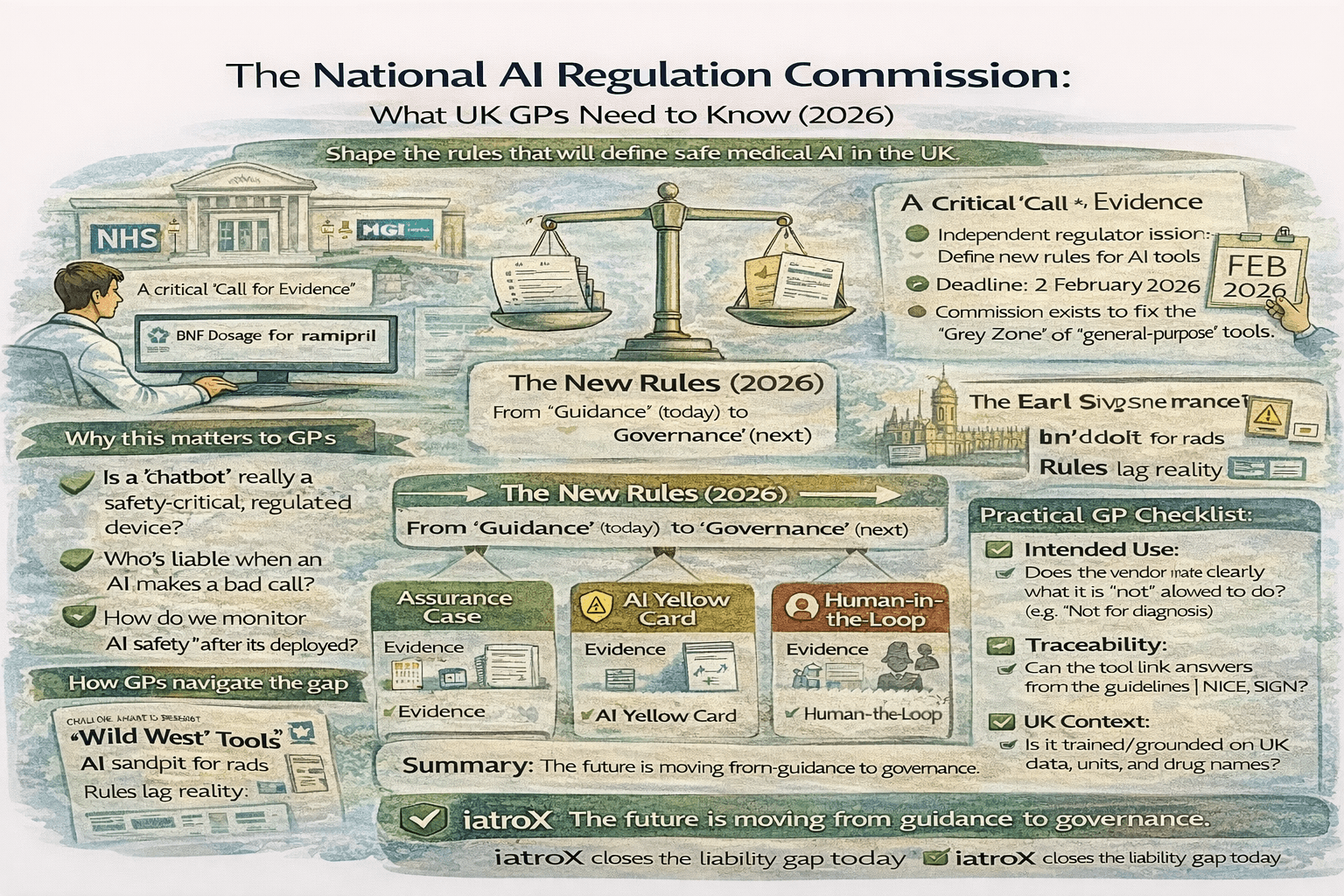
This week, the MHRA opened a critical Call for Evidence to inform the National Commission into the Regulation of AI in Healthcare. For the first time, the regulator is explicitly asking frontline clinicians, not just tech CEOs, to shape the rules that will govern how we use algorithms in patient care for the next decade.
The deadline is tight: 2 February 2026.
This briefing explains what the Commission is, why it matters to your daily practice, and how to navigate the "gap" between current tools and future rules.
What the Commission is and why it exists
The National Commission was launched in late 2025 to solve a specific problem: the "Wild West" of general-purpose AI.
While the MHRA has successfully piloted its AI Airlock sandbox for specific medical devices (like AI radiology tools), it lacks a robust framework for the "grey zone" tools—the LLMs, chatbots, and summarisers that clinicians are already using but which don't fit the traditional "medical device" box.
The Commission exists to advise on a new regulatory framework that balances safety with access. It is the body that will decide:
- When does a "helpful chatbot" become a "regulated medical device"?
- Who is liable when an AI hallucination leads to a wrong prescription?
- How do we monitor AI safety after it has been deployed?
What changes clinicians should anticipate
Based on the early signals from the AI Airlock pilots, clinicians should expect three major shifts in 2026:
1. From "Accuracy" to "Assurance" Vendors will no longer be able to just claim "95% accuracy." They will need to provide an Assurance Case—a structured argument supported by evidence that shows why the system is safe, not just that it passed a test.
2. Mandatory Post-Market Monitoring (The "AI Yellow Card") The days of "deploy and forget" are over. Expect a new requirement for proactive monitoring. Just as you report adverse drug reactions via the Yellow Card scheme, practices may soon be required to report "AI incidents" (e.g., hallucinations or bias) to a central registry.
3. Formalised "Human-in-the-Loop" Protocols The regulator is likely to codify the "Human-in-the-Loop" requirement. This means relying on an AI decision without a documented human verification step could become a specific professional conduct issue, rather than just a general negligence one.
The “frontline reality gap”
There is a stark disconnect between the MHRA's timeline and the frontline reality.
- The Regulator: Is currently gathering evidence to build a framework for late 2026.
- The Clinician: Is already seeing patients who use ChatGPT Health (launched yesterday) and is likely using AI tools for admin today.
This gap creates risk. While the rules catch up, the liability sits with the individual clinician. You cannot wait for the Commission to report; you need a safe operating model now.
A practical GP checklist for “safe adoption” conversations
If a partner or practice manager proposes a new AI tool before the new regulations land, use this checklist to stress-test it against the direction of travel.
The "Commission-Ready" Checklist
- [ ] Intended Use: Is the vendor explicitly clear on what the tool is not allowed to do? (e.g., "Not for diagnosis").
- [ ] Traceability: Can the AI show exactly which UK guideline (NICE/SIGN) it used to generate the answer? (Black boxes will likely face stricter regulation).
- [ ] UK Context: Is the tool trained/grounded on UK data, or will it suggest US insurance codes and FDA-approved drugs?
- [ ] Incident Reporting: Does the vendor have a clear button to report errors, and do they publish their error rates?
Where iatroX fits
At iatroX, we have built our engine to align with where the regulation is going, not just where it is today.
We operate with an "Anti-Wild West" posture:
- Clinician-Grade Traceability: We do not generate answers from the "open web." We retrieve from a closed, curated library of national guidelines (NICE, CKS, MHRA).
- UK-Specific Grounding: Our system is hard-coded to prioritise UK protocols, units, and drug names.
- Medical Device Status: For our specific clinical features, we operate as a UKCA-marked medical device, giving you the regulatory assurance that generic chatbots cannot provide.
While the Commission does its work, iatroX remains the safe, defensible choice for UK clinicians who need speed without sacrificing governance.