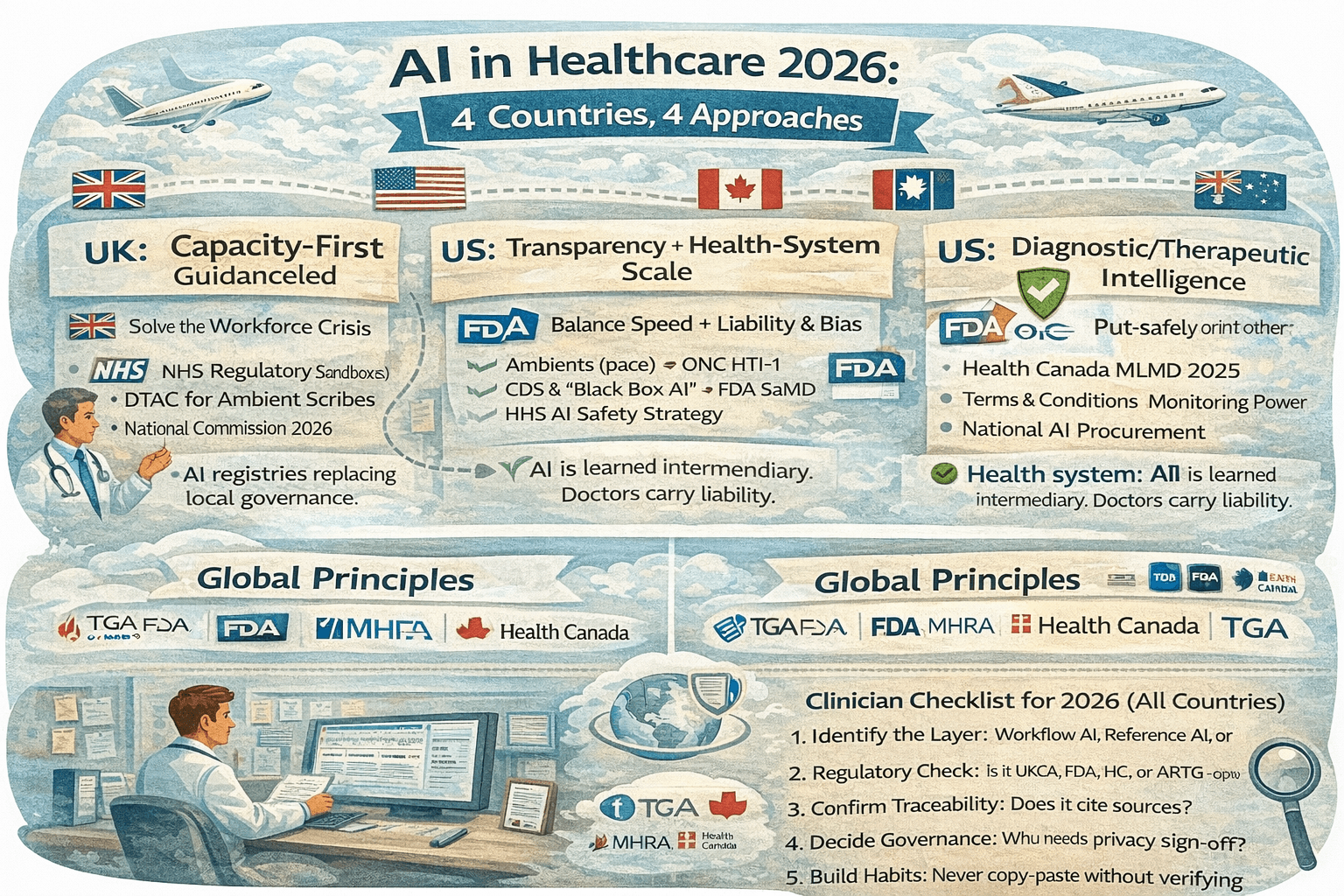
AI in Healthcare 2026: 4 Countries, 4 Approaches (UK, US, Canada, Australia)
There is a common misconception that "AI policy" is a single global standard. It isn't.
If you are a clinician working in London, your AI reality is defined by capacity (waiting lists). If you are in New York, it is defined by liability and billing. In Toronto, it is procurement governance. In Sydney, it is national safety infrastructure.
By 2026, the "Wild West" era of 2023 is over. Regulators have moved from "monitoring" to "enforcing," but they have chosen four very different paths.
This guide is your operating manual for the global AI landscape in 2026. We break down who regulates what, which tools are safe to use, and where the risk has shifted in your specific health system.
The 2026 “AI stack” in healthcare: what counts as AI
Before we look at countries, we must define the layers. In 2026, regulators no longer treat "AI" as one bucket. They regulate based on risk.
The 4 Layers
- Workflow AI (Low Reg): Ambient scribes, inbox automation, coding support. (Focus: Data privacy, not patient safety).
- Reference AI (Low/Med Reg): Evidence search, summarisation, "medical search engines" like iatroX. (Focus: Transparency and hallucinations).
- Clinical Decision Support / CDS (Med Reg): Risk prediction (e.g., Sepsis alerts), deterioration indices. (Focus: "White box" transparency).
- Diagnostic/Therapeutic AI (High Reg): "This X-ray shows cancer," "Change insulin to 10 units." (Focus: Medical Device regulation).
UK (NHS): capacity-first adoption + guidance-led deployment
The Strategy: The NHS is betting on AI to solve its workforce crisis. The regulator (MHRA) is pragmatic, creating "sandboxes" to allow innovation while the laws catch up.
What’s driving adoption
- Capacity: The "NHS Online" hospital model relies on AI triage to keep patients out of A&E.
- Efficiency: There is a national push for "Ambient Voice" technology to reduce GP admin time.
What the NHS has actually produced
- The National Commission: As of Feb 2026, the MHRA's National Commission into the Regulation of AI is closing its call for evidence, with a new statutory framework due mid-year.
- The Ambient Registry: NHS England has launched a "self-certified registry" for ambient voice suppliers, ensuring they meet basic data privacy standards (DTAC) without needing full medical device approval.
- The AI Airlock: A regulatory sandbox allowing advanced tools (like AI radiology) to be piloted in the NHS before full UKCA marking.
What clinicians should expect next
Expect a move away from "local pilots" to "national pathways." If you want to use an AI tool, your Trust/ICB will likely require it to be on an approved framework.
Clinician Tip: You can safely use "Reference AI" (Layer 2) for personal knowledge support, but do not plug "Diagnostic AI" (Layer 4) into patient workflows unless it is UKCA marked and Trust-approved.
US: transparency requirements + FDA scoping + health-system-led scale
The Strategy: The US is market-driven. The FDA and ONC are focusing on transparency—forcing vendors to show how the AI works so physicians can remain the "human in the loop" (and carry the liability).
The 3-part US engine
- FDA CDS Guidance (Jan 2026 Update): The FDA has just updated its guidance to "exercise enforcement discretion" for certain Clinical Decision Support (CDS) tools that provide a single output (e.g., "Prescribe Statin") if the tool is transparent and the clinician can independently review the basis. This is a pro-innovation shift from 2022.
- ONC HTI-1: The "Health Data, Technology, and Interoperability" rule is now fully effective. It mandates that any "predictive decision support" integrated into an EHR (like Epic/Cerner) must display transparency metrics (fairness, validity, safety) to the user.
- HHS Strategy: A push for "AI safety" focusing on non-discrimination and equity in algorithms.
What’s unique about the US in 2026
- Speed: US health systems are deploying ambient AI at massive scale (thousands of doctors) because the ROI (billing/coding) is clearer than in the NHS.
- Liability: The "learned intermediary" doctrine is being tested. If the AI is transparent (ONC compliant), the doctor is liable. If the AI is a "black box" (FDA regulated device), the manufacturer might share liability.
Canada: regulator clarity (MLMD) + procurement maturity
The Strategy: Canada is "buying safely." Health Canada has released some of the world's specific guidance for Machine Learning-enabled Medical Devices (MLMD), focusing on lifecycle management.
Regulatory backbone
- Health Canada MLMD Guidance (Feb 2025): Established clear rules for "Pre-determined Change Control Plans" (PCCP). This allows AI models to update and "learn" without needing a new licence every month, provided they stay within agreed guardrails.
- Terms & Conditions (Jan 2026): Health Canada now has expanded powers to impose specific "Terms and Conditions" on medical device licences, allowing them to force manufacturers to monitor specific risks post-launch.
System backbone
- Procurement: Canada Health Infoway has released robust "AI Procurement Toolkits," helping hospitals ask the right questions before buying.
- Shadow AI: There is less "Shadow AI" (doctors using random apps) in Canada due to stricter hospital-level privacy governance compared to the US.
Australia: clear SaMD framing + national infrastructure momentum
The Strategy: Australia is integrating AI into its national digital backbone. The TGA (Therapeutic Goods Administration) is aligned with international standards but adds strict national reporting.
Regulatory backbone
- Mandatory Reporting (March 2026): Hospitals must now report injuries/adverse events related to medical devices (including AI software) to the TGA.
- UDI (July 2026): The Unique Device Identification system goes live, meaning every piece of AI software must be trackable.
National digital strategy
- My Health Record: The National Digital Health Strategy (2023–2028) is pushing to connect AI tools directly to the national record, but with high scrutiny on data sovereignty (keeping Aussie data in Australia).
Where they converge: global principles
Despite the differences, the FDA, MHRA, and Health Canada have agreed on 10 Guiding Principles for Good Machine Learning Practice (GMLP).
- Interoperability: They all want AI to "speak FHIR" (standard data language).
- Transparency: They all agree the "Black Box" is unacceptable in healthcare.
“What should a clinician do in 2026?” (actionable)
Regardless of your country, use this 5-step checklist before adopting a new tool.
- Identify the Layer: Is this Workflow (Scribe), Reference (Search), or Diagnostic (Device)?
- Regulatory Check:
- UK: Is it UKCA marked or on the Ambient Registry?
- US: Is it FDA cleared or ONC transparent?
- Can: Does it have a Health Canada MDL?
- Aus: Is it ARTG included?
- Confirm Traceability: Does it cite sources (like iatroX) or just guess?
- Decide Governance: Do I need Caldicott/Privacy Officer approval? (Yes, if patient data leaves your network).
- Build a Habit: Never copy-paste without verification.
FAQ
Is clinical AI regulated the same in the UK and US? No. The US separates "Clinical Decision Support" (often non-device if transparent) from "Medical Devices" more aggressively. The UK MHRA is moving towards a similar model but currently relies more on "intended use" definitions.
What is HTI-1 and why does it matter? HTI-1 is a US rule by the ONC that requires EHR vendors to provide "transparency" for predictive AI. It matters because it forces vendors to show you how the AI works, shifting the responsibility of assessment to the clinician.
What is an MLMD in Canada? Machine Learning-enabled Medical Device. Health Canada has specific guidance for these, allowing them to update and learn over time (adaptive AI) under a pre-agreed plan.
When does the TGA consider AI a medical device? The TGA considers software a medical device if it is intended to diagnose, prevent, monitor, or treat a disease. Simple reference tools or workflow automation are generally excluded.
Navigating the global AI landscape requires a reliable compass. Use iatroX as your transparent, reasoning-focused workspace, designed to keep you safe in any jurisdiction.