Key takeaways
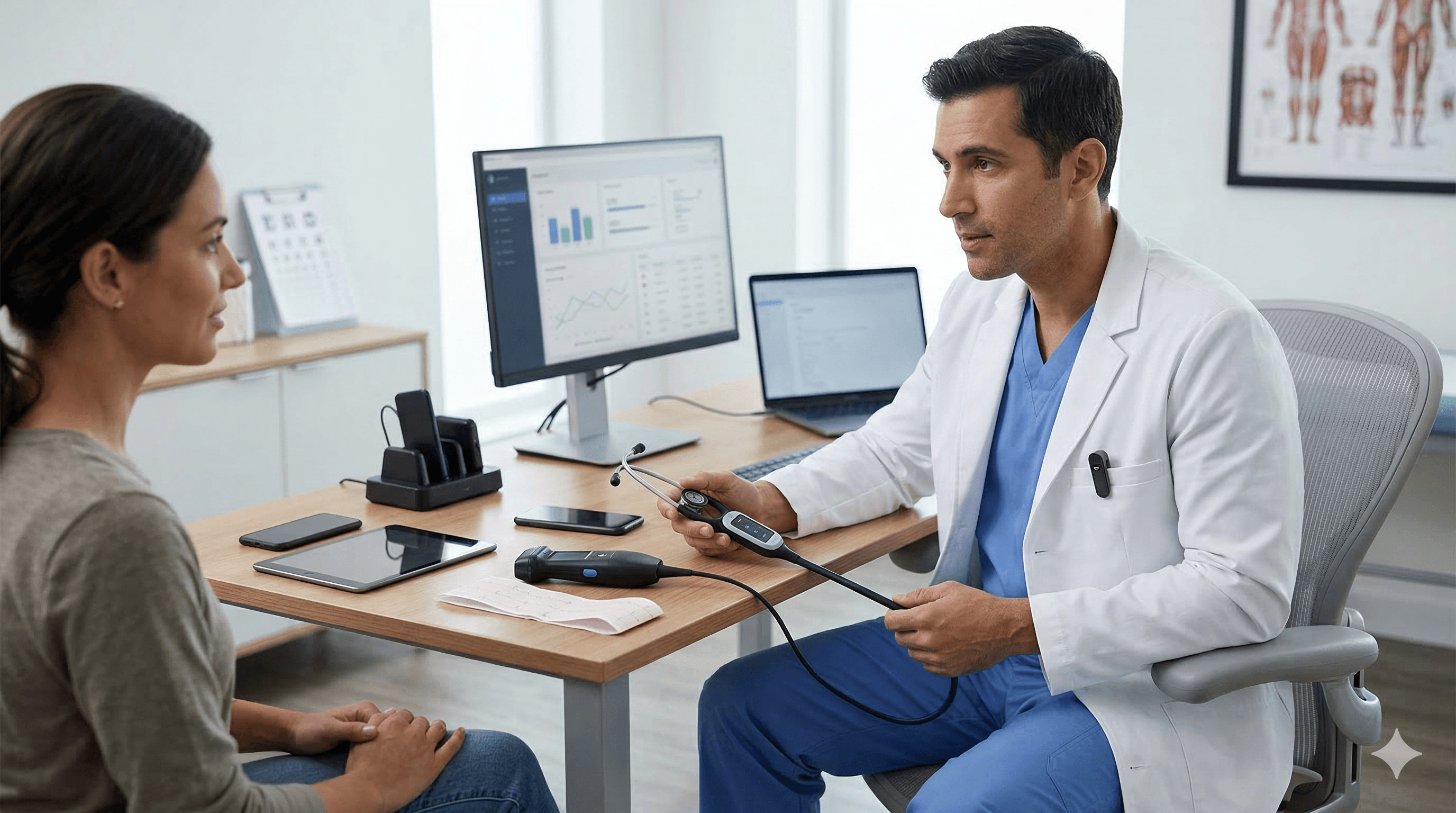
- Clinical AI is undergoing a form-factor revolution. After three years of software-only tools (chatbots, scribe apps, reference platforms), AI is now being embedded into physical devices that clinicians carry, wear, and use during patient encounters.
- The major categories are: ambient scribe wearables (Heidi Remote, Plaud NotePin), AI-enhanced diagnostic instruments (Eko CORE 500 stethoscope, Butterfly iQ3 handheld ultrasound), and AI diagnostic software that bridges hardware (PMcardio for ECG interpretation, AI dermatoscopes).
- The promise is significant: earlier disease detection, reduced administrative burden, and richer clinical data captured during routine encounters. But the practical challenges — device management, battery life, consent, regulatory classification, workflow friction, and cost — are non-trivial.
- The key question for clinicians is not "should I adopt AI?" but "how many AI-enabled devices can I realistically integrate into a single consultation before the technology becomes the distraction rather than the solution?"
- For clinicians who want powerful AI-driven clinical knowledge and reasoning support without adding another physical device to their workflow, tools like iatroX provide free, guideline-grounded clinical reference on any device they already own.
The shift: from software to physical object
Until very recently, the clinical AI landscape was almost entirely software-based. A clinician's interaction with AI meant opening a browser tab, launching a mobile app, or typing a query into a chatbot. The hardware was generic — a laptop, a phone, a tablet — and the AI lived in the cloud.
That model is not going away. Tools like iatroX, OpenEvidence, UpToDate AI Labs, and Heidi Evidence continue to deliver enormous value as pure software services. But in 2026, a parallel trend is accelerating: AI is being embedded into purpose-built physical objects designed specifically for clinical use.
This is not a consumer wellness trend (smartwatches, fitness rings, sleep trackers). This is professional-grade clinical hardware — devices designed by clinicians, for clinicians, with regulatory clearances, clinical validation, and integration into clinical workflows.
Here is what the landscape looks like.
Category 1: Ambient scribe wearables
Heidi Remote
Launched on 19 March 2026, Heidi Remote is a lapel-style wearable from Melbourne-based Heidi Health. It captures consultation audio with a single button press, runs speech-to-text transcription entirely on-device using AI models deployed by Argmax, and stores encrypted audio locally — with no dependency on a phone, app, or internet connection during the encounter.
Heidi Remote sits within Heidi's broader platform, which now includes Heidi Scribe (ambient documentation), Heidi Evidence (clinical reference built on Claude, with partnerships with NICE, BMJ Group, and EMGuidance), and Heidi Comms (patient communications). The company has supported over 100 million clinical interactions and 2.4 million consultations per week globally.
What it changes: The clinician no longer needs to open an app on their phone or laptop. The recording device is a dedicated, single-purpose object — clip it on, press a button, forget about it until the consultation ends.
What it does not change: The clinical note is still generated in the cloud. The downstream privacy model, the need for patient consent, and the requirement for human verification of AI-generated notes remain identical to any cloud-based scribe.
Plaud NotePin and NotePin S
Plaud is the most established player in the wearable AI note-taking hardware space, with over 1.5 million users globally. The NotePin and the newer NotePin S are clip-on or lanyard-mounted devices that record conversations hands-free, transcribe with speaker identification, and generate structured clinical notes (including SOAP notes across 30+ medical templates).
Plaud claims HIPAA, GDPR, SOC 2, and ISO 27001 compliance. The NotePin S features 64GB of local storage, a tactile record button, and a "Press to Highlight" function that lets clinicians mark key moments during a consultation. The device's AI layer runs on GPT-5.2, Claude Sonnet 4.5, and Gemini 3 Pro.
Key difference from Heidi Remote: Plaud is a general-purpose professional note-taker that has been adapted for clinical use, whereas Heidi Remote is designed from the ground up as a clinical-specific device within a clinical-specific platform. Plaud offers more form factors and a more mature hardware product line; Heidi offers deeper integration with clinical workflows (evidence lookup, EHR integration, NHS-specific features).
Omi
At $89, the open-source Omi pendant is the most affordable entry point. It pairs with a phone, records conversations, and uses community-built plugins for transcription and summarisation. It holds HIPAA compliance and SOC 2 certification — surprising for an open-source project. After Meta acquired Limitless (a competing always-on wearable), many users migrated to Omi.
Relevance for clinicians: Limited. Omi is primarily a developer and early-adopter tool, not a clinically validated medical device. But it represents the democratisation of ambient AI hardware and signals a future where these capabilities become commodity rather than premium.
Category 2: AI-enhanced diagnostic instruments
Eko CORE 500 — the AI stethoscope
The most clinically validated AI-enhanced diagnostic instrument available today. The Eko CORE 500 combines 40× sound amplification, active noise cancellation, integrated 3-lead ECG, and FDA-cleared AI algorithms that detect structural murmurs (VHD), atrial fibrillation, and low ejection fraction in real time.
The evidence is now substantial. A February 2026 study in the European Heart Journal — Digital Health showed that AI-augmented auscultation more than doubled VHD detection in primary care. The TRICORDER study (The Lancet), following nearly 1,000 primary care clinicians over 12 months, reported 2.3× more heart failure, 3.5× more AFib, and 1.9× more VHD detected by Eko AI users.
The device costs $379 plus $119.99/year for the Eko+ AI subscription. Over 700,000 units have been sold. It has 9 FDA clearances and has been validated in 70+ publications.
What it changes: The routine physical examination — the most basic and universal clinical act — now includes AI-augmented cardiac screening. A tool that every doctor carries (the stethoscope) becomes an intelligent diagnostic platform.
What it does not change: The clinician still needs to place the device correctly on the chest. The AI produces screening alerts, not diagnoses. Echocardiography remains the confirmatory test. In the UK, MHRA clearance for the AI features should be confirmed before clinical reliance.
Butterfly iQ3 — the AI-guided handheld ultrasound
The Butterfly iQ3 is a handheld, whole-body point-of-care ultrasound (POCUS) device that connects to a smartphone or tablet. It costs approximately $3,899 for the probe plus a mandatory software subscription ($299–$420/year). It has 20+ anatomical presets, AI-powered tools including automated bladder volume measurement, B-line counting for dyspnoea assessment, biplane imaging for vascular access, and needle visualisation for procedures.
The device was FDA-cleared in late 2025 and offers 2× faster processing than its predecessor. Over 145,000 customers use Butterfly devices worldwide. The Caption AI integration (in the GE Vscan Air ecosystem, a competitor) provides real-time guidance for image acquisition — telling the clinician where to move the probe.
What it changes: Whole-body ultrasound — previously requiring a $50,000+ cart-based machine and a sonographer — now fits in a coat pocket. AI guidance reduces the training barrier, enabling non-specialist clinicians to perform basic scans.
What it does not change: Image interpretation still requires clinical skill. AI guidance helps with acquisition (getting a good image) more than interpretation (understanding what the image shows). The cost ($4,000+) is substantial for individual clinicians outside the US.
Category 3: AI diagnostic software that bridges hardware
PMcardio — AI ECG interpretation from a phone photo
PMcardio, developed by Bratislava-based Powerful Medical, is a CE-certified Class IIb medical device (EU MDR) that interprets 12-lead ECGs from a photograph. The clinician takes a picture of any standard ECG printout — paper or screen — and receives an AI-generated interpretation covering 36+ cardiac conditions within seconds.
The platform is used by over 100,000 clinicians globally, has been validated in 15+ peer-reviewed studies, and is backed by institutions including Mount Sinai and Duke Health. Its headline feature is the Queen of Hearts™ model for STEMI detection, which has received FDA Breakthrough Device designation and has demonstrated 2× sensitivity for early STEMI detection compared to standard-of-care interpretation.
PMcardio offers 5 free ECG analyses per month. It is CE-certified for use in the EU and UK, with GDPR and HIPAA compliance.
What it changes: Any ECG machine — including decades-old models with unreliable built-in interpretation algorithms — can now be paired with state-of-the-art AI interpretation via a smartphone camera. This is particularly powerful in resource-limited settings, rural practice, and pre-hospital care where cardiologist over-read is not immediately available.
What it does not change: The AI reads the ECG; the clinician still makes the clinical decision. PMcardio's explainability features (heatmaps showing which leads influenced the diagnosis) help clinicians understand and validate the AI's reasoning, but the responsibility for action remains with the treating clinician.
AI dermatoscopes
AI-enhanced dermatoscopy is one of the most mature applications of diagnostic AI. Devices from companies like FotoFinder, Canfield, and DermEngine combine high-resolution dermoscopic imaging with AI algorithms trained on millions of lesion images to classify skin lesions and estimate malignancy risk. The NHS diabetic eye screening programme already uses AI for retinal image grading — AI-enhanced dermatoscopy follows the same logic for skin cancer screening.
What it changes: A GP examining a suspicious mole can capture a dermoscopic image and receive an immediate AI-generated risk assessment, informing the urgency of dermatology referral.
What it does not change: AI dermatoscopy is a triage tool, not a histopathological diagnosis. Biopsy remains the gold standard.
What this means for the consultation
Let us be concrete about what a 2026 consultation could look like if a clinician adopted all of these technologies:
Before the patient enters: The clinician clips Heidi Remote (or Plaud NotePin) to their lapel.
During the consultation: The wearable captures the conversation. The clinician uses an Eko CORE 500 to listen to the chest — the AI flags a possible structural murmur. They pull out a Butterfly iQ3 to do a focused cardiac ultrasound at the bedside. A concerning ECG from the patient's notes is photographed and interpreted by PMcardio on their phone. The clinician checks the latest NICE guidance on the suspected condition using iatroX.
After the consultation: The scribe wearable syncs and generates a structured clinical note. The clinician reviews, edits, and saves it to the EHR.
This is genuinely powerful. But it is also — and this needs to be said clearly — a lot of technology for a single encounter. Four or five AI-enabled devices or apps, each with its own interface, subscription, charging requirement, consent consideration, and potential failure mode.
The honest assessment is that most clinicians in 2026 will not adopt all of these simultaneously. Adoption will be selective and sequential: a scribe wearable first (the time savings are immediate and measurable), then perhaps an AI stethoscope (particularly for GPs and primary care), with handheld ultrasound and AI ECG interpretation adopted in more specialised or resource-constrained settings.
The regulatory landscape
The regulatory picture varies significantly by device category and jurisdiction.
UK (MHRA)
- Scribe wearables: Not currently classified as medical devices (they document, not diagnose). But if a scribe's outputs are used to inform clinical decisions, classification may be revisited. The NHS England guidance on ambient scribes sets expectations for consent, safety, and human verification.
- AI stethoscopes: AI algorithms that screen for cardiac disease likely require MHRA registration and appropriate classification. Eko's UK MHRA status for the AI features should be confirmed.
- AI ECG interpretation: PMcardio is CE-certified as a Class IIb medical device under EU MDR and is certified for the UK market. It represents one of the more advanced regulatory profiles in this landscape.
- Handheld ultrasound: Butterfly iQ3 is FDA-cleared; UK MHRA status and availability should be verified by clinicians before procurement.
US (FDA)
The January 2026 FDA guidance clarified that low-risk wellness devices and clinical decision support software that clinicians can independently review generally fall outside medical device regulation. This benefits many of these tools, but higher-risk AI algorithms (like Eko's cardiac screening AI, which has 9 specific FDA clearances) still go through formal regulatory review.
Australia (TGA) and Canada (Health Canada)
Both jurisdictions apply risk-based approaches broadly similar to the EU/UK. Clinicians should verify local regulatory status before clinical reliance on AI features.
The trust question
Trust in clinical AI should be calibrated through verification rather than assumed from interface design. The iatroX approach can attach links to retrieved source material so clinicians can inspect the evidence behind an answer. Citations are useful signals, but they do not replace checking the passage, date, applicability and clinical context.
Physical AI devices introduce a different trust dynamic. When an Eko stethoscope displays "Murmur Detected" on its screen, the clinician must decide how to weight that alert against their own auscultatory impression. When PMcardio says "STEMI Equivalent — consider emergent cath lab activation," the stakes are immediately and viscerally higher than a chatbot's suggestion to check a guideline.
The risk of automation bias — over-reliance on AI outputs, particularly when they carry the authority of a physical device displaying a confident result — is real. Equally real is automation neglect — dismissing AI alerts because "the machine is probably wrong." Both failure modes can harm patients.
The mitigation is the same as it has always been in clinical AI: the human is the decision-maker. The AI detects, flags, suggests, and documents. The clinician interprets, decides, and acts. But maintaining this balance becomes harder as AI moves from an advisory chatbot on a laptop to an authoritative alert on a device in the clinician's hand.
The cost reality
| Device | Hardware cost | Annual subscription | Total year 1 |
|---|---|---|---|
| Heidi Remote | TBC | Heidi Pro: ~$99/month | ~$1,200+ |
| Plaud NotePin S | ~$169 | ~$79–$159/year | ~$250–$330 |
| Eko CORE 500 | $379 | $119.99/year (Eko+) | ~$499 |
| Butterfly iQ3 | ~$3,899 | ~$299–$420/year | ~$4,200–$4,300 |
| PMcardio | Free (app) | Free tier (5 ECGs/month) or Pro | $0–$200 |
| Total (all devices) | ~$6,200–$6,500+ |
For an individual clinician paying out of pocket, this is a significant investment. For a health system deploying at scale, the procurement, management, and training costs multiply further.
The counterargument is that these devices pay for themselves through improved efficiency (scribe wearables), earlier disease detection (Eko, PMcardio), and expanded diagnostic capability (Butterfly). But the health-economic evidence to support this at a system level is still emerging.
Where iatroX fits: the knowledge layer that needs no hardware
In a consultation room increasingly populated by AI-enabled hardware, iatroX occupies a distinctive position: the clinical knowledge and reasoning layer that works on any device you already own.
iatroX does not require a lapel pin, a dedicated stethoscope, a handheld ultrasound probe, or a subscription hardware platform. It requires only a browser or a mobile app. And it provides the one thing that none of the hardware devices above can offer: guideline-grounded clinical answers, differential diagnosis support, and exam preparation — instantly, for free.
When the Eko flags a murmur, iatroX helps you decide the next step according to NICE guidelines. When PMcardio detects a STEMI equivalent, iatroX's Brainstorm feature helps you think through the differential. When the scribe generates a note, iatroX's Knowledge Centre helps you verify the clinical content against the latest evidence.
The hardware detects and documents. iatroX helps you think.
iatroX is free, MHRA-registered, and available to every clinician and student in the UK, US, Canada, and Australia — with adaptive exam preparation for UKMLA, MRCP, USMLE, MCCQE, AMC, and more.
Our view: exciting, but adopt selectively
The physical AI device landscape in 2026 is genuinely exciting. For the first time, the routine tools of clinical practice — the stethoscope, the notepad, the ultrasound machine — are becoming intelligent. The evidence behind the leading devices (particularly Eko and PMcardio) is now strong enough to justify adoption in the right clinical contexts.
But we would counsel selectivity over comprehensiveness. The clinician who tries to integrate a scribe wearable, an AI stethoscope, a handheld ultrasound, and an AI ECG app into every consultation will spend more time managing technology than managing patients. The clinician who chooses one or two devices that address their most pressing bottleneck — documentation time, diagnostic uncertainty, or access to specialist-level interpretation — will get far more value.
And for the clinical knowledge that ties everything together — the guidelines, the reasoning, the evidence — that remains a software problem. One that iatroX was built to solve.
Related reading on iatroX
- Heidi Remote: what a dedicated AI scribe hardware device means for clinical documentation
- On-device clinical AI: why Heidi Remote and offline-first scribes matter for data privacy
- AI stethoscopes in 2026: Eko CORE 500 review and what UK/US clinicians should know
- The rise of AI medical scribes in UK primary care: Tortus, Accurx Scribe, and Heidi Health
- AI in clinical decision support: the best knowledge retrieval tools in 2025
- Regulated clinical AI in practice: AutoMedica, Prof. Valmed, iatroX, and TORTUS
- MHRA AI regulation and the Commission call for evidence 2026