Introduction
For IMT doctors and clinical fellows, the MRCP Part 1 and 2 exams are a significant hurdle. Time is the scarcest resource, and "subscription fatigue" is real. The most common question in mess rooms isn't "which book should I read," but "which Q-bank should I buy?"
In 2026, the market is dominated by three giants: PassMedicine, Pastest, and BMJ OnExamination. Each has a distinct personality and strength. This guide provides an honest, head-to-head comparison to help you choose the right single resource for your needs, and explains how to use free tools like iatroX to avoid buying a second one.
Who this comparison is for
This guide is for the time-poor trainee who needs one main resource. If you are buying three question banks, you are likely procrastinating, not revising. You need one source of truth for volume, and one engine for retention.
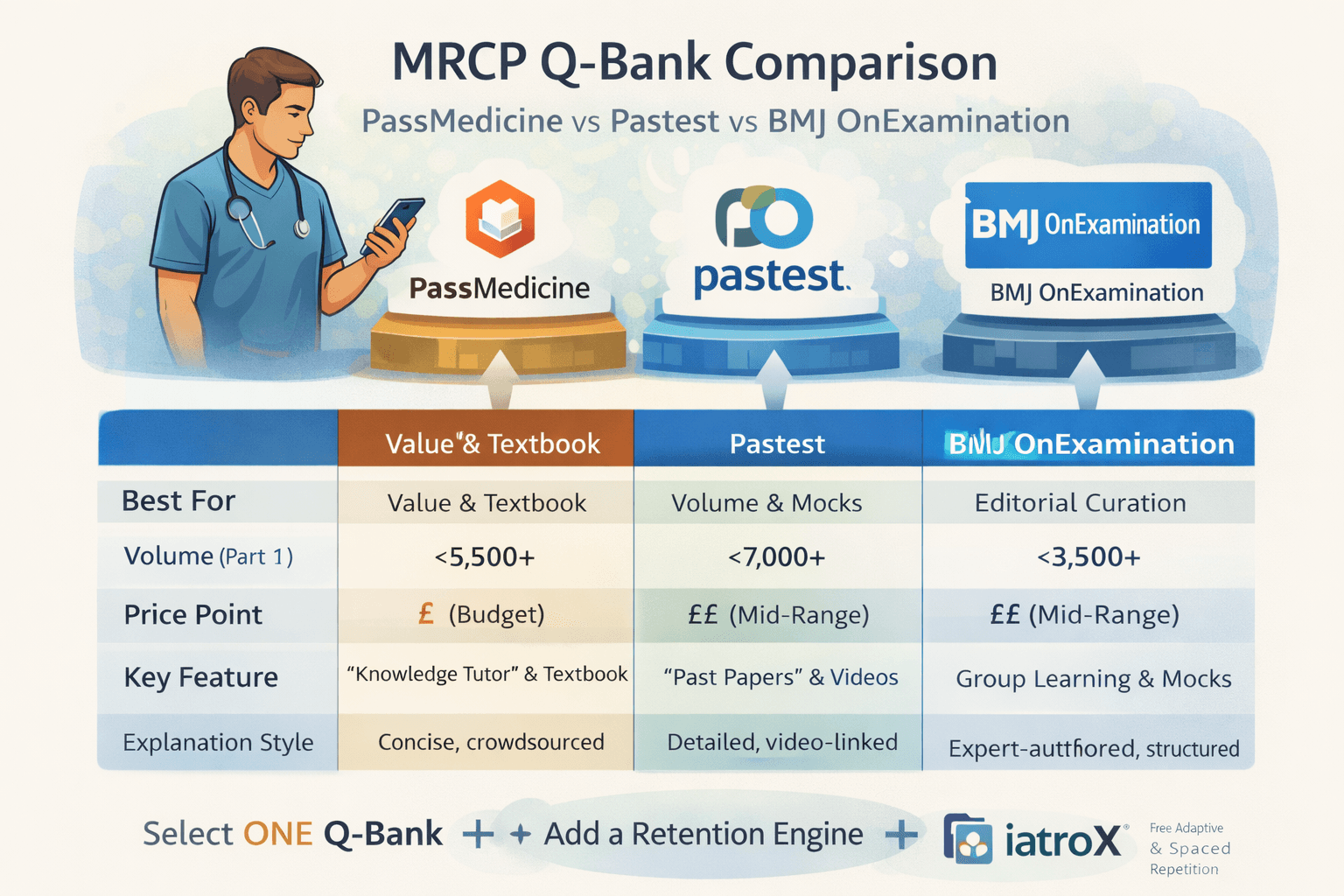
Comparison table
| Feature | PassMedicine | Pastest | BMJ OnExamination |
|---|---|---|---|
| Best For | Value & Textbook | Volume & Mocks | Editorial Curation |
| Est. Q Volume (Part 1) | ~5,500+ | ~7,000+ | ~3,500+ |
| Price Point | £ (Budget) | ££ (Mid-Range) | ££ (Mid-Range) |
| Key Feature | "Knowledge Tutor" & Textbook | "Past Papers" & Videos | Group Learning & Mocks |
| Mobile App | Functional, offline capable | Polished, excellent media | Solid, clean interface |
| Analytics | Strong histogram comparison | Detailed dashboard | Peer benchmarking |
| Explanation Style | Concise, crowdsourced notes | Detailed, video-linked | Expert-authored, structured |
How to choose
If you need volume and value → PassMedicine
PassMedicine remains the undisputed value king.
- The Pros: It is significantly cheaper than its rivals. Its "textbook" feature is a living, breathing medical encyclopaedia that many trainees use as their primary reference. The comment section, while informal, often contains golden nuggets of mnemonic wisdom.
- The Cons: The interface is functional but dated. It can feel like a "grind."
- Verdict: The best choice for the budget-conscious trainee who wants to power through thousands of questions.
If you need exam-style mocks and media → Pastest
Pastest bets big on scale and simulation.
- The Pros: It typically has the largest question bank. Its "Past Papers" feature allows you to sit mocks based on previous exam themes, which is invaluable for pattern recognition. The integrated video lectures are excellent if you prefer watching to reading.
- The Cons: It is more expensive. The sheer volume can be overwhelming if you start late.
- Verdict: The premium choice for candidates who want to leave nothing to chance and prefer a visual learning style.
If you need editorial curation → BMJ OnExamination
BMJ OnExamination offers a more curated experience.
- The Pros: Being from the BMJ group, the editorial standard is high. The questions are often said to be "harder" or more clinically nuanced, closely mimicking the feeling of the real exam's tougher stems.
- The Cons: Smaller question volume compared to Pastest.
- Verdict: A strong choice for candidates who want quality over quantity, or who are resitting and need a fresh, rigorous challenge.
The “one Q-bank + one engine” recommendation
The most efficient strategy is not to buy two Q-banks. It is to buy one Q-bank and pair it with a free retention engine.
The Mistake: Buying PassMedicine and Pastest. You will likely only finish 40% of each, leading to fragmentation and anxiety.
The Strategy:
- Select ONE Q-Bank: Pick the one that fits your budget and learning style (e.g., Pastest for videos, PassMed for text). This is your "Source of Truth."
- Add a Retention Engine: Use iatroX.
Where iatroX fits
iatroX is your free adaptive engine.
- The Workflow: When you get a question wrong in your main Q-bank (e.g., on Glomerulonephritis), don't just read the note. Open iatroX.
- Adaptive Drill: Run a short adaptive quiz on "Renal Medicine." iatroX will drill you on the underlying concepts until you prove mastery.
- Spaced Repetition: iatroX automatically schedules these concepts for review. This solves the "leaky bucket" problem of forgetting what you studied three weeks ago.
By using iatroX as your free "fixer," you get the benefit of adaptive learning without paying for a second subscription.
FAQ
Is buying two Q-banks worth it? Rarely. The cognitive load of switching interfaces and tracking two sets of analytics usually outweighs the benefit of extra questions. It is better to master 5,000 questions in one bank (understanding why you got them wrong) than to rush through 8,000 across two.