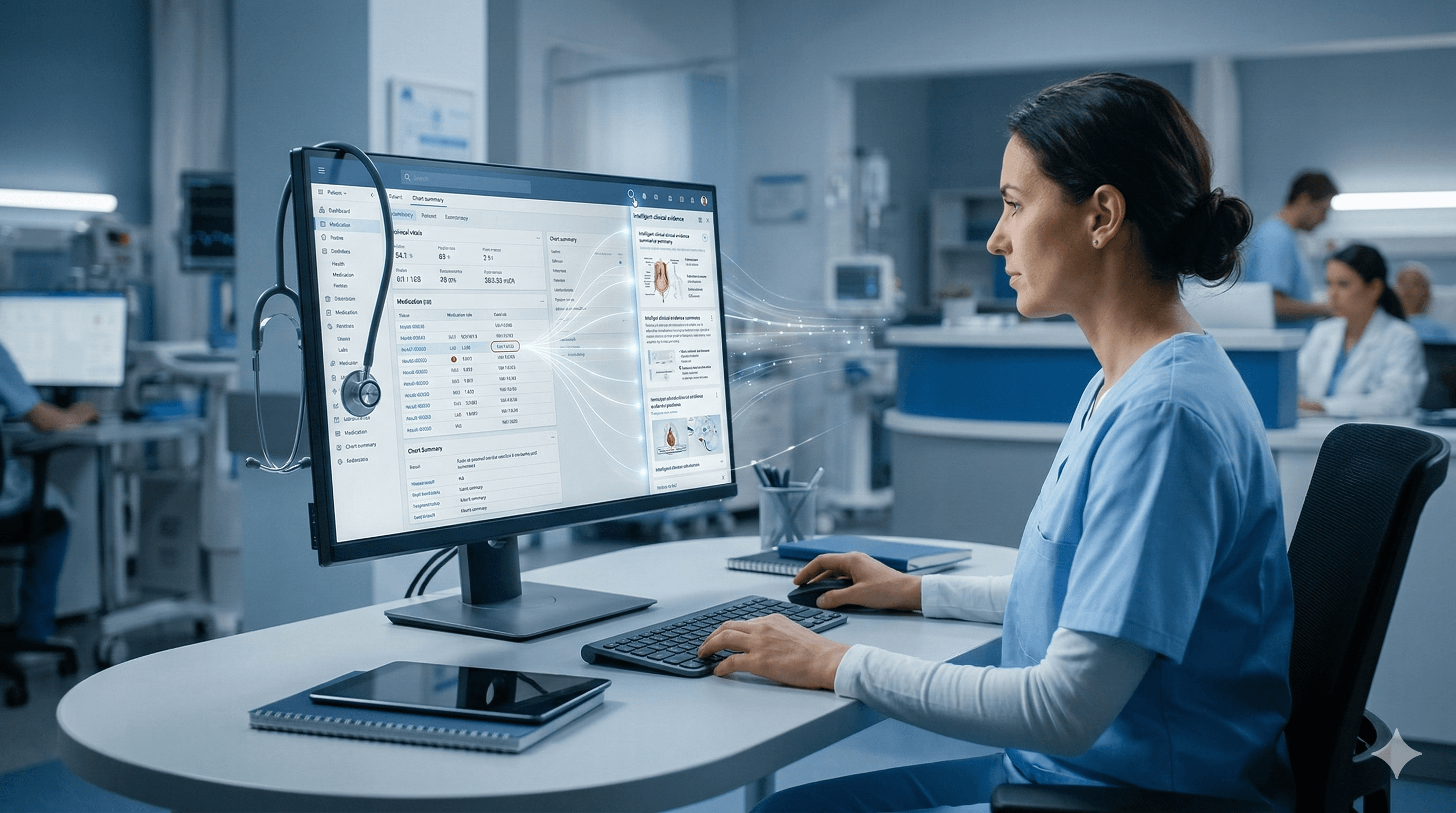
For years, the standard way clinicians accessed evidence was simple, familiar, and deeply inefficient.
A clinical question came up. The clinician left the chart. They opened another browser tab. They searched. They scanned. They compared. They copied something mentally or literally back into the main workflow. Then they returned to the patient, the note, or the task already in front of them.
That model worked well enough for a long time.
It also created a lot of hidden friction.
That friction is now becoming harder to justify.
In 2026, one of the clearest shifts in clinician AI and digital evidence is this: evidence tools are moving inside the EHR and adjacent clinical workflow surfaces.
That shift is not merely a technical integration story.
It is a response to a very simple practical problem:
evidence loses value when it lives in a separate browser tab.
It does not lose all value, of course. A trusted reference remains useful wherever it sits. But its operational value falls when the clinician has to deliberately leave the work to go and find it.
That is why the current market signals matter so much.
OpenEvidence is being embedded into Epic workflows at Sutter Health. UpToDate is being brought directly into Dragon Copilot workflows. And the broader platform layer — especially Epic — is making it increasingly clear that clinical intelligence is expected to sit closer to documentation, messaging, handoff, and decision support rather than live as a distant lookup destination.
This is the deeper story.
Evidence is becoming a workflow layer, not only a destination site.
The search box is being replaced, or at least supplemented, by context-aware retrieval.
Clinical evidence is moving from lookup to co-presence.
That is the real shift.
The short answer
Evidence tools are moving inside the EHR because clinicians work under too much time pressure and cognitive fragmentation for separate-tab evidence retrieval to remain the dominant model.
The browser-tab workflow creates:
- context switching
- lost momentum
- copy-paste or recall friction
- a higher chance of shallow checking rather than deep use
- lower repeat adoption during busy clinical work
In 2026, the clearest proof points are that:
- Sutter Health is embedding OpenEvidence into Epic workflows so clinicians can perform natural-language evidence search without leaving the charting environment
- Wolters Kluwer and Microsoft are integrating UpToDate into Dragon Copilot so evidence-backed answers appear directly in the clinical workflow assistant
These moves matter because they show that evidence is no longer being treated only as something clinicians go out and fetch.
It is increasingly being treated as something that should be present where care work is already happening.
That makes evidence more usable, more habit-forming, and more commercially defensible.
Why the browser-tab model is weakening
The browser-tab model is not dead.
It is just becoming less satisfactory.
For a long time, clinicians tolerated a fragmented digital environment because they had little choice. The chart lived in one place. Messaging lived elsewhere. documentation help lived somewhere else. Evidence and reference tools lived in other tabs entirely.
That fragmentation became normal.
But what becomes normal is not always what remains optimal.
Now that platform vendors, evidence brands, and workflow tools are all pushing toward tighter integration, the old browser-tab pattern looks more fragile.
Why?
Because the costs of leaving the workflow are more visible than they used to be.
A clinician who can access evidence in context becomes less willing to maintain a habit that involves:
- stopping the current task
- leaving the chart
- opening a new environment
- reformulating the question manually
- translating the answer back into the original task
That pattern consumes more attention than the industry often admits.
And attention is one of the scarcest resources in clinical work.
The friction problem
This is the practical heart of the article.
Evidence products do not lose value because they sit in separate tabs in some abstract philosophical sense.
They lose value because separate tabs create specific forms of operational drag.
1. Context switching
This is the most obvious problem.
Each time a clinician leaves the EHR or documentation flow to search elsewhere, there is a mental and operational reset cost. Even small interruptions add up.
A product that lives outside the workflow asks the clinician to re-enter the question, carry the patient context mentally, and then reinsert the answer into the original work.
That is inefficient.
2. Lost momentum
Clinical work often runs on momentum.
A question arises during note-writing, order entry, patient messaging, or review of results. If the clinician can resolve the question in the same environment, the task continues smoothly.
If the clinician must stop and move into a separate environment, the question may still be answered — but the surrounding workflow has been broken.
That matters because digital friction does not just cost seconds. It can reduce follow-through.
3. Copy-paste risk and translation burden
When evidence lives elsewhere, the clinician often has to translate what they found back into the chart, message, or decision pathway.
That creates a burden of interpretation and sometimes a copy-paste habit that is neither elegant nor always safe.
The more distant the evidence is from the action, the more manual bridging is required.
4. Shallow checking
This is a subtler risk.
When evidence retrieval feels cumbersome, clinicians may settle for a faster, shallower interaction with the source.
That does not necessarily mean poor care. It means the retrieval process itself shapes the depth of engagement.
A tool embedded in the workflow may actually make more deliberate evidence use feasible in moments where separate-tab lookup would have been skipped or abbreviated.
What changed in 2026
This argument would be much weaker if it were only theoretical.
It is stronger because the market now has clear proof points.
1. OpenEvidence is being embedded into Epic at Sutter Health
This is one of the most important developments in the evidence-tool market.
OpenEvidence gained traction as a standalone clinician-facing evidence and AI search product. That made sense in the earlier phase of the market.
But the Sutter Health collaboration signals something more important: evidence search is now being moved directly into the EHR workflow.
That matters because it changes the product category.
A tool that once lived primarily as a destination now starts becoming part of the care-delivery environment itself.
The clinician does not merely “use OpenEvidence.”
The clinician uses evidence within Epic.
That is a very different kind of commercial and behavioural position.
2. UpToDate is being brought into Dragon Copilot
This is another major proof point.
UpToDate has long been one of the most trusted destination evidence brands in medicine. In older models, the clinician intentionally opened it when deeper reference support was needed.
Bringing it into Dragon Copilot changes the pattern.
Now the evidence layer sits closer to dictation, productivity, and workflow assistance. The clinician can access evidence-backed answers in the same operational environment that supports clinical documentation and related work.
Again, the shift is not merely “a new integration.”
It is a sign that evidence is being pulled toward the workflow surface where clinical decisions and communication are already unfolding.
3. The broader workflow layer is getting smarter
This matters too.
Even when an evidence brand itself is not the EHR vendor, the surrounding platforms are becoming more intelligent. Epic’s own native AI strategy and the broader move toward workflow-embedded copilots mean the market is increasingly optimising around in-context support.
Once workflow surfaces become smarter, evidence tools have a stronger incentive to join them rather than remain separate destinations.
Why EHR-native evidence is attractive
Once you understand the friction problem, the attraction of EHR-native evidence becomes obvious.
1. Relevance in context
An evidence tool inside the workflow can potentially use the surrounding task context more effectively.
That does not mean it should rely blindly on patient-specific context or always personalise aggressively. It does mean the product can better align with what the clinician is doing in the moment:
- writing a note
- answering a patient message
- reviewing a result
- checking a management question
- preparing a referral
That makes the evidence feel less like a separate lookup event and more like a directly useful layer of support.
2. Less switching
This is still the biggest practical gain.
The fewer windows, tabs, and transitions required, the easier it is for clinicians to use evidence in real time.
That matters not just for convenience, but for repeat adoption.
3. Stronger habit formation
A destination site depends on the clinician remembering to go there.
An embedded evidence layer depends less on deliberate habit and more on natural encounter within the workflow.
That usually improves frequency of use and makes the product more defensible.
4. Better enterprise adoption logic
Health systems increasingly care not only whether a tool is clinically useful, but whether it fits the operational environment.
An evidence capability that can be embedded in the workflow has a stronger argument for enterprise adoption because it is easier to connect to productivity, user behaviour, and system-wide consistency.
Evidence is becoming a workflow layer, not a destination site
This is probably the cleanest conceptual takeaway.
Historically, evidence products were destinations.
You went to them. You searched them. You left them.
Increasingly, that model is being supplemented by something else.
Evidence is becoming a layer that sits alongside the work.
That matters because layers behave differently from destinations.
A destination competes for user visits. A layer competes for workflow presence.
And workflow presence can be much more powerful.
A layer can influence:
- note-writing
- messaging
- referrals
- order-related thinking
- handoff communication
- decision support at the point of action
That is a much bigger commercial and behavioural opportunity than being simply a trusted website clinicians remember to open.
The search box is being replaced by context-aware retrieval
This phrase should be used carefully, because search is not disappearing.
Clinicians will still search.
What is changing is the role of the search box as the main interface metaphor.
The old pattern was:
- leave the work
- type a query
- inspect results
The newer pattern is more like:
- remain in the work
- access evidence in context
- retrieve support with less friction
- move directly from answer to action
That is what context-aware retrieval means in practice.
Not necessarily a fully autonomous system.
More simply, a system where evidence appears in closer relationship to the task, the workflow surface, and the action required next.
Clinical evidence is moving from lookup to co-presence
This is perhaps the most useful phrase in the whole topic.
Evidence used to behave more like a library you visited.
It is increasingly behaving like a colleague or reference layer that is simply there when needed.
That does not mean the evidence is passive. It means it is present.
Co-presence changes clinician behaviour because it reduces the gap between curiosity and action.
If the evidence is right there while the clinician is already documenting, deciding, or responding, it is more likely to be used naturally and less likely to be deferred.
What this means for standalone evidence brands
This shift does not mean standalone evidence brands are doomed.
It does mean their strategy is changing.
If the market is moving toward embedded evidence, then standalone brands increasingly need to think about more than direct user traffic.
1. More enterprise partnerships
The Sutter/OpenEvidence example is likely not a one-off curiosity. It is a model.
Standalone evidence brands increasingly need enterprise deals that place them inside workflow rather than only in browser bookmarks and app icons.
2. More API surfaces and embedded delivery
If workflow placement matters, then technical delivery matters too. Evidence companies need ways to let their capabilities appear in EHRs, copilots, and surrounding workflow tools.
That may mean API strategies, deeper partnerships, or more flexible product architectures.
3. More embedded licensing models
A destination subscription remains useful, but embedded distribution may increasingly drive the most strategic revenue.
That shifts the business model toward enterprise licensing, platform partnerships, and workflow-native commercial structures.
4. A different definition of brand strength
In the old model, brand strength meant being the site clinicians deliberately opened.
In the newer model, brand strength may increasingly mean being the evidence layer that health systems decide to place inside their operational workflow.
Risks and limitations of EHR-native evidence
This shift is not entirely positive.
Evidence moving closer to the workflow introduces genuine risks.
1. Tunnel vision
Evidence that appears only within the immediate context can risk narrowing the clinician’s frame.
Sometimes leaving the workflow and deliberately opening a destination reference encourages a broader or more reflective interaction.
That is not worthless.
2. Over-reliance on context
If an embedded tool feels too seamless, clinicians may over-trust the contextual relevance of what is surfaced.
That can be helpful when it works well, but it also increases the importance of design, transparency, and the ability to inspect the source basis of the answer.
3. Diminished deliberate cross-checking
There is value in friction sometimes.
A small amount of deliberate effort can encourage more thoughtful verification. If evidence becomes too ambient, there is a risk that some forms of deliberate cross-checking weaken.
4. Enterprise dependence and platform power
There is also a market-structure issue.
If evidence increasingly depends on EHR or workflow-platform distribution, platform vendors gain more leverage. That may benefit adoption, but it can also reshape competition and reduce the independence of standalone evidence brands.
These risks do not invalidate the trend.
They simply mean the shift needs to be understood clearly rather than celebrated naively.
What founders and product teams should learn
The lesson is not that evidence quality matters less.
It still matters enormously.
The lesson is that evidence quality alone is becoming less sufficient.
A great evidence product now has to answer a harder question:
Where does this capability live when clinicians are actually working?
That leads to more strategic product questions:
- can this be embedded inside the EHR?
- can it sit inside dictation, inbox, or referral flow?
- can it preserve trust and source visibility while reducing switching cost?
- can it become a workflow layer without becoming a black box?
Those are no longer secondary questions.
They are becoming central to the category.
Bottom line
Evidence tools are moving inside the EHR because the old browser-tab model is weakening.
Clinicians still need trusted evidence.
But increasingly, they need it closer to the point of action, not only at the point of curiosity.
That is the real shift in 2026.
Evidence is becoming a workflow layer, not just a destination site. The search box is being supplemented by context-aware retrieval. Clinical evidence is moving from lookup to co-presence.
That does not eliminate the value of standalone evidence products.
It does mean their future increasingly depends on how well they can move from being something clinicians deliberately visit to something health systems deliberately place inside the work.
Frequently asked questions
Why are evidence tools moving inside the EHR?
Because clinicians work under time pressure and fragmented workflows, and evidence becomes easier to use when it is available inside the clinical environment rather than in a separate browser tab.
What is the biggest problem with browser-tab evidence lookup?
The main problems are context switching, lost workflow momentum, translation burden, and the tendency for evidence use to become shallower or more sporadic under time pressure.
Why does OpenEvidence inside Epic at Sutter matter?
It is an important proof point that an evidence-search product is moving from destination use into direct EHR workflow placement, which changes both clinician behaviour and commercial strategy.
Why does UpToDate in Dragon Copilot matter?
It shows that a major trusted evidence brand is being brought into a clinical workflow assistant rather than remaining only a destination reference site.
Are standalone evidence brands now less relevant?
Not necessarily. But they increasingly need enterprise partnerships, embedded delivery models, and strong reasons for health systems to place them directly in workflow.
What are the risks of EHR-native evidence?
The main risks include tunnel vision, over-reliance on contextual suggestions, weaker deliberate cross-checking, and increased dependence on platform distribution.
Related reading on iatroX
- The next fight in clinician AI is not search — it is workflow placement
- The AI scribe boom is entering its boring phase — and that is where the money is
- From browser tab to bedside workflow: the new clinical AI battleground
- The new health-tech race is not summarisation — it is anticipation
- Why predictive workflow AI may matter more than ambient documentation