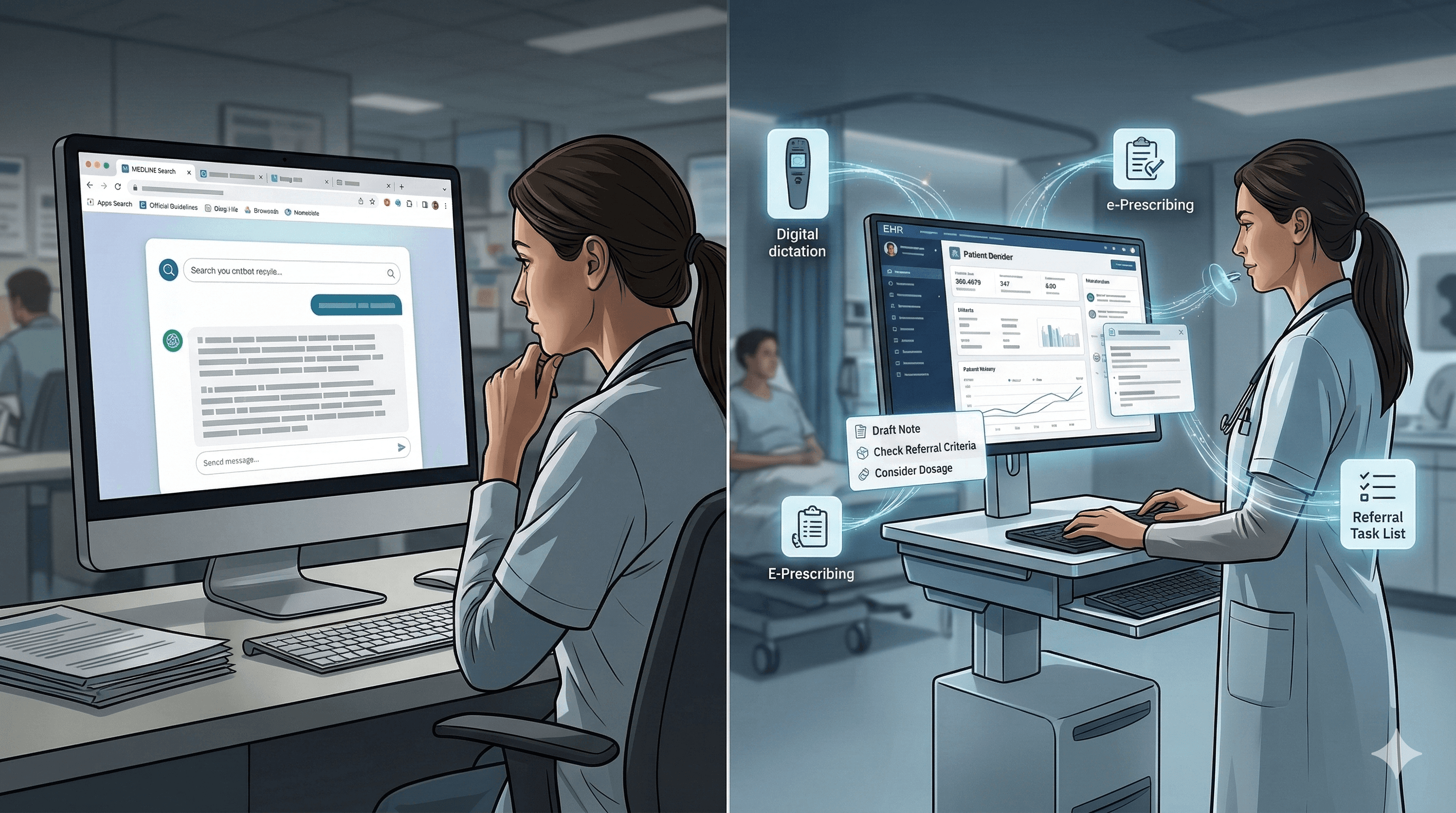
For a while, the clinician AI market looked like a search competition.
Who had the best answer? Who cited better? Who felt faster? Who seemed most trustworthy? Who could persuade doctors to open their product first when a clinical question arose?
That phase was real.
And it mattered.
But it is no longer the whole story.
In 2026, clinician AI is moving into a different phase.
Search was phase one. Workflow placement is phase two.
That means the value of a clinical AI product increasingly depends not only on how good the answer is, but on where the tool appears.
That is the real shift.
A very strong model in the wrong place may lose to a merely very good model in the right place.
A product that asks the clinician to stop, switch context, open another tab, and deliberately leave the main workflow is now competing under harder conditions than it was a year ago.
By contrast, a product that appears right where work is already happening — in the EHR, in the dictation flow, in the inbox, in the referral workflow, in the handoff process, in the documentation layer — gains a completely different kind of advantage.
That advantage is not just technical.
It is behavioural, operational, and commercial.
And it may turn out to be the next real moat in clinician AI.
The short answer
The next fight in clinician AI is not simply about who has the smartest model or the strongest search interface.
It is about workflow placement.
That means:
- being embedded inside the EHR rather than outside it
- being available inside the dictation and note-writing flow
- surfacing evidence without forcing clinicians into a separate browser session
- appearing in handoffs, inboxes, referrals, and after-visit tasks
- reducing interruption rather than adding another destination tool
That is why 2026 matters.
The proof points are no longer theoretical.
OpenEvidence is being brought directly into Epic workflows at Sutter Health. UpToDate is being integrated into Dragon Copilot. Epic is expanding native AI inside its own platform for charting, handoffs, patient messaging, and provider insight.
Those are not small product updates.
They are signs that the market is re-optimising around placement inside care delivery, not only around answer quality.
The best model may still matter.
But increasingly, the best model may lose to the best placement.
Why search was only phase one
The first wave of clinician AI had an obvious shape.
Doctors were overwhelmed by information, documentation burden, and fragmented reference workflows. The most compelling new products promised to make it easier to ask a question in natural language and receive a useful clinical answer quickly.
That was a major step forward.
Instead of keyword search, scattered tabs, and manual source-hunting, clinicians could use a more fluid interaction style:
- ask the question naturally
- receive a synthesis quickly
- inspect citations or supporting material
- move on
That was enough to create real adoption momentum.
It also made sense as the first commercial wedge. A standalone tool is much easier to launch than a deeply integrated workflow layer.
So search became the first battleground.
And products were naturally compared on things like:
- answer quality
- citation visibility
- speed
- trustworthiness
- ease of use
- breadth of content
Those factors are still important.
But search has limits as a long-term moat.
Why?
Because once multiple products become sufficiently good at answering clinical questions, differentiation starts to move elsewhere. Search quality begins to converge. The best answers are still valuable, but they stop being the only thing that matters.
At that point, the commercial question changes from:
“Which product gives the best answer?”
to:
“Which product is easiest to use without leaving the work?”
That is where workflow placement begins to dominate.
What workflow placement actually means
Workflow placement sounds abstract until you define it concretely.
In healthcare, it means appearing inside the places where clinical work already happens.
Not just being available somewhere in the organisation.
Being present at the point of action.
1. In-EHR placement
This is the clearest example.
A product placed inside the electronic health record can reduce one of the biggest structural frictions in healthcare software: context switching.
Instead of leaving the chart, opening a separate tool, searching, then returning, the clinician can access support inside the clinical workspace already in use.
That changes behaviour dramatically.
2. In-dictation placement
This is the layer where clinical AI supports the act of documenting, revising, and generating communication while the clinician is already engaged in a live workflow.
It is not just about ambient note generation. It is about whether intelligence is present while the note, the question, and the next action are all taking shape.
3. In-inbox placement
Clinical work increasingly happens in the inbox:
- patient messages
- refill requests
- follow-up queries
- test result communication
- low-grade but high-volume decision work
A product that appears here is not merely a knowledge tool. It becomes part of operational medicine.
4. In-referral and after-visit placement
Some of the most valuable clinical work is not the answer itself, but what must happen after the answer:
- draft the referral
- check the threshold
- create the patient instructions
- prepare the after-visit summary
- route the next task
A product with placement here moves from information support to workflow participation.
5. In-handoff placement
Handoffs, summaries, and care transitions are another powerful area of placement. A tool that helps convert clinical encounters into usable continuity information can become highly sticky because it sits at a critical operational junction.
So workflow placement is not a vague concept.
It is a very practical question:
Where does the AI meet the clinician?
And perhaps more importantly:
Does it meet the clinician before, during, or after the moment where action must happen?
The 2026 proof points
This argument would be weaker if it were only a theory.
It is stronger because the live market signals are now very clear.
1. Sutter Health is bringing OpenEvidence into Epic workflows
This is one of the most important recent proof points in the evidence-tool market.
OpenEvidence built much of its early momentum as a standalone evidence and medical AI search experience. That made sense in phase one.
But the Sutter Health collaboration changes the framing.
Now the product is being integrated directly into Epic workflows so Sutter clinicians can perform natural-language evidence search without leaving their charting environment.
That is a major shift.
It means the competitive conversation is moving from:
- “How good is the evidence search experience?”
to:
- “Can the evidence experience live inside the EHR?”
That is workflow placement in its clearest form.
2. UpToDate is moving into Dragon Copilot
This is another very strong signal.
UpToDate is one of the most recognised evidence brands in medicine. Historically, much of its power came from being the trusted destination clinicians deliberately opened when they needed depth.
The integration into Dragon Copilot points to a different future.
It suggests that trusted evidence is now being brought directly into a workflow assistant that already sits inside documentation and productivity processes.
That matters because it shortens the distance between:
- a clinical question
- a workflow event
- a trusted answer
- and the action that follows
In other words, the destination model is being supplemented — and in some settings may gradually be displaced — by a workflow-embedded model.
3. Epic’s native AI stack is expanding
Epic’s direction reinforces the same thesis.
Its AI strategy is clearly not limited to one narrow function. Epic is building AI into charting, handoffs, patient communication, and provider-facing support across the EHR environment.
This matters because Epic is not just another application vendor. It is the system of record in a large share of U.S. care delivery.
When the platform layer expands native AI capabilities, it shifts the market power balance.
It tells standalone vendors that placement is no longer optional.
If your product cannot explain why a clinician should leave Epic, or why Epic should host your capability rather than replicate it, your commercial burden becomes much heavier.
Why this matters commercially
The workflow-placement story is not only about convenience.
It changes the economics of clinician AI.
1. Less context switching
This is the most obvious operational advantage.
Healthcare software already imposes enormous switching costs.
Every extra login, tab, window, copy-paste step, or mental transition weakens adoption. A product that reduces those transitions can outperform a technically excellent standalone product simply because it is easier to use repeatedly under pressure.
2. Better habit formation
Habit is one of the most underrated moats in enterprise software.
If a clinician has to remember to open your tool, you are relying on deliberate user behaviour.
If your capability is already sitting inside the workflow, habit formation becomes much easier because the clinician encounters the product naturally as part of the work.
That changes usage frequency, retention, and enterprise value.
3. More enterprise defensibility
A standalone product may win attention quickly.
But a workflow-embedded product often becomes harder to displace because it is tied to real operating processes rather than a discretionary side workflow.
Once a tool is embedded in documentation, messaging, evidence retrieval, or task orchestration, it becomes more than a utility.
It becomes part of the production environment.
4. Stronger distribution
In healthcare, distribution is often more decisive than elegance.
Brand matters. Clinical trust matters. Model quality matters.
But distribution through the places clinicians already live can matter even more.
That is why the market is shifting from brand preference toward workflow insertion.
It is not that brand has become irrelevant.
It is that brand alone is a weaker defence if another product is already sitting inside the user’s default workflow.
The best model may lose to the best placement
This is one of the most important strategic ideas in the whole market.
It also makes many technically minded people uncomfortable.
There is a natural instinct to assume that the best model, the cleanest benchmark performance, or the most elegant reasoning should win.
In healthcare software, that is not always how markets clear.
A slightly less impressive model can win commercially if it has:
- easier workflow insertion
- better enterprise alignment
- tighter integration with the system of record
- lower behavioural friction
- stronger procurement fit
That does not mean intelligence quality stops mattering.
It means intelligence quality is no longer sufficient by itself.
A product can be clinically excellent and still commercially weak if it asks the user to leave the main workflow too often.
That is why “open another tab” is becoming a weaker product strategy.
What kinds of products gain most from placement?
Not every clinician AI product gains equally from deeper workflow insertion.
Some categories benefit enormously.
1. Evidence tools
This is perhaps the most visible category shift.
Evidence tools have historically lived in the browser-tab world. But once evidence enters the EHR or dictation workflow, it becomes much easier for clinicians to use it in real time and much harder for standalone alternatives to compete purely on search quality.
2. Scribes and documentation copilots
Ambient documentation products are obvious beneficiaries of placement because their value is inherently tied to the act of charting. The closer they sit to the note, the more powerful they become.
And if they can move from note creation into orders, patient communication, coding, or handoff support, the value deepens further.
3. CDI and coding tools
Clinical documentation improvement and coding support gain huge advantages from placement because they depend on being near the record, the language, and the billing-relevant workflow at the right moment.
These products can become much more powerful when they are surfaced in context rather than as retrospective audits.
4. Referral and after-visit tools
This category is likely to grow in importance.
The more AI can help at the transition from clinical decision to operational follow-through, the more likely it is to become part of daily work rather than a separate advisory tool.
What standalone products must now prove
Standalone products are not dead.
But their burden of proof is increasing.
If the default environment is becoming smarter, then a product that lives outside the default environment must justify why the clinician should still leave it.
That means standalone products increasingly need to prove some combination of the following.
1. Speed
If the user is going to leave native workflow, the product must be exceptionally fast.
2. Specialisation
It must do something the native environment does not do well enough.
That might mean:
- better depth in a specialty area
- better reasoning support in a narrow domain
- better learning workflows
- stronger provenance or explainability
- more advanced retrieval over certain evidence types
3. Trust
The product may justify separate use if it has unusually strong trust characteristics — for example, better traceability, clearer evidence handling, or a better reputation in a critical use case.
4. A clear reason to leave native workflow
This may be the most important point.
If the answer to “Why should I open this instead of using what is already embedded?” is vague, the product is vulnerable.
A standalone product now needs a sharp, defensible answer.
Why “open another tab” is becoming a weaker strategy
This is worth stating plainly.
For a long time, healthcare technology tolerated a huge amount of fragmentation.
Doctors used separate tabs for:
- the chart
- messaging
- search
- guidelines
- education
- calculators
- dictation
- documentation templates
That behaviour still exists, but the economic and behavioural tolerance for it is changing.
Why?
Because once some parts of the workflow become more integrated, the remaining friction becomes more visible and less acceptable.
A clinician who can get trusted evidence, documentation support, and contextual intelligence without leaving the workflow will become less willing to keep maintaining a separate-tab habit unless the benefit is very obvious.
That is why workflow placement is not a cosmetic issue.
It is an adoption issue.
And adoption is a commercial issue.
Distribution in healthcare is shifting from brand preference to workflow insertion
This is the deeper business lesson.
In earlier phases of the market, brand and clinician enthusiasm could take a product a long way. A product that felt clever, clinically useful, and fast could spread from individual users upward.
That still matters.
But in the next phase, enterprise distribution increasingly depends on where the product lands in the workflow, not just on how much clinicians like the standalone experience.
That is because workflow insertion changes:
- usage frequency
- retention
- switching cost
- procurement logic
- defensibility
- upsell opportunities
The company that owns a well-liked standalone tab has a valuable asset.
The company that owns a strategically placed workflow surface may have a much stronger one.
What founders and product teams should learn from this
The lesson is not that search is over.
Search still matters. Evidence quality still matters. User trust still matters.
But product teams should increasingly ask a harder question:
Where does this capability live when the clinician is doing real work?
That leads to much more practical strategy questions:
- Can this capability be embedded?
- Should it appear inside the EHR, dictation flow, inbox, or referral process?
- What must happen before a clinician needs this support?
- What action follows immediately after the answer?
- How do we remove one context switch rather than add a new one?
Those are not secondary design questions anymore.
They are becoming central product questions.
Bottom line
The next fight in clinician AI is not just search.
It is workflow placement.
That means the next moat is not simply having a better answer.
It is achieving interruption-free insertion into care delivery.
The products that win the next phase of the market will increasingly be the ones that appear:
- inside the EHR
- inside dictation
- inside the inbox
- inside referral flow
- inside handoffs
- and inside the moments where clinicians already need to decide and act
That is why the best model may lose to the best placement.
That is why “open another tab” is becoming a weaker strategy.
And that is why the real race in clinician AI now looks less like a contest for search traffic and more like a contest for position inside workflow.
Frequently asked questions
What is workflow placement in clinician AI?
Workflow placement means putting AI inside the places where clinical work already happens — such as the EHR, dictation flow, inbox, referral process, handoff workflow, or patient communication layer — rather than requiring clinicians to open a separate destination tool.
Why is workflow placement becoming more important than search quality alone?
Because once multiple products become good enough at search and answer generation, adoption increasingly depends on behavioural friction, context switching, enterprise fit, and where the tool appears during real work.
Why does OpenEvidence in Epic at Sutter matter so much?
It is an important proof point because it shows a successful standalone evidence-search product moving directly into the EHR workflow, where clinicians can use it without leaving the charting environment.
Why does UpToDate in Dragon Copilot matter?
It shows that trusted evidence is being embedded into a workflow assistant rather than remaining only a destination product. That shortens the distance between documentation, questioning, and action.
Are standalone clinician AI tools now doomed?
No. But they need a clearer justification than before. They increasingly have to prove exceptional speed, specialisation, trust, or another strong reason for clinicians to leave the native workflow.
What kinds of products benefit most from workflow placement?
Evidence tools, documentation copilots, coding and CDI tools, referral support tools, after-visit workflow tools, and other products that gain value by appearing near the point of decision or execution.
Related reading on iatroX
- The AI scribe boom is entering its boring phase — and that is where the money is
- Why evidence tools are moving inside the EHR
- From browser tab to bedside workflow: the new clinical AI battleground
- The new health-tech race is not summarisation — it is anticipation
- Why predictive workflow AI may matter more than ambient documentation