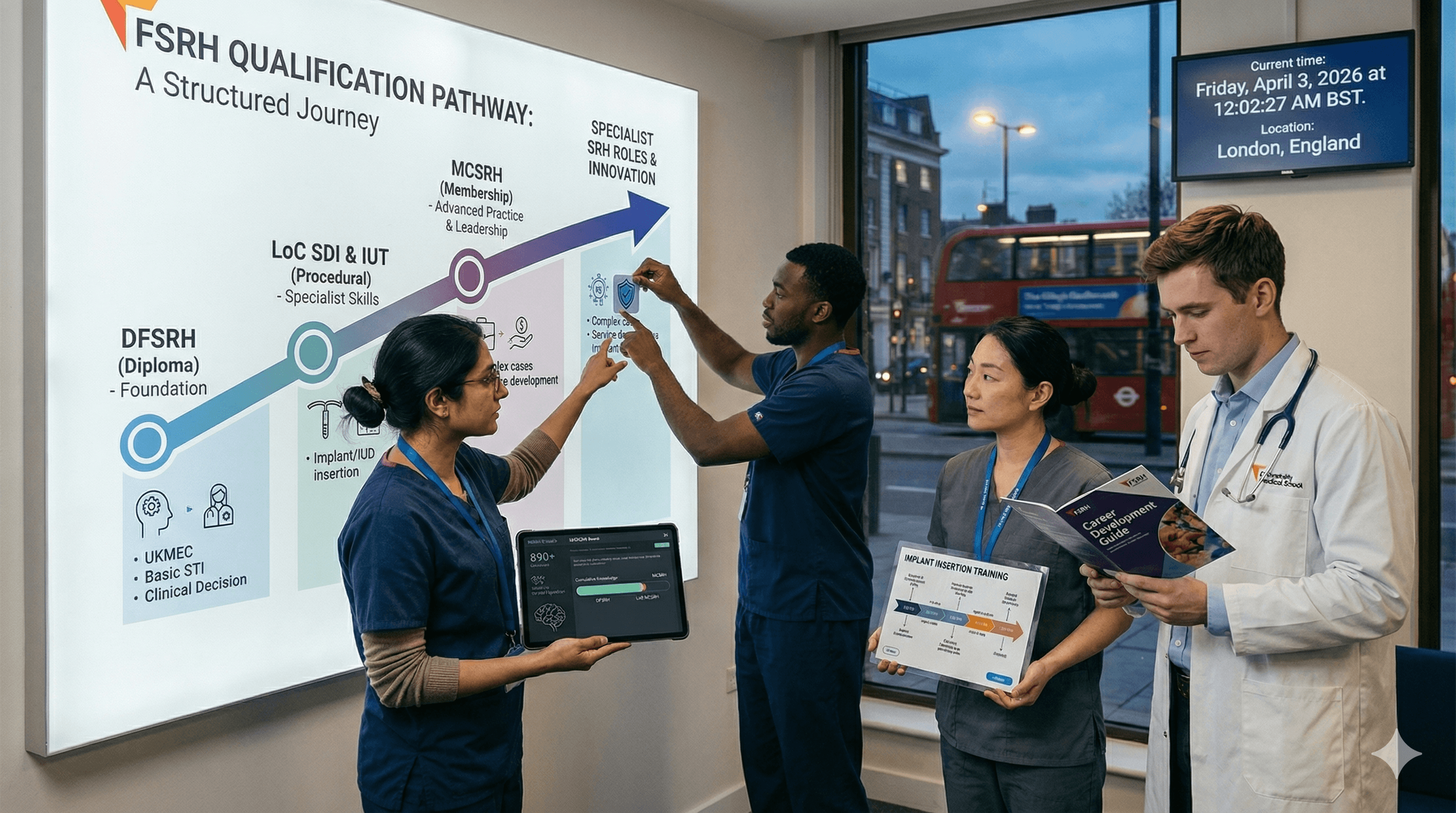
The Faculty of Sexual and Reproductive Healthcare offers a structured qualification pathway from foundation-level contraceptive competence through to specialist membership. Each qualification builds on the previous one, and the clinical knowledge is cumulative — meaning preparation for each level strengthens the foundation for the next.
The Qualification Pathway
DFSRH (Diploma). The foundation qualification. Comprehensive contraceptive care, basic STI management, UKMEC application, and clinical decision-making. Open to all registered healthcare professionals. Four assessment components (ILP, OTA, SCAs, AHD). The starting point for anyone delivering contraception.
LoC SDI (Letter of Competence — Subdermal Implants). Procedural qualification for implant insertion and removal. Requires OTA pass (shared with DFSRH). Clinical training and practical assessment.
LoC IUT (Letter of Competence — Intrauterine Techniques). Procedural qualification for IUD/IUS insertion. Requires OTA pass. Clinical training sessions and practical assessment. Requires competence in bimanual examination.
MCSRH (Membership of the Committee on Sexual and Reproductive Health). The specialist-level qualification for clinicians working in dedicated SRH roles — community SRH clinics, specialist contraception services, and integrated sexual health centres. Tests advanced clinical knowledge, management of complex cases, service leadership, and quality improvement. Typically pursued by doctors and senior nurses in specialist SRH posts.
How the Knowledge Builds
The DFSRH teaches you all contraceptive methods, UKMEC, basic STIs, and clinical consultation skills. The LoC qualifications add procedural competence for specific LARC methods. The MCSRH builds on the diploma-level knowledge with advanced management of complex cases — contraception in severe medical conditions, specialist STI management, HIV pre-exposure prophylaxis, complex safeguarding, and service development.
The clinical knowledge is cumulative. Preparing for the DFSRH OTA with the iatroX DFSRH Q-Bank builds the foundation that the LoC OTA shares and the MCSRH extends. The UKMEC categories you learn for the DFSRH are the same categories tested at every level — they just appear in increasingly complex clinical scenarios.
Preparation Across the Pathway
A single subscription at iatroX Boards provides access to the DFSRH Q-Bank (850+ questions) alongside other specialty Q-banks. The adaptive spaced repetition maintains the foundational knowledge as you progress through the pathway — so UKMEC categories learned for the DFSRH are still retained when you sit the MCSRH years later.
Ask iatroX provides the clinical reference that supports practice at every level — from the GP consulting room to the specialist SRH clinic. The guideline-grounded answers grow with your practice: the same tool that helped you learn UKMEC for the DFSRH helps you verify complex UKMEC scenarios for the MCSRH.
Whatever stage of the SRH pathway you are at, iatroX supports your preparation and your practice. Start at iatroX Boards.