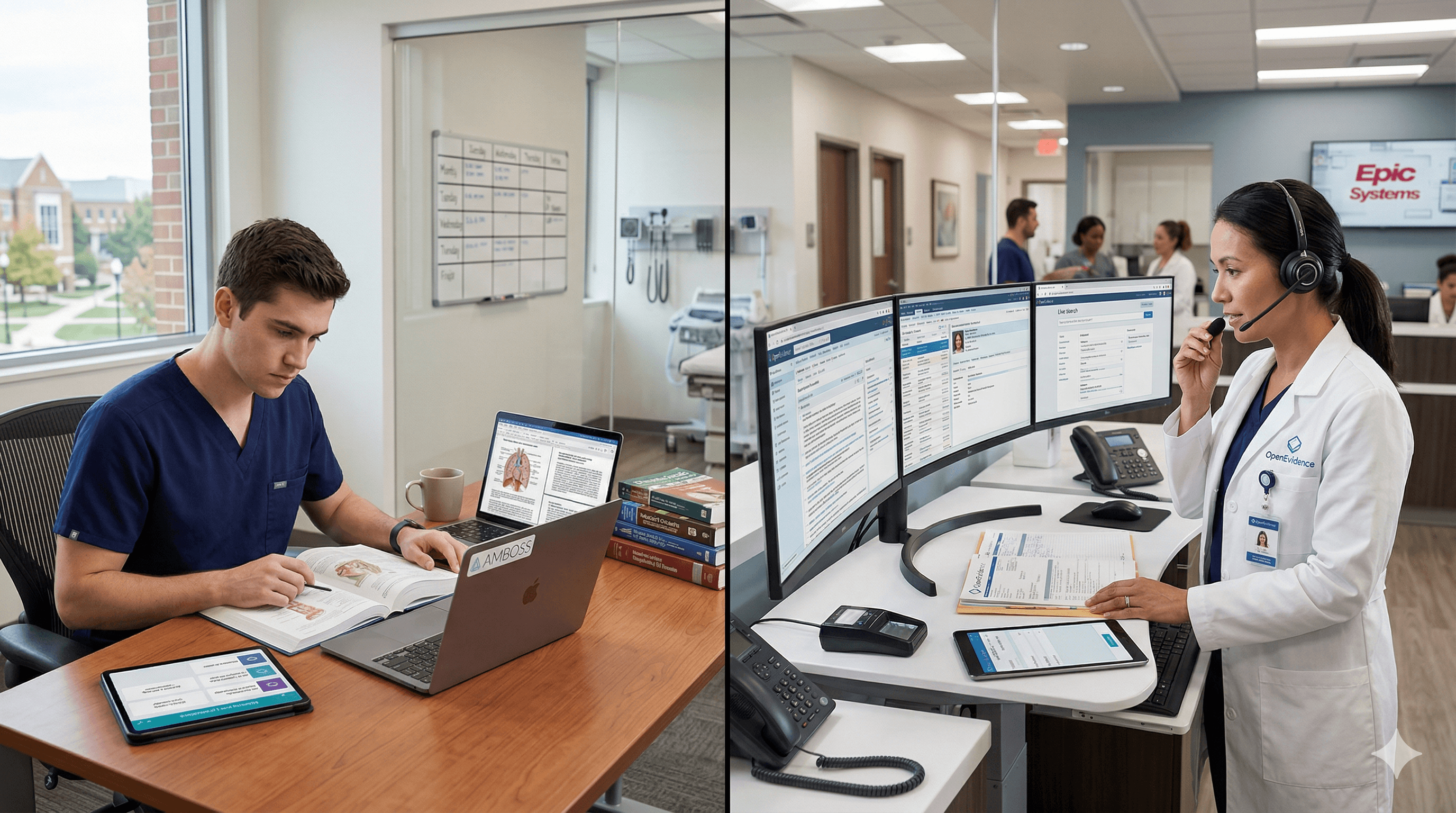
OpenEvidence Learn and AMBOSS now compete for more of the same study session. Both can sit between uncertainty and further learning. The useful distinction is how each helps the learner decide what to do next.
AMBOSS approaches that task through a curated library, question practice and a developing model of the learner's knowledge. iatroX offers another purposeful route through examination-specific attempts, Tutor discussion and available simulation practice. The comparison becomes clearer when it follows the work rather than the list of features.
This article compares published documentation checked on 4 November 2026. It does not claim hands-on testing of account-restricted Learn features or comparative examination outcomes. Our Learn review covers the launch and access conditions.
Begin with the purpose of the session
Learn is free for eligible OpenEvidence users. That lowers the cost of trying a new learning environment, but it does not determine where a candidate should spend most of their preparation time.
“I need to understand this unexpected finding” and “I need to cover the cardiovascular curriculum before my assessment” are legitimate, different starting points. The first benefits from relevance and responsiveness. The second also requires coverage, sequencing and a way to detect what has been neglected.
A useful comparison therefore follows several activities: understanding a topic, answering unfamiliar questions, retaining distinctions and applying knowledge in context. A service can be valuable for one activity while complementing another resource used for a different purpose.
For a student near an examination, continuity should make the next appropriate activity easier to begin. It should not mean that one interesting question absorbs an evening intended for broader revision.
AMBOSS has made its learning environment conversational
Describing AMBOSS as a conventional library with a search box misses its current direction.
Its AI Mode Learning FAQ describes explanations grounded in clinician-reviewed AMBOSS content, uploaded study material, and links to articles, questions and Anki resources. Learner Chat is currently included during testing; long-term packaging remains undecided. Access is through the web, including mobile browsers, rather than native learning chat in the apps.
Consider a student who repeatedly confuses two related presentations. An explanation may resolve the immediate misunderstanding. A valuable next step is an unfamiliar question containing a misleading feature, followed by review of the underlying distinction. Linking explanation to existing material reduces the effort of constructing that sequence.
The curated environment also gives the learner a stable account to inspect when a generated response leaves something unresolved. That can help maintain a consistent conceptual framework across sessions.
These are meaningful strengths. Their educational value still depends on the learner attempting something, examining the error and returning to a fresh decision. Reading a more convenient explanation is not the same observation as demonstrating improvement.
A learner model changes the comparison
A question total describes supply. A knowledge profile attempts to say something about the person using it. That is the more consequential part of AMBOSS's recent direction.
The 5 October Knowledge Profile announcement describes Rasch-based knowledge tracing that uses question difficulty and tagged skills to guide practice. AMBOSS reports comparing Step 2 CK estimates with self-reported scores from 7,244 learners: mean absolute error was 8.52 points. Current inputs are Qbank responses; AI interactions and Anki activity are future additions. Readiness metrics depend on the selected examination.
This is vendor-reported validation of a prediction system. It is not a trial showing that the feature raises examination scores. Those are separate questions: whether an estimate reflects current performance and whether following the recommendations improves future performance.
The distinction matters to the buyer. A prediction can be reasonably informative while the learning sequence still needs evaluation. Equally, useful teaching can occur in a product that has no validated pass prediction.
Ask what evidence enters the estimate and what the number means for your examination. Avoid treating a neat dashboard as a complete account of capability. Some important difficulties concern communication, uncertainty or how reasoning changes when the familiar options disappear.
Decide where recall already lives
A flashcard is useful when it retrieves something the learner might otherwise fail to retrieve. Turning every interesting explanation into a deck can create another maintenance obligation without addressing the most consequential errors.
AMBOSS's Anki integration adds term explanations and article access, recommends questions from cards and connects questions with relevant AnKing material. Qbank connections are desktop features; pop-up explanations also work on supported mobile Anki apps.
For someone already committed to a scheduled deck, that is a substantial practical advantage. It enriches work already happening rather than asking the learner to maintain a competing review system.
The alternative is a smaller collection of personally useful distinctions. Before adding a card, identify the error: failure to recall, misreading, overlooking a qualifier or misunderstanding why the alternative fits less well. Only some of those problems need another fact to memorise.
The purchasing decision concerns where the learner will reliably review worthwhile material. Several attractive flashcard tools can leave someone with several neglected queues. A coherent routine has more value than creating the same lesson in multiple places.
Keep conversational rehearsal and clinical reference distinct
A fluent case discussion can reveal whether the learner explains a decision coherently. It does not automatically reproduce a specific observed clinical assessment.
AMBOSS documents oral-style practice through Learning mode while distinguishing it from a dedicated oral-exam mode. Its separately documented Clinical Care mode has limited access and draws on external US guidelines, a drug database and the AMBOSS knowledge base.
Those distinctions help users choose the appropriate environment. Studying a concept, investigating a clinical question and rehearsing a consultation place different demands on the platform and the learner.
For a new or contested clinical question, inspect evidence and applicability. For a concept that needs systematic understanding, a concise curated account may be an efficient starting point. During rehearsal, commit to a decision before asking for the explanation.
A useful reflection afterwards is specific: which action did you choose independently, which required a hint, and what would change in another case? That makes the next practice task easier to identify.
Compare the job your next hour needs done
| Your starting problem | Useful evidence from a trial session |
|---|---|
| A concept remains unclear | You can explain the distinction after closing the response |
| You do not know what to study | The suggested task addresses a demonstrated, exam-relevant gap |
| Your deck is becoming unmanageable | The workflow improves review without duplicating material |
| You want a readiness estimate | The metric's inputs and intended examination are explicit |
| You can recognise answers but struggle to explain | A changed case exposes and corrects the weak reasoning |
| You need consultation practice | Feedback refers to what happened in the encounter |
This is a task framework, rather than a scorecard awarding an overall winner. A platform can deserve a central place because it solves the learner's recurring problem particularly well.
Match access, assessment and subscription
Geography and educational relevance are separate questions. OpenEvidence's current terms exclude UK, EU and EEA access. Elsewhere, readers should confirm current eligibility.
A Canadian candidate preparing for USMLE has a US examination target. An American doctor preparing for Australian registration has a different one. Shared medical science does not make every national qualification interchangeable.
AMBOSS's pricing page distinguishes standard membership, which includes library access and fifty questions monthly, from additional unlimited-question packages. Institutional access and regional offers can change the calculation. Check the actual access period and workload included at checkout.
A reference membership and a dedicated revision bank are different purchases, even when sold within one platform. Evaluate the package needed for your routine, rather than comparing the lowest displayed price with someone else's complete preparation subscription.
Time belongs in the calculation too. A free resource that creates useful daily learning has clear value. A paid resource that directs scarce revision time towards the right gaps can also justify its cost.
Where iatroX provides a coherent alternative
iatroX makes a strong case for learners whose priority is connecting an examination-specific attempt to a better understanding of their reasoning.
With iatroX Tutor, the conversation begins beside a question already attempted. Learners can explore the distinction behind their selected answer, request a direct explanation and retain highlights or editable cards for Anki.
Imagine selecting a feature shared by two conditions when the question requires the feature distinguishing them. More general reading may leave the error intact. A conversation attached to that attempt can examine the reasoning move, then preserve the useful correction for later retrieval.
The exam catalogue spans American, Canadian, Australian and UK pathways. The learning subscription connects paid banks with Tutor, planning and available simulations. This provides a practical route from a written decision to further reasoning work or rehearsal where an appropriate simulation is available.
That is useful for a candidate with a defined qualification and a recurring difficulty to resolve. It also creates continuity for doctors whose next assessment changes as their careers develop.
Which platform should take the central role?
AMBOSS has a strong documented proposition for supported US examination preparation: a curated learning environment, established Anki connections and an explicit approach to adapting practice and interpreting progress.
Learn deserves a deliberate trial by eligible users. Give it an identifiable learning job and examine whether it improves what you can do on fresh material. Free access creates an opportunity to evaluate; it does not establish an examination outcome.
iatroX is a compelling option when the target qualification and the learner's attempted answer should organise the session. Its question-linked Tutor and available rehearsal make the connection between an error and the next useful activity tangible.
Choose the platform that repeatedly helps you attempt, understand and practise the weak decision. The quality of that sequence matters more than accumulating another collection of explanations.