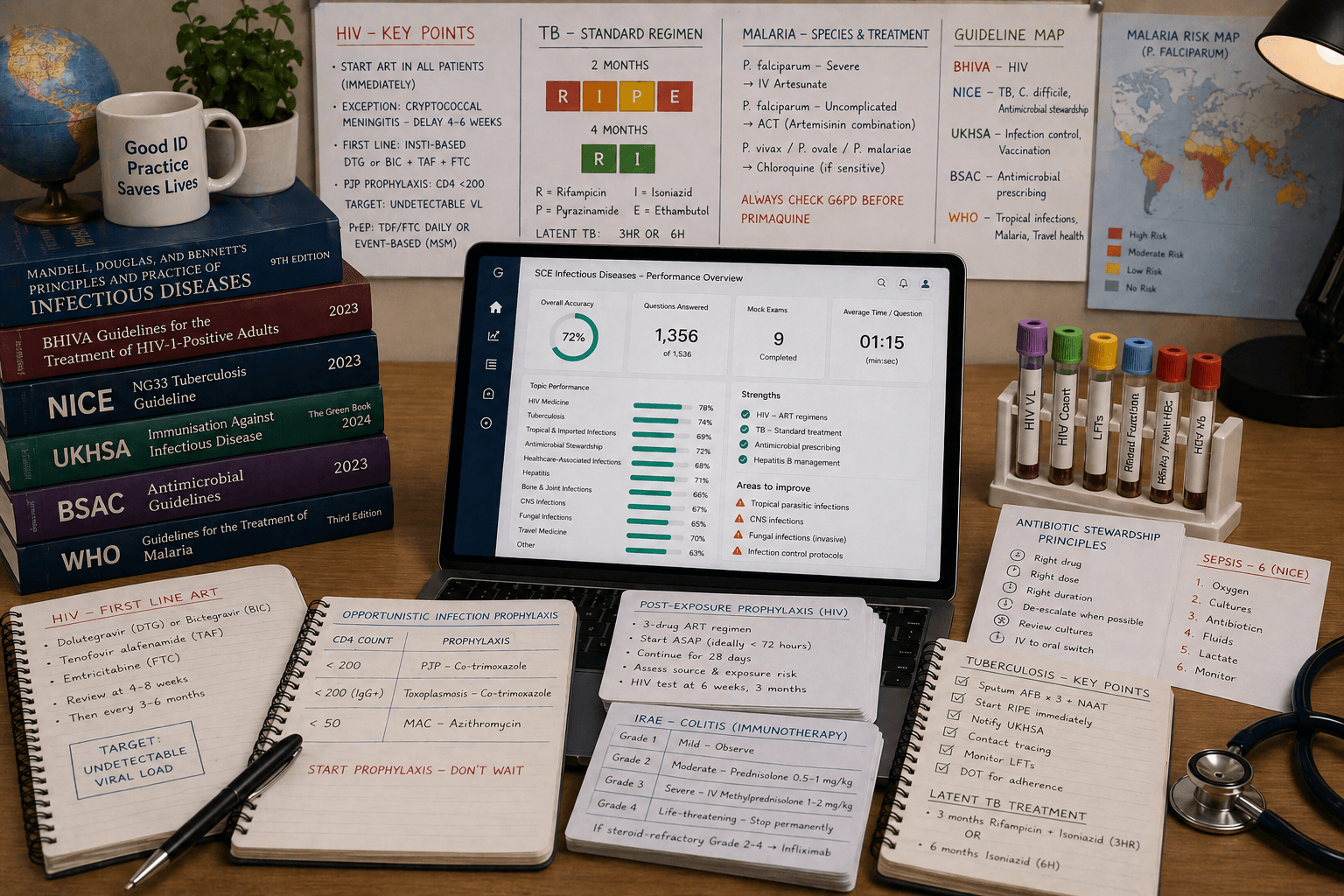
The SCE Infectious Diseases sits once per year in June and has one of the most internationally oriented curricula of any SCE specialty. HIV medicine alone accounts for roughly 18 per cent of questions, tropical and imported infections account for 12 per cent, and TB accounts for another 12 per cent. The remaining questions cover antimicrobial stewardship, healthcare-associated infections, hepatitis, bone and joint infection, CNS infection, fungal infections, and travel medicine.
The guideline landscape is unusually diverse — BHIVA for HIV, NICE and UKHSA for TB and infection control, BSAC for antimicrobial prescribing, WHO for tropical infections, and specialty-specific guidance for individual conditions. The exam expects you to know which guideline applies in which context.
HIV medicine — 18 per cent of the exam
HIV is the single largest domain and the most guideline-intensive. You must know current first-line ART regimens (integrase inhibitor-based — dolutegravir or bictegravir with tenofovir alafenamide and emtricitabine), when to start ART (immediately for all patients, with the cryptococcal meningitis exception — delay four to six weeks), baseline and ongoing monitoring (viral load, CD4, resistance testing, renal function, bone density), opportunistic infection prophylaxis (PJP at CD4 below 200, toxoplasmosis at CD4 below 200 if IgG positive, MAC at CD4 below 50), and PrEP (daily tenofovir-emtricitabine or event-based dosing for MSM).
The exam also tests HIV in pregnancy (ART regardless of CD4, aim for undetectable viral load by delivery, mode of delivery based on viral load at 36 weeks), post-exposure prophylaxis (three-drug ART for 28 days, ideally started within 72 hours), and the interpretation of resistance mutations.
TB — 12 per cent
You must know the standard treatment regimen (RIPE — rifampicin, isoniazid, pyrazinamide, ethambutol for two months, then rifampicin and isoniazid for four months), drug-resistant TB management principles, latent TB diagnosis (IGRA or Mantoux) and treatment (three months of rifampicin-isoniazid or six months of isoniazid), contact tracing protocols, TB in immunosuppression (screening before biologics, managing active TB with concurrent immunosuppressive therapy), and BCG vaccination policy.
Tropical infections — 12 per cent
This is the domain where many UK-trained registrars feel least prepared. You need to know malaria (species identification from blood film description, severity criteria, treatment by species and severity — artesunate for severe, artemisinin-based combination for uncomplicated falciparum, chloroquine for non-falciparum), dengue (warning signs, supportive management), typhoid (diagnosis, treatment, carrier state), schistosomiasis (egg morphology described textually, praziquantel), leishmaniasis (visceral vs cutaneous, liposomal amphotericin B), and the returning traveller assessment framework (incubation periods, geographic risk mapping).
Antimicrobial stewardship — 10 per cent
Questions test your knowledge of antimicrobial resistance patterns, empiric antibiotic selection, de-escalation principles, therapeutic drug monitoring (aminoglycosides, vancomycin), Clostridioides difficile management, and the principles of antimicrobial stewardship programmes. BSAC and NICE guidelines are the references.
Revision strategy
Four months before the June sitting. Spend the first six weeks on HIV — it is the largest domain and the most detail-heavy. Read the current BHIVA guidelines alongside question bank practice. Weeks seven to ten should cover TB and tropical infections — read NICE NG33 for TB and use the question bank to expose yourself to tropical presentations you may rarely encounter clinically. Weeks eleven to fourteen should cover antimicrobial stewardship, healthcare-associated infections, hepatitis, and the remaining topics, followed by mock exams.
iatroX's SCE Infectious Diseases bank contains over 1,500 questions aligned to BHIVA, NICE, UKHSA, WHO, and BSAC guidelines. HIV, TB, and tropical content are tagged for focused practice. The adaptive algorithm ensures tropical infections receive appropriate revision time even if your clinical exposure is predominantly UK-acquired infections. All included at £29 per month or £99 per year.