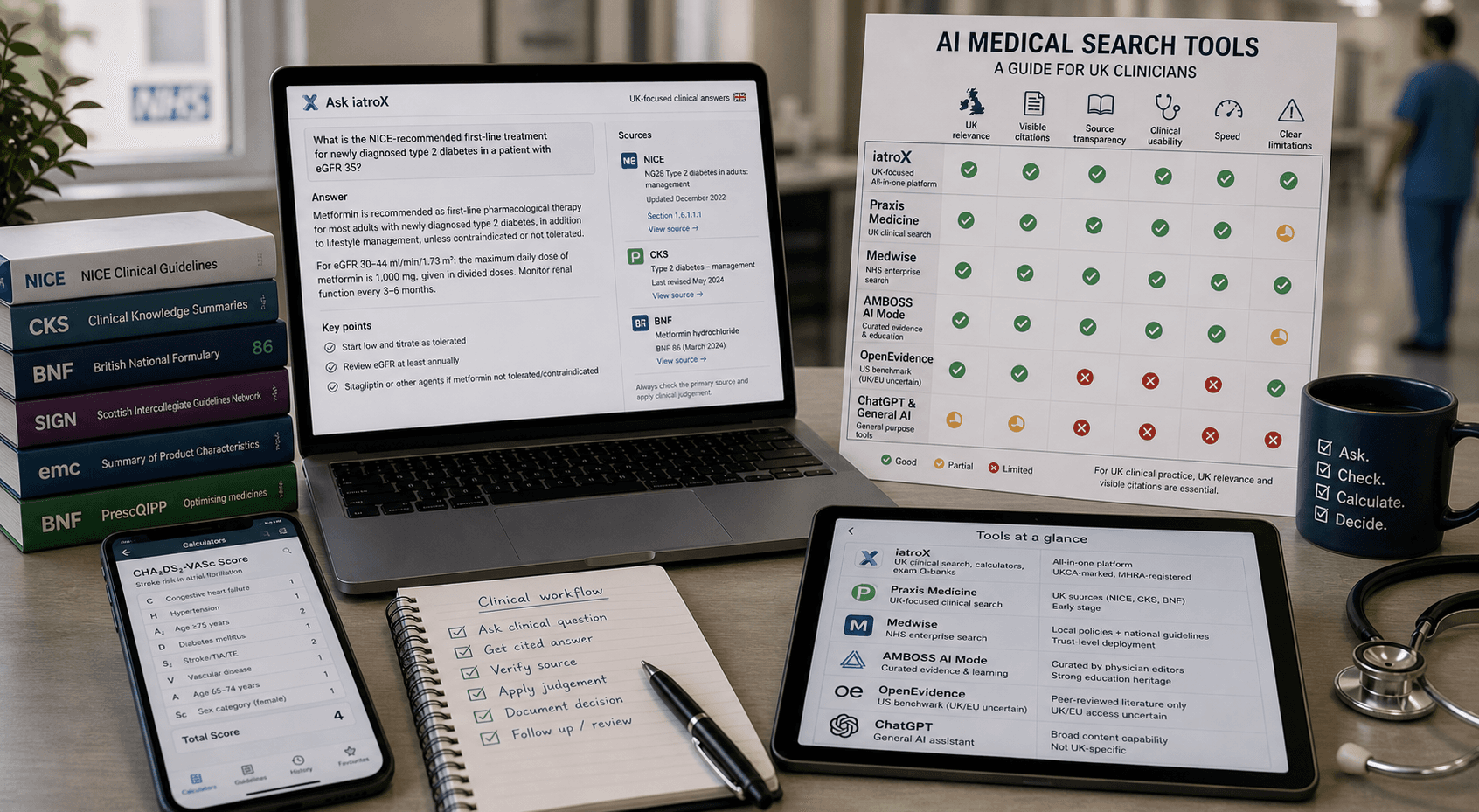
Doctors are no longer only choosing between textbooks, PubMed, and UpToDate. They are choosing between AI-assisted medical search tools — each with different strengths, different source strategies, and different levels of UK relevance. This guide covers the tools available to UK clinicians, what distinguishes them, and how to choose.
What Makes a Good AI Medical Search Tool?
Six criteria matter for clinical use.
UK relevance. Does the tool provide answers grounded in the sources UK clinicians actually use — NICE, CKS and SIGN guidance, alongside current UK medicines information? A tool citing US guidelines for a UK clinical question is not helpful; it is potentially misleading.
Visible citations. Can you see where the answer came from? Can you click through to the primary source and verify? A tool without citations is a black box.
Source transparency. Does the tool clearly state what sources it draws from? Is it trained on peer-reviewed literature only, or on the broader internet?
Clinical usability. Can you use it during a 10-minute consultation without disrupting your workflow? Is it fast enough for point-of-care use? Is it mobile-optimised for ward rounds?
Speed. How quickly does it return an answer? If it takes longer than searching NICE/CKS manually, it adds no value.
Clear limitations. Does the tool acknowledge what it cannot do? Does it remind users to verify with primary sources? Clinical humility in an AI tool is a safety feature.
The Difference Between AI Search, AI Scribes, and General Chatbots
These are three distinct categories that often get confused.
AI medical search tools retrieve, synthesise, and cite clinical evidence in response to clinical questions. They sit around clinical uncertainty — prescribing questions, guideline queries, diagnostic reasoning, exam preparation.
AI scribes capture and document consultations — ambient listening, note generation, coding. They sit inside the consultation workflow. Heidi Health, Tortus AI, Tandem Health, and Nuance DAX are scribes.
General chatbots (ChatGPT, Claude, Gemini) can answer medical questions, but they are not purpose-built for clinical use. They draw from broad training data, may cite US guidelines for UK queries, and carry hallucination risk on clinical content.
UK doctors should be clear about which category they need for a given task.
The Tools
iatroX — Best for UK Clinicians Who Want Clinical Search, Calculators, and Exam Preparation in One Platform
iatroX is a UK-focused clinician platform. Ask iatroX provides cited clinical answers oriented around UK practice. The platform also includes 80+ clinical calculators with editorial content and guideline references, and 15+ adaptive exam Q-banks covering all major UK exams. UKCA-marked, MHRA-registered Class I medical device. Free.
Best for: The UK clinician who wants clinical search, practical tools, and exam preparation in one daily-use platform — not just a search box.
Praxis Medicine — Emerging UK-Focused Clinical Search
Praxis Medicine is an emerging clinical decision-support product focused on the UK. Founded by Douglas Stark (Voi co-founder), backed by Balderton Capital and Creandum. Its landing page lists NICE, CKS, NHS Digital, and Europe PMC as sources. Praxis has publicly described itself as a UK-only product for UK-licensed healthcare professionals and is seeking NHS API integrations.
Best for: Clinicians interested in a dedicated clinical search product with explicit UK-source positioning. Early stage — watch this space.
Medwise — NHS Enterprise Guideline Search
Medwise AI deploys at NHS Trust level, integrating local policies and formularies alongside national guidelines. The HRA has listed a prospective pilot comparing Medwise against manual intranet search. Enterprise licensing — not available to individual clinicians directly.
Best for: Hospital buyers and NHS Trusts who need clinical AI search with local policy integration and institutional governance.
AMBOSS AI Mode — Curated Evidence with Education Heritage
AMBOSS AI Mode offers natural-language search across AMBOSS's curated clinical content library. Inline citations, transparent limitations, and traceable source links. The curated-content model — evidence selected and maintained by physician editors — provides a different trust approach from RAG-over-open-guidelines tools. Strong education heritage with structured learning pathways.
Best for: Clinicians who value curated, physician-edited content and want evidence search alongside structured medical education. Particularly strong for DACH markets and international users.
OpenEvidence — US Benchmark, UK/EU Availability Uncertain
OpenEvidence is the US reference point for clinical AI search. $12 billion valuation. Approximately 15 million consultations per month. Trained exclusively on peer-reviewed medical literature. HIPAA-compliant. Telecare Aware reported in April 2026 that OpenEvidence access has been terminated in the UK and EU, citing regulatory uncertainty. UK availability is currently uncertain.
Best for: US physicians. UK clinicians should check current availability before relying on this tool.
ChatGPT and General AI Tools — Powerful but Not UK-Specific
Standard ChatGPT is powerful for evidence synthesis, literature review, writing, and administrative tasks. It is not optimised for UK-specific clinical queries, does not preferentially cite UK guidelines, and carries hallucination risk. For clinical decision support where UK guideline accuracy matters, purpose-built tools are more appropriate. For drafting, research synthesis, and non-clinical tasks, ChatGPT remains genuinely useful.
Best for: Administrative tasks, broad literature synthesis, writing assistance, and general research where UK-specific guideline precision is less critical.
How UK Doctors Should Choose
Start with your actual workflow. If you need a quick NICE/CKS-grounded answer during a consultation, use a UK-focused clinical search tool. If you need exam preparation alongside clinical reference, use a platform that combines both. If you need clinical scoring, use validated calculators with guideline context. If you need to draft a letter or summarise a paper, ChatGPT is strong.
No single tool covers every clinical need. The best approach is a deliberate stack: a UK-focused clinical search tool for guideline queries, a calculator library for scoring, an exam platform for revision, and a general AI tool for administrative work.