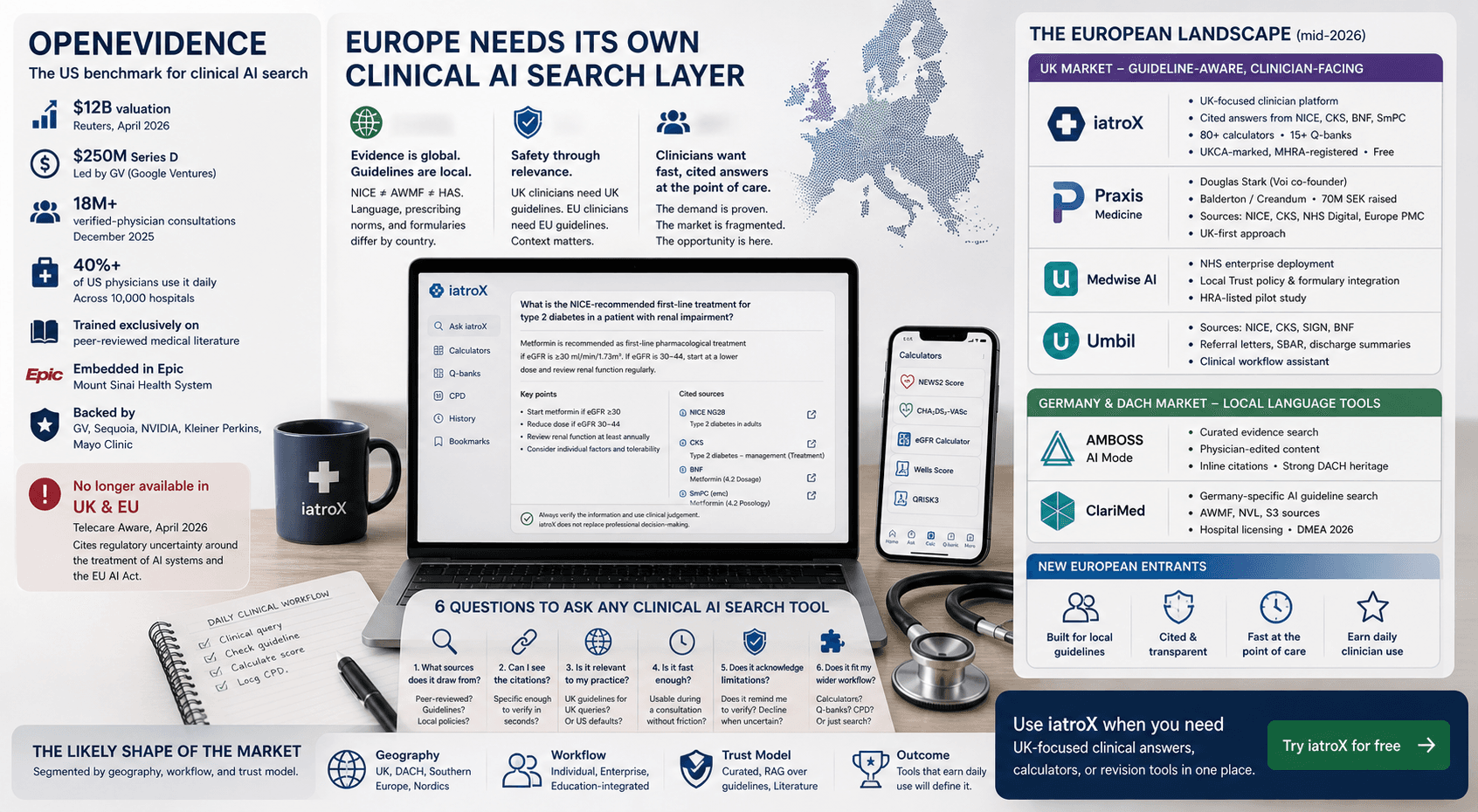
OpenEvidence became the US benchmark for clinical AI search — and for good reason. Reuters reported a $12 billion valuation, $250 million Series D, daily use by more than 40% of US physicians across 10,000 hospitals, and approximately 18 million verified-physician clinical consultations in December 2025. Trained exclusively on peer-reviewed medical literature. Free for verified clinicians. Embedded in Mount Sinai's Epic EHR. Backed by GV, Sequoia, NVIDIA, Kleiner Perkins, and Mayo Clinic.
That level of adoption proved something important: clinicians want fast, cited, source-grounded medical answers at the point of care. The demand is real, large, and commercially viable.
But OpenEvidence is no longer the whole story — particularly for European clinicians.
Why Europe Needs Its Own Clinical AI Search Layer
Telecare Aware reported in April 2026 that OpenEvidence has withdrawn from the UK and EU, citing regulatory uncertainty around the treatment of AI systems. The EU Artificial Intelligence Act and the UK's evolving regulatory guidance create compliance requirements that OpenEvidence has not yet addressed for European markets.
The withdrawal does not mean European clinicians lack options. It means the question has shifted from "can I use OpenEvidence?" to "what European-native tools exist that understand my clinical practice?"
Europe is not a copy-paste market. Clinical evidence may be global — the same trials published in the same journals — but the guidelines derived from that evidence differ by country. UK clinicians need NICE and CKS guidance and current UK medicines information. German clinicians need AWMF/S3/NVL. French, Italian, and Nordic clinicians each have national guideline ecosystems. Language, prescribing norms, formulary structures, and regulatory approaches add further fragmentation. A tool trained on PubMed alone cannot safely serve a UK GP and a German internist with the same responses.
The UK Market: Guideline-Aware, Clinician-Facing Answers
The UK is the most developed European market for clinical AI search — partly because its clinical-source ecosystem — NICE, CKS and SIGN guidance alongside current UK medicines information — is comprehensive and publicly accessible, and partly because the NHS provides a unified healthcare system with shared clinical pathways.
Several tools are now building for this opportunity.
iatroX. UK-focused clinician platform. Cited clinical answers oriented around UK practice. 80+ clinical calculators. 15+ adaptive exam Q-banks. UKCA-marked, MHRA-registered. Free.
Praxis Medicine. New entrant — Douglas Stark (Voi co-founder), Balderton/Creandum backing, 70M SEK raised. Explicitly UK-focused, listing NICE, CKS, NHS Digital, and Europe PMC as sources.
Medwise AI. NHS enterprise deployment with local Trust policy integration. HRA-listed pilot study.
Umbil. A UK clinical-workflow assistant with guideline-search and document-generation features. Its public materials emphasise UK clinical guidance; check current vendor documentation for the exact source set, source dates and whether product-specific SmPCs on eMC are included.
The German and DACH Market: Local-Language Evidence Tools
The same pattern is emerging independently in German-speaking markets.
AMBOSS AI Mode. Curated evidence search with physician-edited content, inline citations, and strong DACH heritage. The curated-content model offers a different trust approach from RAG-over-open-guidelines tools.
ClariMed. Germany-specific AI guideline search across AWMF/NVL/S3 sources. Hospital licensing model. Exhibited at DMEA 2026.
Praxis, iatroX, and the New European Entrants
For UK clinicians, iatroX is one of the tools built around the idea that clinical answers should be short, cited, and relevant to UK practice — not generic medical chatbot responses. Praxis is the newest entrant with strong founder and VC signals. Medwise addresses enterprise NHS needs. Umbil provides ward workflow tools with guideline retrieval.
The likely winners will be those that combine trusted sources, visible citations, simple clinician workflow, clear limitations, low friction, and daily usefulness. The tools that clinicians use once and forget will lose to the tools that clinicians open every day.
What Doctors Should Compare Before Trusting Any Medical AI Search Tool
Six questions to ask about any clinical AI search tool.
What sources does it draw from? Peer-reviewed literature? National guidelines? Local Trust policies? All three?
Can I see the citations? Are they specific enough to verify in seconds? Or vague references to "NICE guidelines" without a guideline number?
Is it relevant to my practice? Does it cite UK guidelines for UK queries? Or might it default to US recommendations?
Is it fast enough for clinical use? Can I use it during a consultation without the patient noticing?
Does it acknowledge limitations? Does it remind me to verify? Does it decline to answer when it lacks evidence?
Does it fit my wider workflow? Does it offer calculators, exam preparation, or CPD — or is it a standalone search box?
The Likely Shape of the Market
Europe will not produce one OpenEvidence-scale winner immediately. The market will segment by geography (UK, DACH, Southern Europe, Nordics), by workflow (individual clinician search, enterprise deployment, education-integrated platforms), and by trust model (curated content, RAG over guidelines, peer-reviewed literature, physician-verified outputs).
The US has OpenEvidence. The UK is developing its own clinical AI search layer. The tools that earn repeated daily use from working clinicians will define it.
Use iatroX when you need UK-focused clinical answers, calculators, or revision tools in one place →