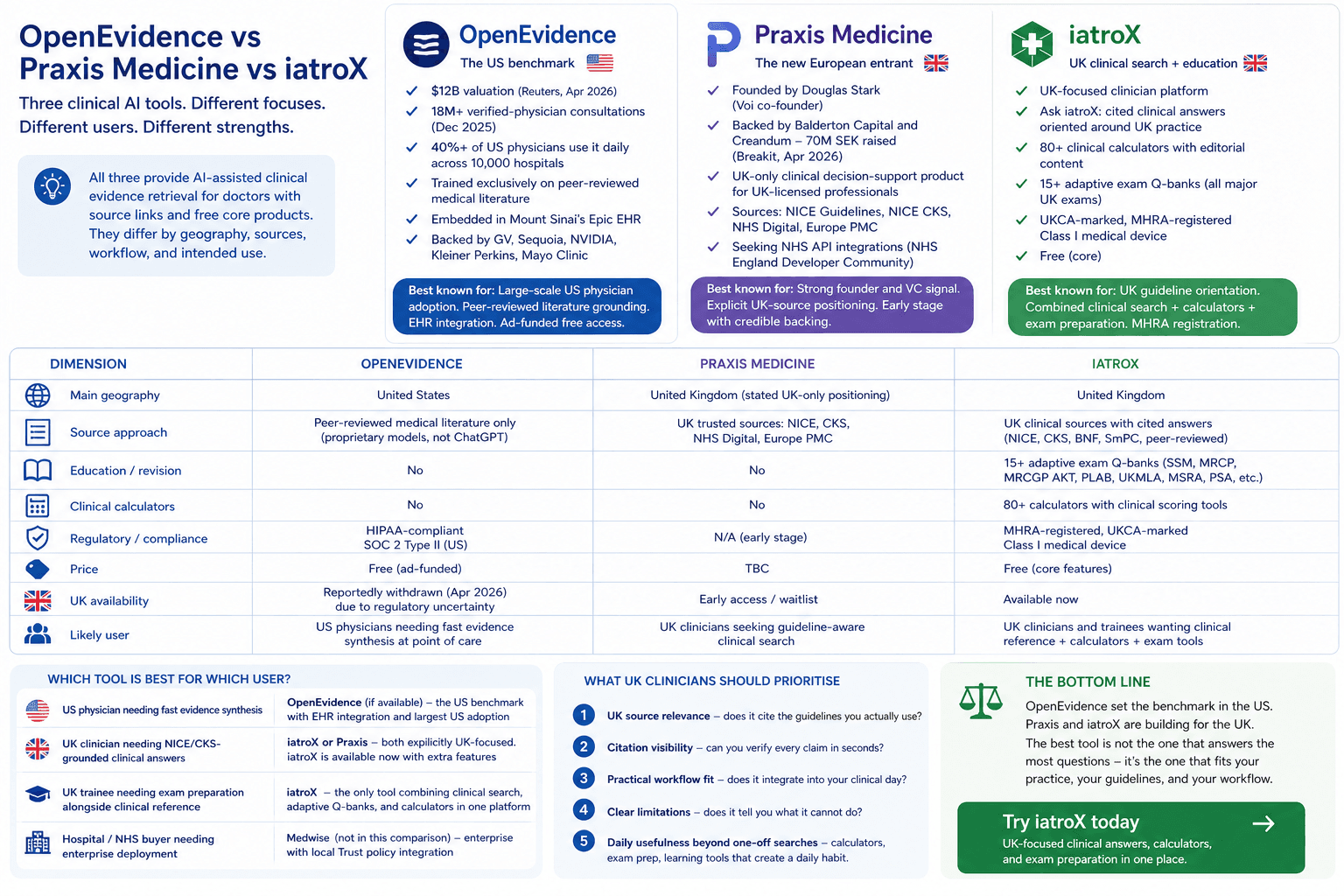
These three tools are increasingly mentioned together — but comparing them only by "which gives the best answer to a single clinical question" misses the point. They differ by geography, source relevance, clinical workflow, citation approach, and intended use. Understanding these differences matters more than a prompt-by-prompt accuracy contest.
Why These Tools Are Being Compared
All three sit near the same category: AI-assisted clinical evidence retrieval for doctors. All three provide answers to clinical questions with source links. All three are free (or have free core products). But they serve different markets, different workflows, and different user needs.
OpenEvidence: The US Benchmark
OpenEvidence is the reference point for clinical AI search globally. Reuters reported a $12 billion valuation, $250 million Series D, daily use by more than 40% of US physicians across 10,000 hospitals, and approximately 18 million verified-physician clinical consultations in December 2025. It is trained exclusively on peer-reviewed medical literature using proprietary models (not ChatGPT). HIPAA-compliant, SOC 2 Type II certified. Backed by GV, Sequoia, NVIDIA, Kleiner Perkins, and Mayo Clinic. Embedded in Mount Sinai's Epic system.
Telecare Aware reported in April 2026 that OpenEvidence access has been terminated in the UK and EU, citing regulatory uncertainty. UK availability is currently uncertain.
Best known for: Large-scale US physician adoption. Peer-reviewed literature grounding. EHR integration. Ad-funded free access.
Main geography: United States.
Likely user: US physicians needing fast evidence synthesis at the point of care.
Praxis Medicine: The New European Entrant
Praxis Medicine is an emerging clinical AI search product focused on the UK market. Founded by Douglas Stark (Voi co-founder). Backed by Balderton Capital and Creandum — 70 million SEK raised (Breakit, April 2026). Publicly positioned as a UK-only clinical decision-support product for UK-licensed healthcare professionals. Sources listed: NICE Guidelines, NICE CKS, NHS Digital, Europe PMC. Seeking NHS API integrations as described in the NHS England Developer Community.
Best known for: Strong founder and VC signal. Explicit UK-source positioning. Early stage with credible backing.
Main geography: United Kingdom (stated UK-only positioning).
Likely user: UK clinicians seeking guideline-aware clinical search.
iatroX: UK-Focused Clinical Search and Education
iatroX is a UK-focused clinician platform that combines clinical search with calculators and exam preparation. Ask iatroX provides cited clinical answers oriented around UK practice. The platform also includes 80+ clinical calculators and 15+ adaptive exam Q-banks covering all major UK exams. UKCA-marked, MHRA-registered Class I medical device. Free.
iatroX is best understood as a UK-focused clinical knowledge platform rather than a pure search product — it combines cited clinical answers with calculators and exam-focused learning.
Best known for: UK guideline orientation. Combined clinical search + calculators + exam preparation. MHRA registration.
Main geography: United Kingdom.
Likely user: UK clinicians and trainees wanting clinical reference, exam preparation, and clinical scoring in one platform.
Comparison Table
| Dimension | OpenEvidence | Praxis Medicine | iatroX |
|---|---|---|---|
| Best known for | US physician adoption at scale | VC-backed UK clinical search entrant | UK clinical search + calculators + exams |
| Main geography | United States | United Kingdom | United Kingdom |
| Source approach | Peer-reviewed literature only | UK trusted sources (NICE, CKS, NHS) | UK clinical sources, cited answers |
| Education/revision | No | No | 15+ adaptive exam Q-banks |
| Clinical calculators | No | No | 80+ with editorial content |
| Regulatory status | HIPAA/SOC 2 (US) | N/A (early stage) | MHRA-registered, UKCA-marked |
| Price | Free (ad-funded) | TBC | Free (core) |
| UK availability | Reportedly withdrawn | Early access | Available now |
Which Tool Is Best for Which User?
US physician needing fast evidence synthesis: OpenEvidence (if available) — the US benchmark with EHR integration and the largest US physician adoption.
UK clinician needing NICE/CKS-grounded clinical answers: iatroX or Praxis — both explicitly UK-focused. iatroX is available now with additional calculator and exam features. Praxis is early stage with strong signals.
UK trainee needing exam preparation alongside clinical reference: iatroX — the only tool combining clinical search, adaptive Q-banks, and clinical calculators in one platform.
Hospital buyer needing enterprise deployment: Medwise (not in this comparison but relevant for institutional needs with local Trust policy integration).
What UK Clinicians Should Prioritise
When evaluating any clinical AI search tool, prioritise: UK source relevance (does it cite the guidelines you actually use?), citation visibility (can you verify every claim?), practical workflow fit (does it integrate into your clinical day?), clear limitations (does it tell you what it cannot do?), and daily usefulness beyond one-off searches (calculators, exam preparation, learning — the features that create a daily habit).
Try iatroX if you want UK-focused clinical answers alongside calculators and exam preparation →