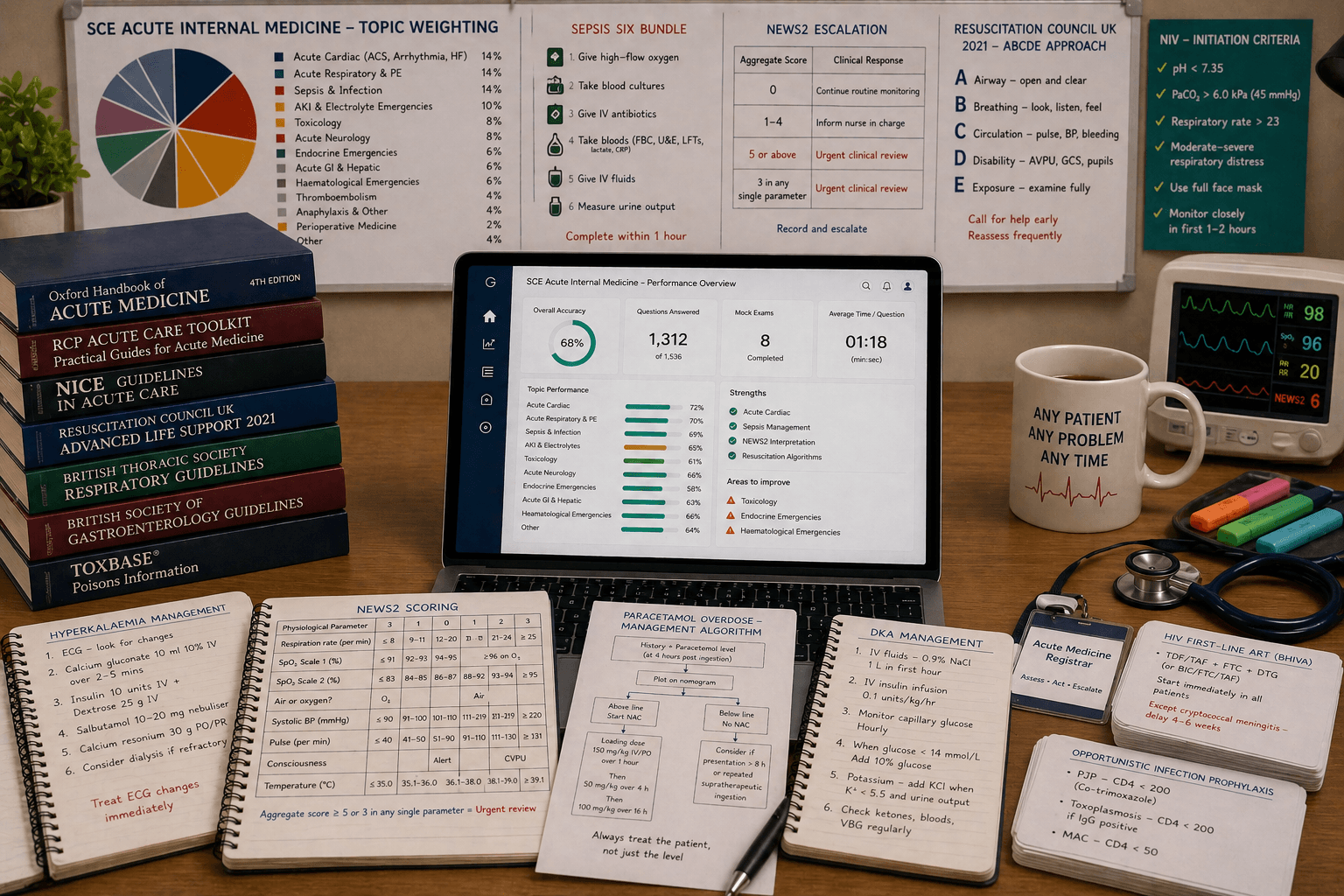
The SCE Acute Internal Medicine is the broadest Specialty Certificate Examination by clinical scope. Where other SCEs test depth within a single organ system, Acute Medicine tests the ability to manage any undifferentiated medical emergency that walks through the door — cardiac, respiratory, neurological, toxicological, endocrine, haematological, or infectious. The exam sits twice per year, typically February and September.
Why breadth is the challenge
An acute medicine registrar must be competent to manage a STEMI, a tension pneumothorax, status epilepticus, DKA, paracetamol overdose, neutropenic sepsis, and acute upper GI bleeding — all in the same shift. The exam reflects this breadth. No single clinical rotation covers all of these presentations at the depth the exam requires, which means dedicated revision across all domains is essential.
The curriculum maps to the RCP Acute Care Toolkit series, NICE guidelines, Resuscitation Council UK 2021 algorithms, and specialty-specific guidelines (BTS for respiratory, BSG for GI, NICE NG51 for sepsis). You need to know which guideline applies to which presentation and the specific management algorithms within each.
Topic weighting
Acute coronary syndromes and acute cardiac emergencies (STEMI, NSTEMI, acute heart failure, arrhythmia, cardiac tamponade) account for roughly 14 per cent. Acute respiratory failure and pulmonary embolism account for another 14 per cent — including NIV initiation criteria (pH below 7.35, PaCO2 above 6.0 kPa), PE investigation algorithms (Wells score, D-dimer, CTPA), and massive PE management.
Sepsis and infection account for 14 per cent — the Sepsis Six bundle, empiric antibiotic selection, source control, and the distinction between sepsis and septic shock. AKI and electrolyte emergencies account for 10 per cent — hyperkalaemia management (calcium gluconate, insulin-dextrose, salbutamol nebuliser, calcium resonium), hyponatraemia classification and management, and AKI staging.
Toxicology accounts for 8 per cent — paracetamol (Staggered overdose management, NAC protocol, King's College criteria), salicylate (urine alkalinisation), opioid (naloxone — 400 microgram initial dose, repeated as needed, consider infusion), tricyclic antidepressants (sodium bicarbonate for QRS prolongation), lithium, and ethylene glycol/methanol (fomepizole). Acute neurology (stroke thrombolysis/thrombectomy time windows, status epilepticus management, meningitis) accounts for 8 per cent. Endocrine emergencies (DKA, HHS, adrenal crisis, thyroid storm, myxoedema coma) account for 6 per cent.
The remaining questions cover acute GI emergencies (variceal and non-variceal upper GI bleeding, acute liver failure, acute pancreatitis), haematological emergencies (neutropenic sepsis, DIC, massive transfusion protocol), thromboembolism, anaphylaxis, and perioperative medicine.
NEWS2 integration
The National Early Warning Score 2 is integral to acute medical practice and is tested throughout the exam. Questions present NEWS2 scores as part of clinical scenarios and expect you to interpret the aggregate score, understand the escalation thresholds (score 5 or above, or 3 in a single parameter), and apply the clinical response framework. NEWS2 is not tested as a standalone topic — it is woven into clinical scenarios across all domains.
Revision strategy
Three to four months. The first six weeks should cover the three largest domains — acute cardiac, acute respiratory, and sepsis. These alone account for over 40 per cent of the exam. Weeks seven to ten should cover toxicology, acute neurology, endocrine emergencies, and AKI. Weeks eleven to twelve should cover mock exams, remaining topics, and weak-area revision.
Given the breadth, an adaptive question bank is particularly valuable. iatroX's SCE Acute Medicine bank contains over 1,500 questions covering all domains at exam weighting, with NEWS2 integrated throughout. The adaptive algorithm ensures that low-exposure domains (toxicology, endocrine emergencies) receive proportional attention. All included at £29 per month or £99 per year.