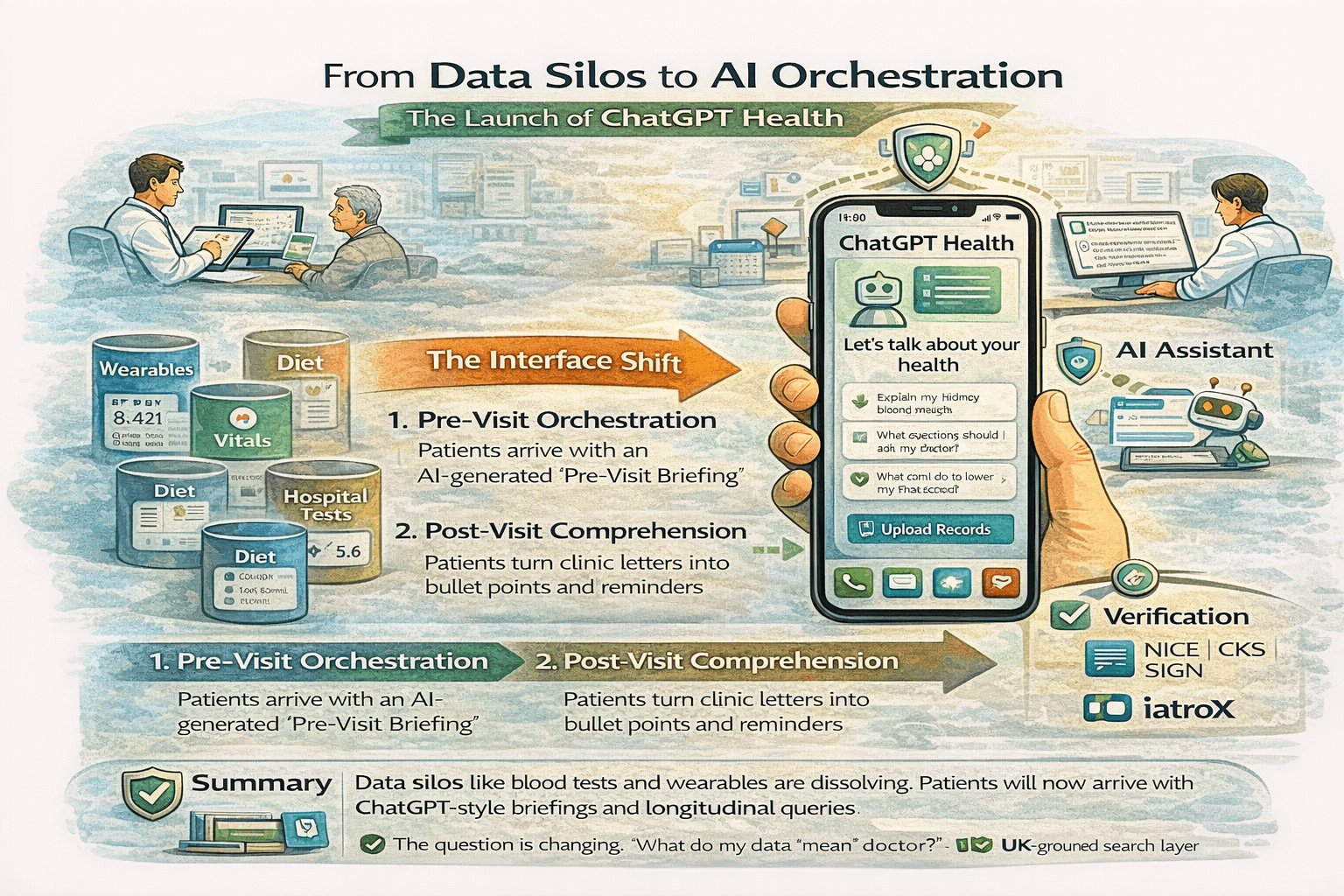
The launch of ChatGPT Health today is not just another feature drop; it is a signal that the interface of medicine is shifting.
For the last decade, "digital health" meant fragmentation: your bloods were in a portal, your sleep data was in an app, and your diet was in a diary. We, the clinicians, were the only ones who could see the full picture—and often, we couldn't see it either.
With OpenAI’s new dedicated health workspace, the walls between these silos are dissolving. We are moving from the era of "Data Storage" to the era of AI Orchestration.
ChatGPT Health as a product signal
The significance of today's launch is not that an AI can answer medical questions—it could do that in 2023. The shift is unification.
- The Connection Layer: Through its partnership with b.well, users can now connect actual medical records (HL7/FHIR data) alongside lifestyle feeds from Apple Health, Function, and MyFitnessPal.
- The "Pattern" Shift: Because the AI has access to longitudinal data, the interaction shifts from "Help, I have a headache" (moment of illness) to "Why does my migraine frequency correlate with my sleep debt last month?" (pattern over time).
- The Interface: It is no longer a chatbot; it is an agent that can "read" your history before you type a single word.
The three big shifts this creates
This new interface forces three specific changes in the doctor-patient dynamic:
1. Pre-visit orchestration becomes normal Patients will no longer arrive with a mental list of symptoms. They will arrive with an AI-generated "Pre-Visit Briefing" that synthesises their last 6 months of wearable data and blood trends. This is efficient, but it changes the consultation from "gathering data" to "verifying the summary."
2. Post-visit instruction comprehension improves The "black hole" of adherence—where patients forget 50% of what is said the moment they leave—is solvable. If a patient can upload their discharge summary or clinic letter and ask, "Turn this into a shopping list and a calendar," compliance will skyrocket.
3. Longitudinal coaching pressure increases The most dangerous shift. Patients accustomed to an "always-on" AI coach that knows their daily step count will find the episodic nature of GP appointments (once every 3 months) jarringly disconnected. They will expect us to know the data too.
Why “search + synthesis” is the sane centre
In the hype, do not miss the fine print. OpenAI explicitly states that ChatGPT Health is not intended for diagnosis or treatment. It is a navigation layer.
This distinction is critical. The "Diagnosis" model of AI (the "Robot Doctor") is fraught with liability and safety failures. The "Search + Synthesis" model is the sane centre.
- The AI's job: Search the data, find the pattern, summarise the complexity.
- The Human's job: Verify the finding, make the decision, hold the risk.
The safest scalable model for 2026 is Retrieval + Citation + Clinician Judgement.
The UK reality check
While the US rollout allows direct connection to hospital portals via b.well, the UK launch is currently paused due to GDPR and safety governance.
However, data borders are porous.
- UK patients will see this on TikTok.
- They will use "regular" ChatGPT to paste in their NHS App exports.
- They will ask you about features they can't access yet.
- The lesson: You cannot ignore the behaviour just because you don't have the software.
Practical implications for clinicians
You are about to face a new category of "Data Questions."
- "My AI says my HRV trend indicates burnout—should I sign off work?"
- "My cholesterol is stable, but my AI says my ratio is optimizing too slowly."
Your job is changing. You are no longer the gatekeeper of the fact (the cholesterol number); you are the arbiter of significance. You must become the expert who says, "Yes, the data shows that trend, but clinically, it does not require intervention."
Where iatroX fits
If patients use ChatGPT Health to prepare, clinicians need an equally fast, UK-specific evidence retrieval layer to respond.
You cannot meet an AI-armed patient with a 5-year-old textbook. You need iatroX.
- The Answer Stack: While the patient uses AI for personal patterns, you use iatroX for clinical precedents.
- Engine Works: iatroX provides the "ground truth"—checking national UK guidelines to verify if the patient's AI-generated concerns are valid.
- Q&A Library: See how other GPs are managing the influx of "wearable-worried" patients.
Summary The next AI shift in medicine is not "AI diagnosis"; it’s a new interface over fragmented health data. ChatGPT Health makes records + wearables conversational, which will raise patient expectations for rapid interpretation. Clinicians will increasingly win by using citation-first search and verification workflows that convert raw data into safe decisions.
Ready to upgrade your side of the desk? Compare your current search tools with the citation-first power of iatroX.