The 10-minute consultation is a pressure cooker. You do not have time to wade through a 40-page pdf to find a single dosing regimen.
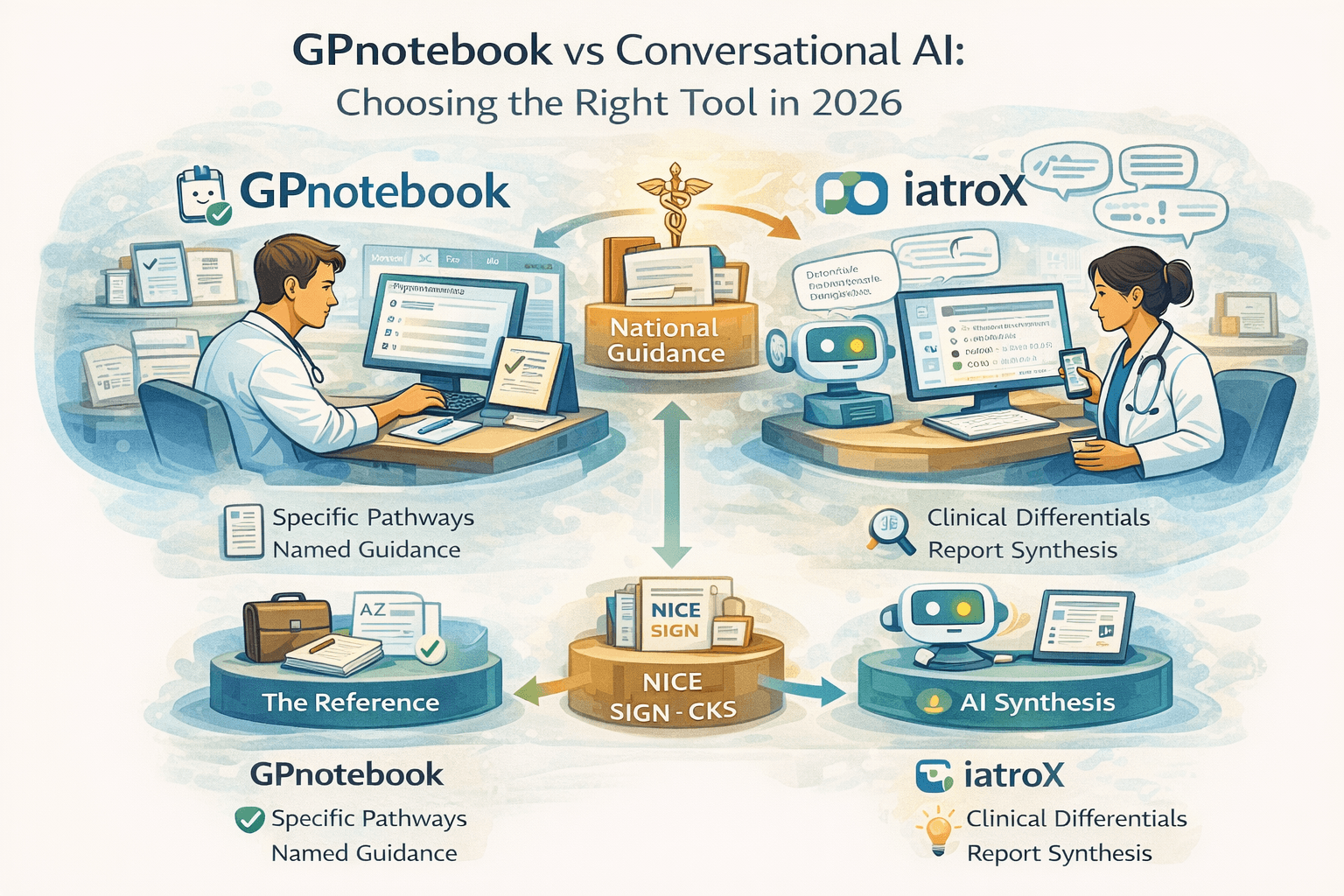
In 2026, the most efficient GPs do not rely on a single source of truth; they use a "stack" of tools, each assigned a specific job based on the complexity of the clinical question.
This guide defines the three layers of the modern clinical knowledge stack and provides a decision tree for what to open, and when.
The three layers
To optimise speed and safety, categorise your information needs into three layers.
1. Information libraries (Fast Retrieval)
- What they are: Static, curated summaries of conditions (e.g., GPnotebook, CKS, BMJ Best Practice).
- Best for: "Lookup" tasks. Finding a specific drug dose, checking DVLA fitness-to-drive rules, or verifying the criteria for a 2-week wait referral.
- Speed: Moderate (requires navigation).
2. AI synthesis (Interpretation + Citations)
- What they are: Conversational engines that synthesise answers from multiple guidelines (e.g., iatroX).
- Best for: "Complex queries." Questions that span comorbidities (e.g., "hypertension management in a patient with CKD and gout") or when you need a rapid summary of a broad topic.
- Speed: Fast (direct answer).
3. Primary guidance (Final Authority)
- What they are: The source documents (e.g., NICE Full Guideline, SIGN, local formulary).
- Best for: "High-stakes/Medicolegal." When you are prescribing off-label, managing a rare condition, or need to defend a decision against a complaint.
- Speed: Slow (requires deep reading).
“Open this first” decision tree
Stop random googling. Use this heuristic to choose the right tool instantly.
Scenario A: You need a named pathway or rule.
- Query: "What is the step-up asthma therapy for a 12-year-old?"
- Action: Go to Primary Guidance / CKS.
- Why: You need a rigid, defined flowchart. AI synthesis introduces unnecessary noise here.
Scenario B: You need a quick, cited summary of a broad problem.
- Query: "What are the second-line options for neuropathic pain if amitriptyline fails, considering the patient is elderly?"
- Action: Ask iatroX.
- Why: You need to synthesise "neuropathic pain guidelines" with "elderly prescribing cautions." An AI engine can pull these together faster than you can cross-reference two tabs.
Scenario C: You want to check precedent or "what others do."
- Query: "How do other GPs manage persistent cough post-viral infection?"
- Action: Check the Q&A library.
- Why: Sometimes the guidelines are vague ("consider supportive care"). Seeing a bank of similar questions helps calibrate your practice against peers.
How iatroX positions itself
iatroX is designed to sit in the middle layer of your stack—the AI Synthesis layer—but with a safety rail that generic chatbots lack.
It doesn't just guess; it checks a curated library of national guidelines before answering. When you ask a question, iatroX scans its internal index of NICE, SIGN, and CKS documents to construct an answer that is "grounded" in UK protocol.
- The Knowledge Centre: This is the engine room. It indexes clinical guidelines, management pathways, and essential medical knowledge into a searchable format.
- The Q&A Library: If you don't want to ask a fresh question, you can browse the Q&A library to see verified answers to common clinical queries.
- The Workflow:
- Start at the Knowledge Centre for a broad topic overview.
- Check the Questions section for specific scenarios.
- If you can't find it, use Ask iatroX to generate a custom, cited answer.