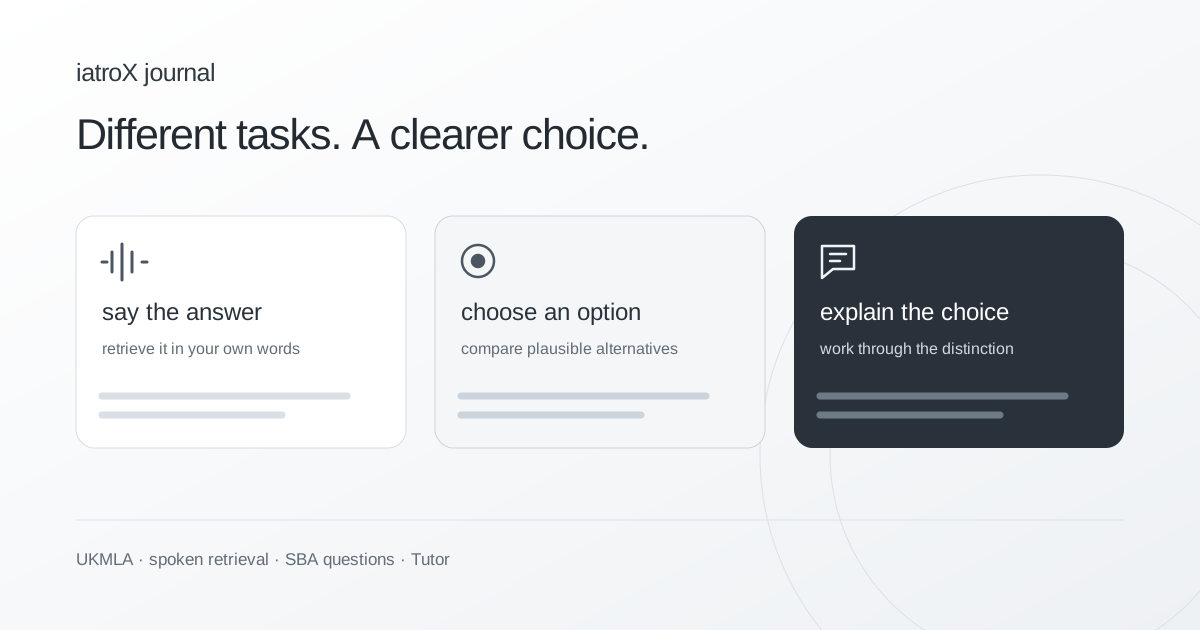
Clinify's spoken short-answer feature raises a more useful question than “which platform has the most questions?” What do you need to practise: recognising an answer, producing the key points without options, explaining your reasoning, or conducting a consultation?
Those tasks can complement each other, but they need different feedback. This guide is published by iatroX, so our own learning route appears first. It is a comparison of current advertised uses, checked on 1 November 2026, rather than an independent ranking or a report of hands-on product testing.
The practical takeaways:
- Compare UKMLA SBAs with SBAs; a total covering several question formats is a different measure.
- Check the plan: Clinify distinguishes self-marked short answers from voice answers and AI marking.
- Inspect a marked response as well as its score. Then choose the next exercise for the gap it reveals.
Spoken recall is a distinct practice task
Clinify's product page describes short answers that can be spoken, transcribed and marked against a scheme. It also advertises UKMLA SBAs, a knowledge map and case-based learning materials. The interesting distinction is the learner's task: producing an answer without first seeing a list of possibilities.
A short-answer marking scheme asks whether your response contains relevant points. A Socratic Tutor conversation asks you to examine how you reached an answer. A consultation exercise asks you to interact with a patient, choose questions and communicate a plan. Speaking into a microphone can be involved in more than one of these, but the microphone is not what defines the assessment.
The GMC distinguishes the MLA's AKT and CPSA components. Match practice to the task and your medical school's requirements. Here, AKT refers to the medical-school applied knowledge test, rather than the separate MRCGP exam.
Compare methods before comparing subscriptions
| Resource or method | What you practise | What to inspect |
|---|---|---|
| iatroX UKMLA bank and Tutor | Selecting an answer, reviewing its explanation and examining reasoning in context | Whether you can explain the distinction after the Tutor exchange |
| Clinify AKT practice | Answering UKMLA-style SBAs | The question's lead-in, alternative explanations and relevance to your syllabus |
| Clinify short answers | Producing marked points; voice and AI marking depend on the plan | The response transcript, expected points and feedback behind the result |
| iatroX CPSA consultation practice | Patient-facing consultation decisions and communication | The particular scenario and feedback, alongside your school's practical teaching |
The first decision is whether your current resource already supplies the method you need. If you select the correct option but struggle to explain why, another large SBA collection may be less relevant than a focused reasoning exercise. If you understand explanations yet repeatedly miss unfamiliar written decisions, keep unseen question practice in the plan.
Read Clinify's package boundaries carefully
The official pricing page separates its free Placebo offer, Standard Dose and Maximum Dose. Standard lists full question practice, textbooks and analytics, with self-marked short answers and no AI tools. Maximum adds voice answers and AI marking, Pocket Doc and an OSCE AI examiner. The free offer includes trial questions and a mock paper; it should be compared with a trial, rather than assumed to include every paid feature.
Read the chosen package before subscribing, especially if speaking rather than typing is the reason you are interested. In a study group, one person describing a higher-tier feature can otherwise create the mistaken impression that it is included in everyone's account.
The homepage also separates its overall mixed question total from its AKT subset. Do the same in your comparison: SBAs, short-answer parts and clinical cases are different units. A larger combined figure does not tell you how many distinct exam-style decisions you will practise.
One case, three different learning outputs
Consider an original study exercise about an adult with breathlessness. Do not begin by trying to complete every available mode. Choose one learning question, such as explaining which feature would make a proposed diagnosis less likely.
First, answer a written decision. Complete an unseen SBA before reading the explanation. Record why you chose the option and which alternative nearly persuaded you. This makes an uncertain correct answer visible, rather than letting the score hide it.
Second, retrieve a short answer. Close the options and explain the distinction briefly, by speaking or typing. If using voice marking, compare the transcript with what you intended to say before interpreting the result. Then inspect the expected points. Did you omit an idea, express it unclearly, or disagree with the suggested answer? Each possibility needs a different response: revision, clearer wording or checking the underlying source.
Third, investigate the reasoning gap. In iatroX Tutor, use an attempted iatroX question as the context. Ask about the tempting alternative or explain your own approach. The aim is to articulate why a detail changes the decision, rather than simply obtaining a longer model answer.
If your next need is a patient-facing explanation, move to a suitable consultation exercise or supervised teaching. A recalled list and an intelligible explanation to a patient are separate outputs. Judge each against its own purpose, rather than expecting one score to summarise them all.
Make a short trial answer a real buying question
Use one topic you know reasonably well and one you find difficult. This gives you a chance to evaluate both useful confirmation and unfamiliar feedback. Choose material you are permitted to use; write your own short summary instead of copying a paid bank's question into another service.
For each activity, note the time spent answering, the feedback you could act on and the next step you actually took. A tool may produce detailed feedback, but your purchasing decision should turn on whether you can use it within the study time available. Keep the tool that resolves a recurring problem and remove duplicate steps.
Clinify advertises a free 100-question, two-hour mock. Treat it as one-paper practice. The Medical Schools Council's official practice set contains two 100-item papers, with answer justifications. Use official materials to calibrate question style; a provider's mock or dashboard is a separate observation, rather than a guaranteed examination outcome.
Put the next step into your week
Use the study planner to preview a realistic schedule around your exam and available days. Reserve time to revisit the distinction you identified, then try an unfamiliar question that requires you to apply it. Your personal note should be specific enough that you know what to retrieve next time.
For iatroX question samples: Up to 10 new sample questions per day, shared across exams and subject to availability, with explanations and no account required.
One complete guided Tutor session is included with a verified free account; continued Tutor use is included in all-access. The introduction is one question with up to ten replies. Full UKMLA practice and continued Tutor use are included in all-access: £29/month or £99/year in the UK; US$29/month or US$99/year elsewhere
If the learning is relevant to clinical work, iatroX CPD can support a focused activity and a personal record that you review and confirm. Describe the actual change in your understanding and a follow-up action. An AI mark or generated reflection is not, by itself, professional credit.
Frequently asked questions
Are voice answers included in every Clinify plan?
The current pricing page assigns voice answers and AI short-answer marking to Maximum Dose. Standard Dose lists self-marked short answers. Check the selected package and trial terms before subscribing.
Is spoken short-answer practice the same as a CPSA consultation?
They practise different tasks. A short answer retrieves specified points; a consultation involves interaction and communication. Use your school's CPSA requirements to decide which practical teaching and preparation you need.
Can I try iatroX before buying full UKMLA access?
Yes. Anonymous question samples use the shared daily allowance. A verified account also includes one introductory Tutor session; ongoing Tutor and the full UKMLA bank require all-access.
Start with an answer, then explain it
Try UKMLA sample questions. Choose an answer, read the explanation and identify the one distinction you would like to explain more clearly.