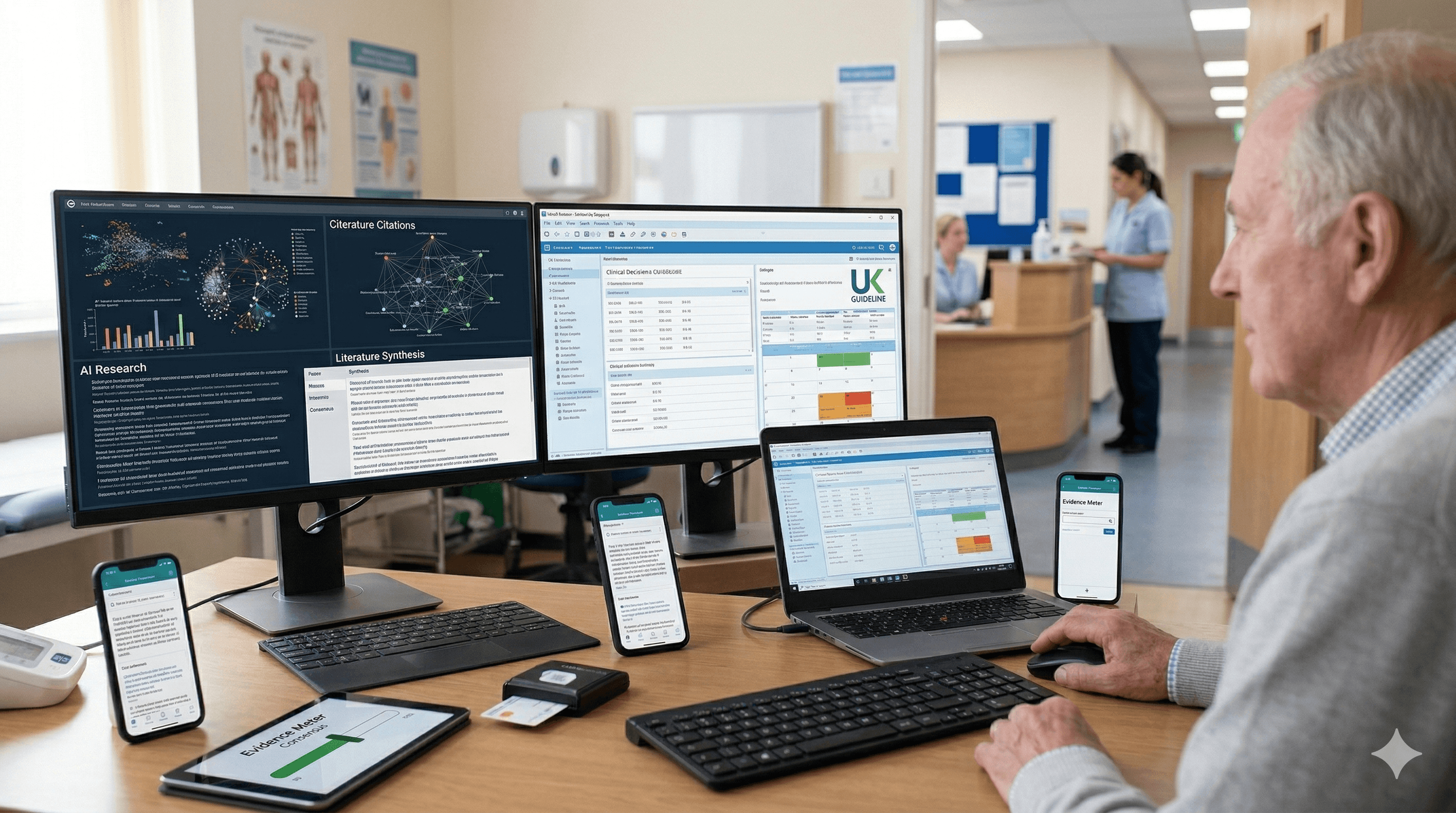
Key takeaways
- AI research tools and clinical decision support tools are different categories that solve different problems. Research tools summarise the literature. Clinical tools summarise the guidelines. Confusing them at the bedside is a patient safety risk.
- Elicit is the best tool for structured literature reviews and data extraction from multiple papers. Think of it as an AI research assistant that reads papers for you.
- Consensus is the best tool for quick, binary evidence questions ("Does X help with Y?"). Its Consensus Meter synthesises the weight of evidence into a visual signal.
- Semantic Scholar is the best free discovery engine for finding relevant papers, with AI-generated TLDRs and powerful citation graph visualisation. 200M+ papers indexed.
- Perplexity is the fastest general-purpose AI search engine with inline citations. It draws from the web and academic literature, making it versatile but less constrained than Elicit or Consensus.
- scite is the essential citation-context tool. It tells you not just that a paper was cited, but how — whether the citing paper supported, contradicted, or merely mentioned the original finding.
- For clinical decision-making at the point of care — where you need a guideline-grounded answer in 30 seconds, not a literature synthesis in 30 minutes — use a clinical tool like iatroX, UpToDate, or DynaMed instead.
The critical distinction: research tools vs clinical tools
This is the most important section of this article. If you take nothing else away, take this.
AI research tools (Elicit, Consensus, Semantic Scholar, Perplexity, scite) search the published literature — millions of peer-reviewed papers, preprints, and clinical trials. They synthesise what the research says. They are designed for evidence exploration, literature reviews, and answering questions where you need to understand the weight of evidence across multiple studies.
Clinical decision support tools (iatroX, UpToDate, DynaMed, BMJ Best Practice, ClinicalKey AI, OpenEvidence) synthesise guidelines and curated clinical content. They are designed for point-of-care decisions — "What is the first-line treatment for this patient?" — and their content is filtered through an editorial and regulatory lens.
The danger: A research tool that finds 15 papers suggesting a treatment works is not the same as a clinical tool that tells you the treatment is recommended by NICE. The papers may be low-quality, the populations may not match your patient, and the guideline body may have reviewed and rejected the evidence. Research tools are for exploring. Clinical tools are for deciding.
Use the right tool for the right job:
| Job | Tool category | Examples |
|---|---|---|
| "What does the literature say about X?" | Research tool | Elicit, Consensus, Semantic Scholar |
| "What should I do for this patient according to current guidelines?" | Clinical tool | iatroX, UpToDate, DynaMed, BMJ Best Practice |
| "Has this specific trial been contradicted?" | Citation-context tool | scite |
| "Quick, broad search with citations" | General AI search | Perplexity |
The five tools, compared
1. Elicit — the AI research assistant
What it does: Elicit is an AI-powered research assistant that helps you find, read, and extract data from academic papers. You ask a research question; Elicit searches 138M+ papers (plus 545K clinical trials), identifies the most relevant, and presents structured summaries. Its killer feature is data extraction — you can define columns (sample size, methodology, key findings, side effects) and Elicit populates a table across dozens of papers automatically.
Best for: Systematic reviews, literature reviews, evidence synthesis, and any task where you need to compare findings across multiple papers.
Architecture: Semantic search over academic databases, enhanced by LLM-powered summarisation and extraction. It reads the actual papers, not just abstracts.
Pricing: Free tier (5,000 credits/month). Plus plan from $12/month for heavier use. Institutional plans available.
Strengths: Unmatched for structured data extraction. Reproducible search strategies. Excellent for building evidence tables.
Limitations: Focused on the search-and-extract phase; does not offer deep synthesis or knowledge visualisation. Not designed for clinical point-of-care use.
Medical use case: You are writing a review of SGLT2 inhibitors in heart failure. Elicit finds 40 relevant trials, extracts the sample size, endpoint, and result from each, and presents them in a sortable table — work that would take days done manually.
2. Consensus — the evidence yes/no engine
What it does: Consensus is an AI search engine built exclusively on peer-reviewed literature (~200M papers via Semantic Scholar). Its unique feature is the Consensus Meter — when you ask a question (e.g., "Does zinc supplementation reduce the duration of the common cold?"), it searches the literature, extracts findings, and displays a visual indicator of whether the evidence generally says "Yes," "No," or "Possibly," with links to the supporting papers.
Best for: Answering specific, binary-style research questions quickly. "Does X cause Y?" "Is A more effective than B?" "Is there evidence for C in population D?"
Architecture: Semantic search over Semantic Scholar's academic database, with LLM-powered finding extraction and aggregation.
Pricing: Free tier with limited searches. Pro plans available for heavier use.
Strengths: The Consensus Meter is genuinely useful for getting a rapid sense of the evidence landscape. Excellent for journal club preparation or quickly checking whether a clinical hunch has literature support.
Limitations: Works best for binary questions with clear outcomes. Less useful for nuanced, multi-faceted research questions. The Meter can oversimplify — a "Yes" from 10 small studies is not the same as a "Yes" from one large RCT.
Medical use case: A patient asks whether melatonin helps with jet lag. You open Consensus, ask the question, and the Meter shows strong "Yes" support with links to the key trials — a 30-second evidence check.
3. Semantic Scholar — the free discovery engine
What it does: Developed by the Allen Institute for AI, Semantic Scholar indexes 200M+ academic papers and uses AI to understand research context and relationships. Its standout features are TLDR (one-sentence AI summaries of abstracts), citation graphs (visual maps of how papers relate to each other), and Research Feeds (alerts for new papers matching your interests).
Best for: Discovering relevant papers, understanding the citation landscape, and staying current with new publications in your field.
Architecture: AI-powered semantic search with NLP-based paper understanding. Entirely free.
Pricing: Free. No subscription, no credit limits.
Strengths: The best free tool for paper discovery. The citation graph is powerful for tracing the lineage of an idea from foundational work to current research. TLDR summaries let you scan 50 papers in the time it takes to read 5 abstracts.
Limitations: Primarily a discovery tool, not an analysis tool. It helps you find papers; you still need to read and synthesise them yourself (or use Elicit/Consensus for that step).
Medical use case: You are starting research into AI-assisted dermatoscopy. Semantic Scholar helps you find the seminal papers, trace the citation network, and set up alerts for new publications — building your mental map of the field in an afternoon.
4. Perplexity — the fast general-purpose AI search
What it does: Perplexity is a conversational AI search engine that provides cited answers to any question, drawing from web pages, academic papers, and other sources. It is not restricted to peer-reviewed literature — it searches the entire web but provides inline citations so you can verify claims.
Best for: Quick, broad research questions where you need a cited answer fast and the question may span clinical, regulatory, commercial, or general knowledge domains.
Architecture: LLM-powered search with retrieval from multiple web and academic sources.
Pricing: Free tier. Pro plan ($20/month) for more capable models and deeper research.
Strengths: Extremely fast. Versatile — handles clinical, regulatory, and general questions. The inline citations make it much more trustworthy than a generic chatbot.
Limitations: Draws from the open web, which includes low-quality sources alongside high-quality ones. Less constrained than Elicit or Consensus, which means more versatility but less rigour. Not appropriate as a sole source for clinical decisions.
Medical use case: You want to understand the current FDA regulatory position on AI-enabled wearable medical devices. Perplexity searches the web, finds the January 2026 FDA guidance documents, relevant STAT News articles, and IEEE Spectrum analysis, and synthesises a cited summary in seconds.
5. scite — the citation-context checker
What it does: scite analyses how papers cite each other — not just that paper A cites paper B, but whether paper A supports, contradicts, or merely mentions the findings of paper B. Its Smart Citations system has analysed over 1.2 billion citation statements across 200M+ sources.
Best for: Verifying the reliability of a key paper before you cite it or base a clinical decision on it. Checking whether a landmark trial has been replicated, contradicted, or retracted.
Architecture: NLP-based analysis of citation context across the global academic literature.
Pricing: Free tier with limited searches. Institutional and individual plans available.
Strengths: Unique capability — no other tool tells you how a paper has been received by the subsequent literature. Essential for evidence appraisal.
Limitations: It tells you about citation context, not about the quality of the citing papers. A paper could be "supported" by 10 low-quality studies and "contradicted" by one high-quality RCT — scite shows both, but the interpretation is yours.
Medical use case: You are about to cite a 2019 trial on a novel anticoagulant in your audit presentation. Before you do, you check scite — and discover that two subsequent studies with larger sample sizes contradicted the primary finding. You revise your conclusion.
The practical research workflow
Here is how to combine these tools for a real medical research task:
Phase 1: Discovery
Tool: Semantic Scholar (free) + Consensus (for a quick evidence check)
Start by mapping the landscape. Use Semantic Scholar to find the key papers, trace the citation network, and identify the seminal reviews. Use Consensus for a rapid sense of "what does the literature generally say?"
Phase 2: Deep extraction
Tool: Elicit
Upload your shortlisted papers (or search within Elicit). Define the data points you need (sample size, population, intervention, outcome, effect size). Let Elicit's AI extract structured data across all papers into a table. This is your evidence base.
Phase 3: Verification
Tool: scite
Before you draw conclusions, check the reliability of your key papers. Have the landmark trials been replicated or contradicted? Are there retraction concerns? scite gives you the citation context that PubMed alone cannot.
Phase 4: Quick reference checks
Tool: Perplexity
For questions that fall outside the peer-reviewed literature — regulatory positions, drug pricing, clinical pathway details, conference abstracts not yet indexed — Perplexity fills the gaps with cited web search.
Phase 5: Clinical application
Tool: iatroX (for UK guidelines) or UpToDate / DynaMed (for international reference)
When you move from research to clinical practice, switch to a clinical decision support tool. The literature may say one thing; the guideline may say another. Use Ask iatroX to check what NICE, CKS, or SmPC/emc recommends for the specific clinical scenario. Use iatroX Brainstorm to think through how the research applies to your patient's specific context.
The comparison table
| Feature | Elicit | Consensus | Semantic Scholar | Perplexity | scite |
|---|---|---|---|---|---|
| Primary job | Literature review & data extraction | Quick evidence synthesis | Paper discovery | General AI search | Citation-context analysis |
| Database | 138M+ papers + 545K trials | ~200M papers (via Semantic Scholar) | 200M+ papers | Web + academic | 1.2B+ citation statements |
| Unique feature | Structured data extraction tables | Consensus Meter (Yes/No/Possibly) | TLDR summaries + citation graph | Inline-cited web answers | Supporting/contradicting/mentioning analysis |
| Best for | Systematic reviews, evidence tables | Binary evidence questions | Discovering papers, staying current | Broad, fast research questions | Verifying reliability of cited papers |
| Free tier | Yes (5,000 credits/month) | Yes (limited) | Fully free | Yes (limited) | Yes (limited) |
| Paid plan | From $12/month | Pro available | Free | $20/month (Pro) | Institutional/individual plans |
| Clinical point-of-care use? | No — research tool | No — research tool | No — discovery tool | Partial (with caution) | No — verification tool |
| Constrained to peer-reviewed lit? | Yes | Yes | Yes | No (web + academic) | Yes |
| Medical-specific? | Not exclusively, but strong in medicine | Not exclusively, but strong in medicine | All fields | All fields | All fields |
Where iatroX fits: from research to the bedside
These five tools are powerful for research. But when the question is not "What does the literature say?" but "What should I do for this patient right now?", you need a different kind of tool.
iatroX bridges the gap between research and clinical practice for UK clinicians. It does not search the open literature — it retrieves guideline-grounded answers from NICE, CKS, SIGN, emc, and other trusted UK sources. Every answer is cited, every recommendation is traceable, and the platform is MHRA-registered as a medical device.
The workflow is complementary:
- Research phase: Use Elicit, Consensus, Semantic Scholar, Perplexity, and scite to explore the evidence.
- Clinical phase: Use iatroX to check what the UK guidelines say, use Brainstorm to think through the differential, and use iatroX Quiz to reinforce the learning.
- CPD phase: Log the research question and reflection as CPD evidence using iatroX's CPD export.
Research tools make you smarter. Clinical tools keep your patients safe. Use both — but never confuse which is which.
FAQs
Can I use Elicit or Consensus for clinical decisions?
With extreme caution. These tools summarise the literature, not the guidelines. The literature may contain conflicting evidence, low-quality studies, or findings that guideline bodies have reviewed and rejected. For bedside decisions, use a clinical decision support tool like iatroX, UpToDate, or DynaMed.
Is Semantic Scholar really free?
Yes, completely. No subscription, no credit limits, no paywalls. It is funded by the Allen Institute for AI.
Which tool is best for a systematic review?
Elicit. Its structured data extraction capability — defining columns and auto-populating a table across dozens of papers — is purpose-built for this task.
Can I use Perplexity for medical research?
Yes, but with awareness that it searches the open web as well as academic databases. Verify any clinical claim against a peer-reviewed source or guideline.
How does scite differ from checking a paper's citation count?
Citation count tells you how many times a paper was cited. scite tells you how — whether the citing papers supported, contradicted, or merely mentioned the finding. A paper with 500 citations that has been contradicted by 50 of them is very different from one with 500 supporting citations.
Related reading on iatroX
- AI medical search engines that cite sources: Perplexity, Elicit, Consensus, and Semantic Scholar
- Beyond UpToDate: 5 new clinical reference apps clinicians should know (2026)
- 2025's new guard of clinical AI: CDSS and knowledge retrieval
- DynaMed vs UpToDate vs BMJ Best Practice vs ClinicalKey AI vs iatroX (2025)
- Free AI apps for doctors in 2025: what's genuinely free and what isn't
- Risks of general AI for medical advice in the UK
- Introducing iatroX Brainstorm: your AI co-pilot for clinical reasoning