For twenty years, "checking the literature" meant one thing: opening UpToDate. It was the gold standard—authoritative, comprehensive, and comfortably familiar.
But in 2026, the paradigm has shifted. We have moved from Reference (browsing chapters) to Answer Engines (asking questions).
The "new wave" of clinical tools isn't just about digitising textbooks; it's about using Retrieval-Augmented Generation (RAG) to synthesize millions of papers into a single, cited answer in seconds. But with speed comes risk. This guide reviews the five major players you need to know, and how to verify their output without slowing down.
The 2026 checklist: what a “good” reference app must do
Before you download anything, run it against this safety filter. In 2026, a clinical AI tool is only as good as its constraints.
Five non-negotiables
- Clear sourcing / citations: Does every sentence link back to a primary paper or guideline? If it's a "black box," delete it.
- Transparent scope: Does it admit when it doesn't know? (e.g., "No evidence found for this specific interaction").
- Content Provenance: Is it reading the "whole internet" (dangerous) or a "curated library" (safer)?
- Safe UX for uncertainty: Does it flag "Low Confidence" or "Conflicting Evidence"?
- Data handling posture: Is your query used to train their model? (For patient specific queries, this must be a hard "No").
The 5 apps
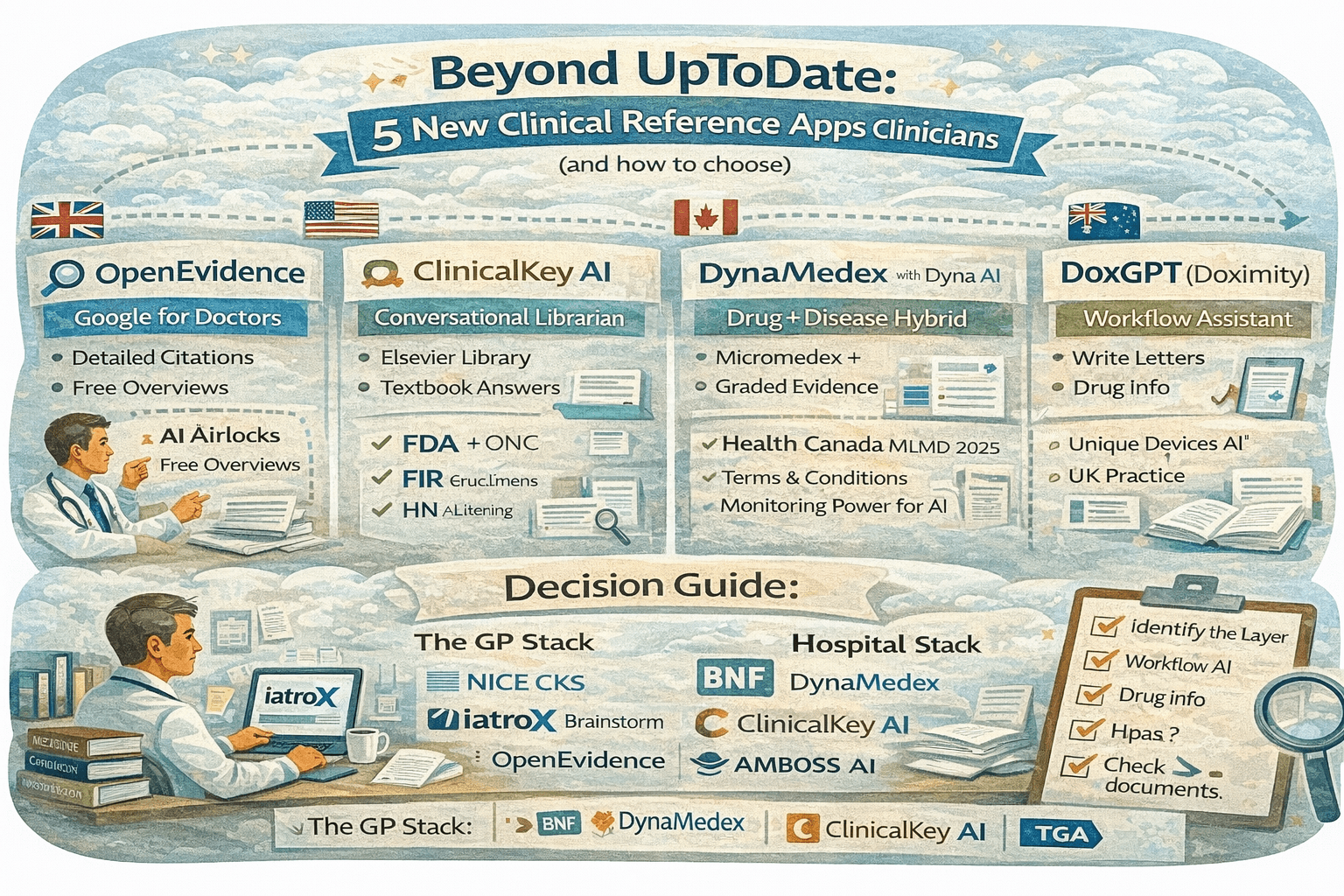
We have selected the five "Answer Engines" that have defined the 2026 landscape.
1. OpenEvidence
What it is: The "Google for Doctors." A free, clinician-only search engine that reads 35 million+ peer-reviewed papers to generate cited answers. Best for: The specific, niche question that isn't in a guideline (e.g., "Prevalence of Long COVID in patients with existing mitral valve prolapse"). Strengths:
- Depth: It reads the "long tail" of literature that human editors miss.
- Traceability: Every claim has a clickable superscript citation.
- Price: Free for verified US healthcare professionals (ad-supported). Limitations:
- US-Centric: Often defaults to FDA approvals and US guidelines.
- "Paper-bias": It treats all published papers as "evidence," sometimes failing to weight a small trial against a major meta-analysis. How I’d use it in a 10-minute consult:
- Scenario: Patient asks about a new supplement mentioned in a newspaper.
- Action: Ask OpenEvidence for "Safety profile of [Supplement] and interaction with Warfarin." Scan the summary, click the top 2 papers to verify. Where iatroX fits: OpenEvidence is your "Search Engine." iatroX is your "Reasoning Engine." Use OpenEvidence to find the fact; use iatroX to reason through the case.
2. ClinicalKey AI (Elsevier)
What it is: The "Conversational Librarian." It uses GenAI to chat with Elsevier’s massive library of 1,000+ textbooks and 600+ journals. Best for: Deep dives where you want "textbook quality" reliability but "chatbot speed." Strengths:
- Content Authority: It is grounded in trusted sources (Gray's Anatomy, Braunwald's Heart Disease), not random PDFs.
- Rationale: It explains why it gave the answer, often showing the "Considerations" behind the logic.
- Visuals: Can surface diagrams and flowcharts from the source books. Limitations:
- Cost: Institutional subscriptions are expensive.
- Lag: Can be slightly slower than a raw search engine due to the "reasoning" layer. How I’d use it in a 10-minute consult:
- Scenario: Complex pathophysiology question from a medical student.
- Action: "Explain the mechanism of action of SGLT2 inhibitors in heart failure," and show the diagram on the screen.
3. DynaMedex with Dyna AI
What it is: The "Drug + Disease Hybrid." EBSCO’s answer engine that combines DynaMed (disease monographs) with Micromedex (drug data). Best for: The pharmacist-clinician workflow. Checking interactions and dosing in complex patients. Strengths:
- Hybrid Power: Seamlessly bridges "Treatment of Pneumonia" (DynaMed) with "Gentamicin dosing in renal failure" (Micromedex).
- Evidence Grading: Explicitly tags claims with Level 1 (Likely Reliable) to Level 3 (Lacking Direct Evidence).
- Safety: The "Dyna AI" layer is strictly constrained to the curated content; it does not hallucinate from the web. Limitations:
- UI Density: The interface can be busy for a quick 30-second check. How I’d use it in a 10-minute consult:
- Scenario: Prescribing a new antibiotic to a patient on 12 medications.
- Action: Use the AI to "Check interactions between Linezolid and this medication list," then verify the severity flags.
4. AMBOSS AI
What it is: The "Exam-to-Ward Bridge." A learning ecosystem that has added an "AI Mode" to its library, acting as a study assistant and clinical guide. Best for: Medical students, Foundation Doctors (FY1/2), and trainees preparing for exams. Strengths:
- Educational Integration: Links answers back to the QBank and learning cards.
- On-the-fly Learning: Can explain a concept "like I'm a student" or "like I'm a consultant."
- Hallucination Control: Restricted strictly to the AMBOSS library. Limitations:
- Depth: Less suited for ultra-specialist consultant queries than OpenEvidence. How I’d use it in a 10-minute consult:
- Scenario: Junior doctor double-checking a protocol before presenting on the ward round.
- Action: "Summarise the management of hyperokalaemia according to the latest guidlines," to refresh memory instantly.
5. DoxGPT (Doximity)
What it is: The "Workflow Assistant." Part of the Doximity app (US-heavy), it combines a GPT-4 class model with "Instant Answers" for drugs. Best for: Admin tasks (drafting letters) + quick drug lookups. Strengths:
- Workflow: Writes appeal letters, patient instructions, and referral notes instantly.
- Speed: "Instant Answers" feature bypasses the AI for simple drug stats (dosing, interactions) to ensure 100% accuracy.
- Hipaa: Enterprise-grade privacy for US clinicians. Limitations:
- US-Centric: Heavily tied to the US healthcare system (billing, insurance letters).
- Less "Reference" focused: More of a utility tool than a pure knowledge base. How I’d use it in a 10-minute consult:
- Scenario: Need to write a "Letter of Medical Necessity" for insurance.
- Action: Dictate the key clinical points and have DoxGPT draft the formal letter in 10 seconds.
Decision guide: 3 stacks depending on your role
One app is rarely enough. Build your "Stack" based on your workflow.
The GP Stack:
- Baseline: NICE CKS (The Rules).
- Quick Check: iatroX Brainstorm (The Thinking).
- Deep Dive: OpenEvidence (The Search).
The Hospital Stack:
- Baseline: Hospital Intranet / MicroGuide (Local Policy).
- Drugs: DynaMedex / organisation-approved medicines-reference app.
- Complexity: ClinicalKey AI (Pathology/Textbooks).
The Student/Trainee Stack:
- Baseline: AMBOSS (Library + QBank).
- Reasoning: iatroX (Brainstorm + Exam Prep).
- Pocket: MDCalc (Scores).
Safety: where clinicians get burned
The danger in 2026 is not "no information," but "confident misinformation."
- Provenance: Always ask "Where did you read that?" An AI that synthesises a Reddit thread looks the same as one that synthesises NEJM.
- Drift: Guidelines change. An AI trained on 2023 data might recommend a drug that was withdrawn in 2025. Always check the date of the source citations.
FAQ
Is OpenEvidence a substitute for UpToDate? For specific, niche questions, it can be faster and more granular. However, UpToDate remains superior for broad, curated topic overviews ("Management of Diabetes") where you need a structured, expert-authored narrative rather than a list of papers.
What is ClinicalKey AI built on? It is built on a RAG (Retrieval-Augmented Generation) architecture that references only Elsevier's proprietary content (journals like The Lancet, books like Gray's Anatomy). It does not search the open web.
Is Dyna AI only using DynaMed content? Dyna AI uses content from both DynaMed (disease topics) and Micromedex (drug information). This combination allows it to answer complex clinical questions that span both pathology and pharmacology safely.