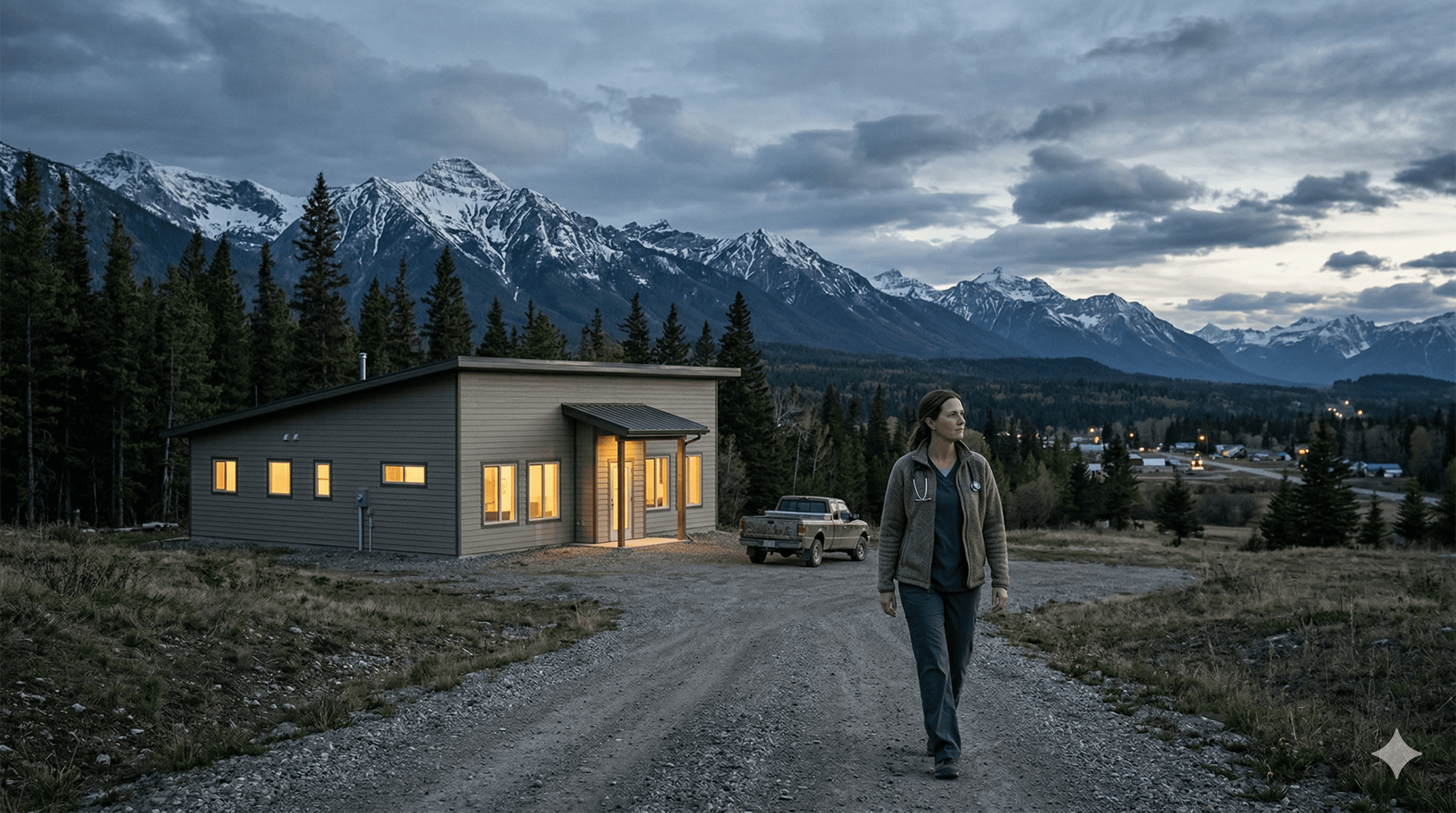
If you're taking the PRA route to Canadian practice, you will almost certainly spend your first 2–3 years in a rural community. If you're recruited through a provincial health authority incentive programme, same thing. Rural and underserved communities are where Canada needs doctors — and they're where Canada sends them.
For UK GPs whose experience is suburban or urban NHS practice, "rural Canada" is not rural England. Here's what it actually means.
The clinical scope
This is the best part. Rural Canadian GPs are generalists in a way that UK GPs haven't been for decades.
Your typical week might include: Morning clinic (rostered patients — chronic disease, preventive care, acute presentations). Afternoon ER shift (trauma, chest pain, paediatric emergencies, overdoses, psychiatric crises). Evening on-call from home (phone triage, callbacks, emergency callouts). Weekly obstetric clinic (antenatal care). Monthly OR list (assisting with or performing caesarean sections under GP anaesthesia). Inpatient rounds (managing your admitted patients on the hospital ward).
This is not an exaggeration for many rural Canadian communities. When you're the only doctor (or one of two or three), you do everything. If you enjoyed the variety of foundation training — seeing something different every hour — rural Canada is the closest you'll get to that feeling as an independent practitioner.
Skills you may need to acquire or refresh: Emergency intubation, chest drain insertion, central line placement, procedural sedation, basic obstetric ultrasonography, neonatal resuscitation, fracture reduction, and laceration repair. Many provinces offer enhanced skills training programmes for rural-bound physicians — take advantage of these before starting.
The isolation
Let's be direct: some rural Canadian communities are genuinely remote.
"Rural" in England means a village 20 minutes from a district general hospital, with a Tesco Express and reliable mobile signal.
"Rural" in Canada can mean a community of 800 people, 3 hours by road from the nearest hospital with a CT scanner, with no mobile signal for 100km in any direction, accessible only by ice road in winter, and with temperatures that reach -40°C for weeks at a time.
Not all rural placements are this extreme. Many ROS communities are small towns (population 3,000–15,000) within 1–2 hours of a regional centre. But some are genuinely remote — particularly in northern BC, Saskatchewan, Manitoba, Ontario, and the Atlantic provinces.
The clinical implications of isolation: When the nearest specialist is 3 hours away (or accessible only by medevac), your clinical decision-making carries different weight. You manage things that a UK GP would refer. You stabilise patients for transport that in the UK would arrive by ambulance in 15 minutes. You develop clinical confidence — and clinical anxiety — faster than in any other practice setting.
Telemedicine helps but doesn't solve everything. Virtual specialist consultations are increasingly available, and most rural communities have reasonable internet connectivity. But a video call with a dermatologist doesn't replace a biopsy, and a phone discussion with an intensivist doesn't replace an ICU bed.
The income
Rural physicians in Canada generally earn more than their urban counterparts. The reasons: higher billing volumes (you see more patients because there are fewer doctors), procedural income (ER shifts, obstetrics, and hospital work generate additional billings), and provincial incentive programmes that provide bonuses, relocation assistance, and fee premiums for rural practice.
Typical rural GP gross billings: CAD $400,000–$500,000+ — higher than the Canadian average of ~$369K. After lower overhead (clinic space in rural communities is cheaper) and provincial incentives, net income is often CAD $200,000–$280,000.
Add to that: lower cost of living (housing in rural Saskatchewan or Nova Scotia is a fraction of Vancouver or Toronto), provincial student loan forgiveness programmes (some provinces forgive medical school debt for rural physicians), and relocation assistance (moving costs, temporary housing, sometimes a signing bonus).
The lifestyle
The good: Community. Space. Nature. Clean air. Knowing your patients as people. Being valued — genuinely, personally valued — by a community that needs you. Outdoor activities: skiing, fishing, hiking, hunting, canoeing — depending on region. Safe environment for raising children. Lower cost of living. Less traffic, less noise, less urban stress.
The challenging: Limited dining, entertainment, and cultural options. Fewer educational choices for children (though rural Canadian schools are often good). Social isolation — particularly if your partner doesn't work locally or you don't have a pre-existing social network. The weather (this cannot be overstated for Prairie and northern placements). Limited spousal employment opportunities in some communities. On-call burden — with fewer doctors, your call frequency is higher. Burnout risk — the same clinical breadth that's rewarding can become overwhelming without adequate locum coverage for breaks.
The honest filter question: Could you be happy in a community where the nearest cinema is 2 hours away, winter lasts 5 months, and your social life revolves around the people in town? If yes — genuinely yes, not reluctantly yes — rural Canada can be extraordinary. If the answer is "I'll tolerate it for 3 years," that's a valid strategy, but go in with eyes open.
What UK doctors who've done it say
The consistent feedback from UK GPs who've moved to rural Canada:
Clinically, it's the most stimulating practice they've experienced. The scope is broader than anything available in UK general practice. The clinical autonomy is higher. The variety is incomparable.
Personally, it's either transformative or isolating — and the difference usually correlates with whether their partner and family were genuinely on board, whether they engaged with the community (joined things, showed up, said yes to invitations), and whether they had realistic expectations about the lifestyle before arriving.
Most would do it again. Not all stay rural permanently — many complete their ROS and move to a regional centre or city. But the clinical skills, confidence, and professional identity built during rural practice stay with them for the rest of their careers. Several UK-to-Canada GPs describe their rural years as the period that made them the doctors they wanted to be.
Preparing for rural practice
Take an Enhanced Skills programme if your province offers one. These 6–12 month programmes provide focused training in emergency medicine, anaesthesia, obstetrics, or surgery for rural-bound physicians. They're the best investment of time before starting rural practice.
Refresh your procedural skills. Attend ALS/ACLS, NRP (neonatal resuscitation), and ALSO (Advanced Life Support in Obstetrics) courses before starting.
Visit the community. In winter. Meet the other doctors, the nurses, and the community. Make an informed decision.
Bring your family into the decision. The doctors who thrive in rural Canada are those whose families chose it together. The ones who struggle are those who made the decision alone and expected everyone else to adapt.
iatroX supports doctors building careers in any setting with AI clinical search — evidence-based answers at the point of care, whether that's a London surgery or a northern Saskatchewan ER. MCCQE1 qbank for Canadian exam preparation.