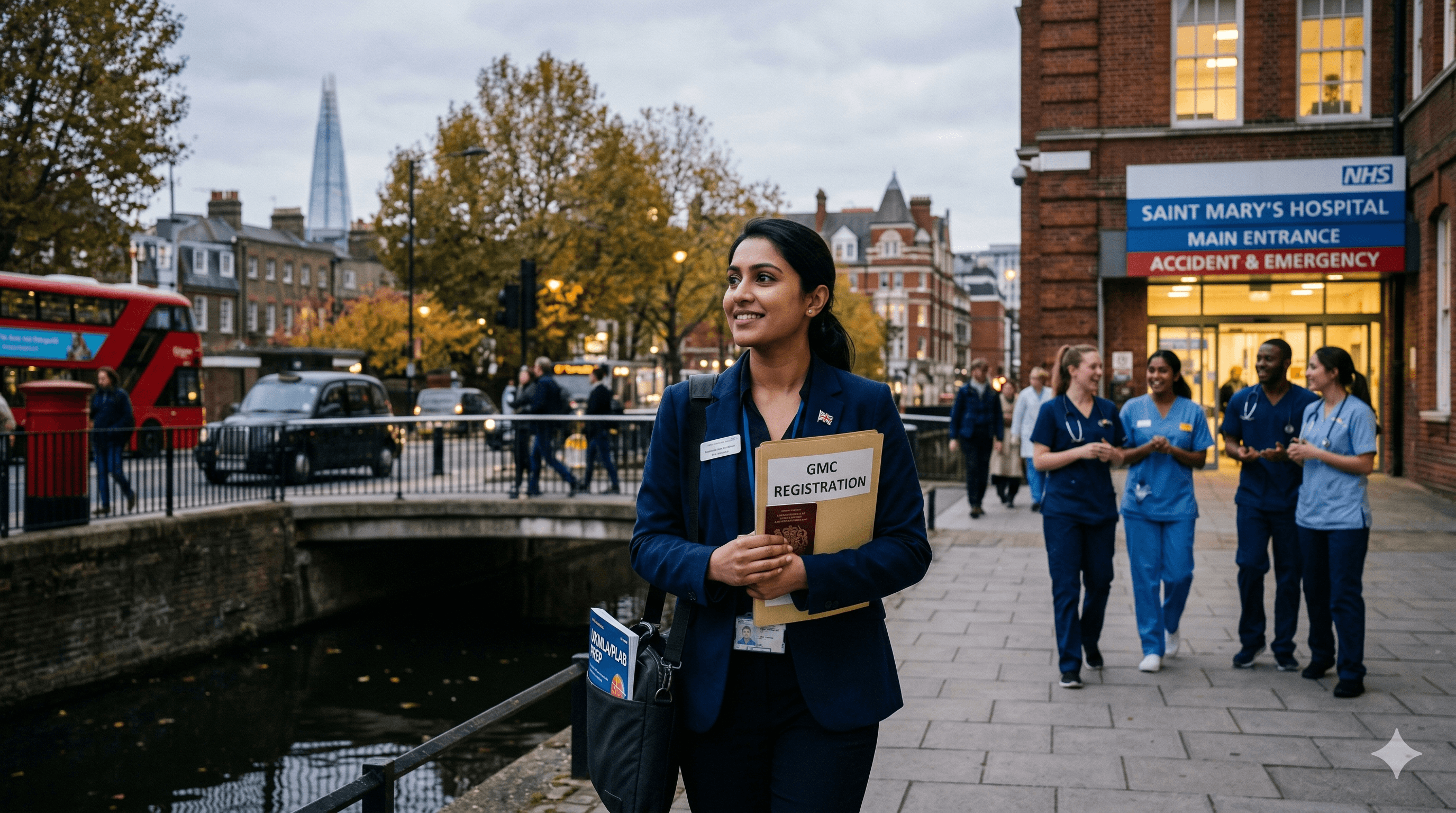
Every year, thousands of international medical graduates move to the UK to practise medicine. The NHS depends on them — IMGs constitute roughly a third of the medical workforce. But the pathway from "I have a medical degree" to "I'm working as a doctor in the UK" is bureaucratically dense, poorly documented, and full of steps where wrong choices cost months or years.
This guide covers the entire journey: registration, exams, language requirements, visas, job applications, and the practical realities of working in the NHS as an IMG.
Step 1: GMC Registration — the gateway
To practise medicine in the UK, you need registration with the General Medical Council (GMC). For IMGs, this means meeting three requirements: an acceptable primary medical qualification (PMQ), English language proficiency, and a knowledge assessment.
Acceptable PMQ: Your medical degree must be listed in the World Directory of Medical Schools (WDOMS) and the issuing institution must be one the GMC recognises. Check the GMC website with your specific medical school before proceeding — discovering your qualification isn't recognised after you've moved is devastating.
English language: IELTS Academic (minimum 7.0 in each component, 7.5 overall) or OET (minimum B in each component). The OET is healthcare-specific and many doctors find it more natural than IELTS. Both are accepted equally by the GMC. Scores are valid for two years from the test date. Take the test early — it's often the slowest step because achieving the required scores can take multiple attempts.
Knowledge assessment: PLAB (Professional and Linguistic Assessments Board) or UKMLA (UK Medical Licensing Assessment), depending on timing and eligibility. PLAB 1 is an SBA exam testing clinical knowledge. PLAB 2 is a clinical OSCE. The UKMLA is gradually replacing PLAB — check the current transition timeline on the GMC website. If you've passed USMLE/MCCQE or certain other recognised exams, you may be exempt from PLAB/UKMLA under mutual recognition agreements.
The iatroX PLAB/UKMLA guide covers the comparison in detail.
Step 2: PLAB/UKMLA preparation
PLAB 1 / UKMLA Applied Knowledge Test: 180 SBA questions, 3 hours. Tests clinical knowledge across medicine, surgery, psychiatry, paediatrics, obstetrics, and clinical sciences. The content overlaps significantly with UK undergraduate finals. Resources: iatroX UK qbank, PassMedicine PLAB, PLABable, AMBOSS. Focus on UK guidelines (NICE, CKS) rather than your home country's practice — the exam tests UK clinical standards.
PLAB 2 / UKMLA Clinical Assessment: OSCE format with 16 stations testing clinical and communication skills. This is where many IMGs struggle — not because of clinical knowledge but because of communication style differences. UK OSCE stations reward structured, patient-centred communication with explicit safety-netting and shared decision-making. Practise with UK-trained doctors if possible.
Step 3: Visa and right to work
Health and Care Worker visa (subclass of Skilled Worker visa): The most common route. Requires a job offer from an NHS trust or practice with a sponsor licence. Benefits: reduced visa fees, exemption from the Immigration Health Surcharge, and a pathway to settlement. Processing time: typically 3–8 weeks.
Key requirements: Certificate of Sponsorship (CoS) from your employer, proof of English language (your GMC registration satisfies this), proof of funds (£1,270 in your bank account for 28 consecutive days, unless your sponsor certifies your salary), and TB test certificate (if from a listed country).
Dependants: Your spouse/partner and children under 18 can apply as dependants on the same visa. They have full work rights in the UK.
Settlement (ILR): After 5 years on a Health and Care Worker visa, you can apply for Indefinite Leave to Remain (settlement). This removes the link between your visa and your employer.
Step 4: Finding a job
Foundation programme: If you're coming to the UK at the beginning of your career, you may enter the Foundation Programme through the IMG-specific application stream. Competition is high and places are limited.
Trust-grade / clinical fellow / locally employed doctor (LED) posts: The most common entry point for IMGs. These are non-training posts at NHS trusts, usually at SHO or registrar level. They provide clinical experience, references, and — critically — the NHS track record needed for specialty training applications. Search on NHS Jobs, BMJ Careers, and trust websites directly.
GP posts: With full GMC registration and the right to work, you can apply for salaried GP posts or locum work. GP practices with high vacancy rates (typically in less popular geographic areas) are often the most receptive to IMG applicants.
Recruitment agencies: Agencies like BDI Resourcing, TTM Healthcare, and MSI Group specialise in placing IMGs in NHS posts. They can handle visa sponsorship logistics and are especially useful for your first UK post.
Step 5: Practical settling in
Indemnity: NHS work is covered by state indemnity (CNSGP). Consider additional advisory membership with MDU or MPS for GMC support and non-NHS cover.
Bank account: High-street banks typically require proof of address. Monzo and Starling offer accounts without proof of address and can be opened before you arrive — useful for receiving your first salary.
Accommodation: NHS trusts sometimes offer temporary accommodation for new international staff. Ask the medical staffing department before you arrive.
RCGP/Royal College membership: Associate membership of the relevant Royal College for your specialty demonstrates commitment on training applications and provides access to resources, events, and networking.
Cultural adjustment. The NHS has its own culture: multidisciplinary team working, structured handovers, the "see-and-treat" model in emergency medicine, the GP gatekeeper role, shared decision-making in consultations. None of these are universal globally. The IMGs who adjust fastest are those who observe actively in their first weeks, ask questions without assuming, and build relationships with nursing and allied health colleagues — not just other doctors.
The honest picture
The IMG pathway to UK practice is achievable but genuinely demanding. The bureaucratic steps (GMC registration, language tests, visa applications) are time-consuming and expensive — budget £3,000–£6,000 for exams, language tests, visa fees, and flights before you earn your first NHS salary. The clinical adjustment is real: UK medicine is practiced differently from most other health systems, and the communication expectations are specific and high.
But the opportunity is genuine. The NHS needs IMGs, the training pathways are open (GP training is actively recruiting internationally), and the UK offers career progression, professional development, and — eventually — settlement and citizenship.
The doctors who do best are those who prepare thoroughly, arrive with realistic expectations, and treat the first year as an investment rather than a destination.
iatroX supports IMGs with UK exam preparation (PLAB, UKMLA, AKT), AI clinical search covering NICE/CKS guidelines, and IMG pathway guides. Built by a practising NHS GP.