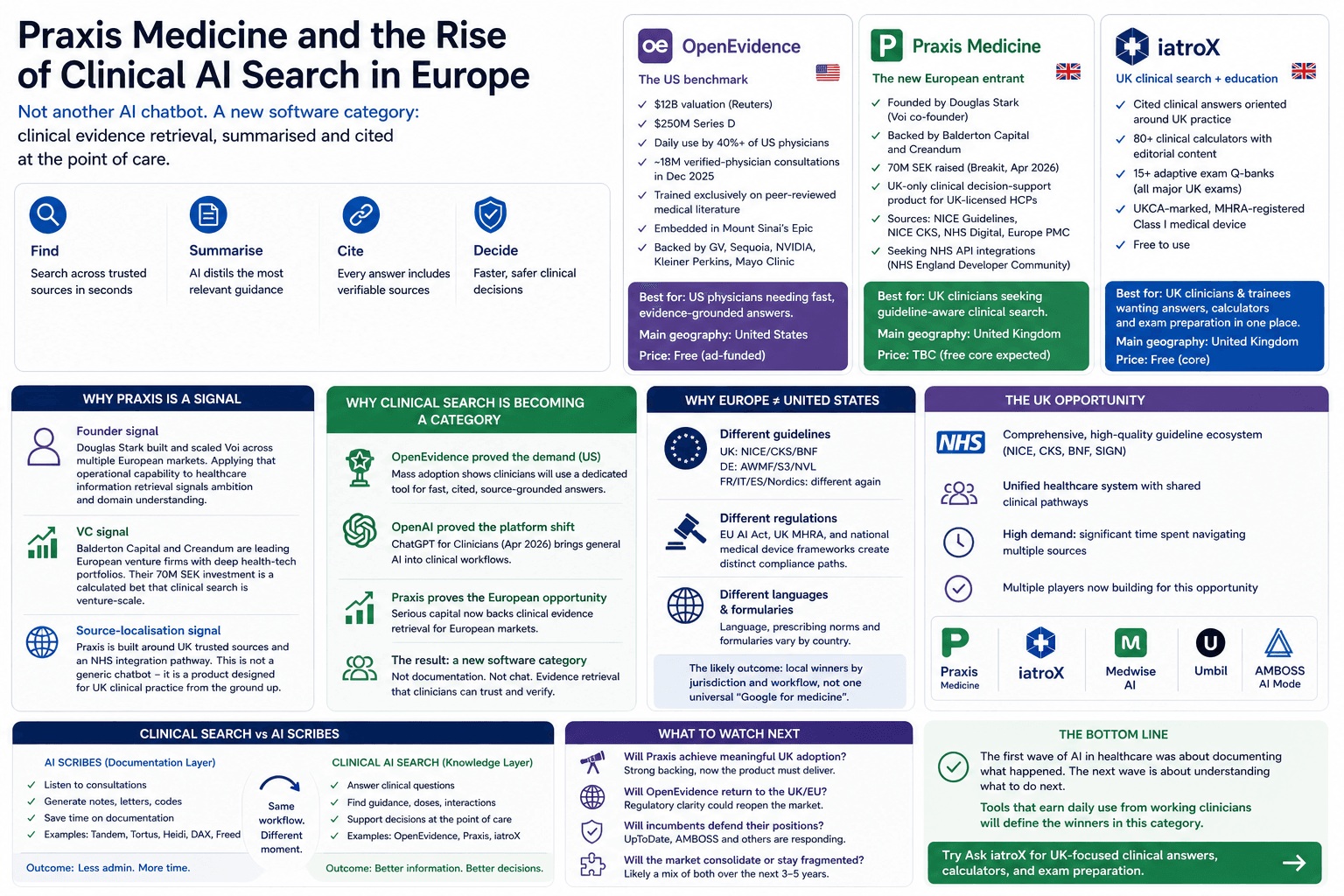
Praxis Medicine is not important because Europe needs another AI chatbot. It is important because it shows that clinical evidence retrieval — finding, summarising, and citing the right guidance at the point of care — is becoming a serious European software category.
What Is Praxis Medicine?
Praxis Medicine is a clinical AI search tool for medical professionals, founded by Douglas Stark. Stark is a serial entrepreneur previously known as a co-founder of Voi, the European micromobility company. Praxis Medicine Europe AB is registered in Stockholm, and the company is backed by Balderton Capital and Creandum — two of Europe's most recognised venture firms. Breakit reported in April 2026 that Praxis had raised 70 million SEK.
The product describes itself as "free, evidence-based AI search for medical professionals." Its landing page lists UK trusted sources: NICE Guidelines, NICE CKS, NHS Digital, and Europe PMC. In the NHS England Developer Community, Praxis described itself as building a UK-only clinical decision-support product for UK-licensed healthcare professionals and seeking NHS Website Content API access as a first step toward broader NHS integrations.
Why Praxis Is a Signal, Not Just a Startup
The individual company matters less than what it represents. Three signals converge.
Founder signal. Douglas Stark built and scaled Voi — demonstrating the ability to operate a complex, regulated, multi-market European technology business. Applying that operational capability to clinical evidence retrieval suggests the founder sees a serious market, not a side project.
VC signal. Balderton Capital and Creandum are not early-stage spray-and-pray investors. Both have deep European health-tech portfolios. Balderton recently led a $55 million round for Lindus Health (clinical trial platform) and a $50 million round for Voize (AI for nursing). Creandum is an early backer of Klarna, Spotify, and multiple European SaaS companies. When these firms invest in clinical evidence search, they are making a calculated bet that the category is venture-scale.
Source-localisation signal. Praxis has not launched as a generic medical chatbot trained on the general internet. It has explicitly positioned around UK trusted sources — NICE, CKS, NHS Digital, Europe PMC — and described its NHS integration pathway publicly. This suggests a product built from the ground up for UK clinical practice, not a US product adapted for Europe.
Why Clinical Search Is Becoming a Category
OpenEvidence proved the demand side in the US. Reuters reported its $12 billion valuation, $250 million Series D, and daily use by more than 40% of US physicians. That level of adoption demonstrates that clinicians want fast, cited, source-grounded answers at the point of care — and that the demand is large enough to support a standalone product category.
OpenAI proved that general AI platforms are entering clinical workflows. ChatGPT for Clinicians launched in April 2026 as a free tool for verified US clinicians, with plans to expand internationally.
Praxis proves that European VCs now see clinical evidence retrieval as venture-scale. 70 million SEK from Balderton and Creandum for a clinical search tool is a bet that this category has European legs.
Why Europe Is Different from the United States
The US can support a large national physician-search product because there is a relatively unified professional market — one set of board certifications, one FDA, one PubMed, and a dominant EHR ecosystem (Epic, Cerner). OpenEvidence's model works for that context.
Europe is structurally different. Clinical evidence, formularies, prescribing norms, and guidelines vary by country. UK clinicians need NICE and CKS guidance and current UK medicines information. German clinicians need AWMF/S3/NVL. French, Italian, Spanish, and Nordic clinicians each have national guideline ecosystems. Language adds another fragmentation layer. Regulatory approaches differ — the EU AI Act, UK MHRA guidance, and country-level medical device frameworks create distinct compliance requirements.
The likely European market will not have one universal "Google for medicine." It will probably split by jurisdiction and workflow — UK-focused tools for UK clinicians, DACH-focused tools for German-speaking markets, and so on. Praxis's UK-only public positioning is therefore not a limitation — it may be the correct market entry strategy.
The UK Opportunity: Guideline-Aware Answers for Working Clinicians
The UK is particularly well suited to clinical AI search because its clinical-source ecosystem is comprehensive and well structured. NICE, CKS and SIGN provide national guidance; current UK medicines information and relevant SmPCs on eMC support prescribing; and NHS pathways add shared implementation context. The demand is clear — UK clinicians spend significant time navigating between these sources during consultations, ward rounds and exam preparation.
Multiple tools are building for this opportunity. Praxis is a newer entrant. Medwise is building for NHS enterprise deployment with local Trust policy integration. Umbil publicly positions itself around UK clinical-guidance retrieval and workflow tools; check its current product documentation for the exact source set rather than assuming SmPC or eMC coverage. AMBOSS AI Mode offers curated evidence search with a strong education heritage.
Where iatroX Fits
In the UK, iatroX sits in the same broader shift toward clinician-facing, source-grounded medical information retrieval. Its focus is practical: cited clinical answers, calculators, exam preparation, and education tools for doctors and healthcare professionals. UKCA-marked, MHRA-registered. Free.
What to Watch Next
Whether Praxis achieves meaningful UK clinician adoption — the VC backing and founder credibility are strong signals, but adoption requires product quality, speed, and daily usefulness. Whether OpenEvidence re-enters the UK/EU market once regulatory frameworks settle. Whether incumbents like UpToDate and AMBOSS defend their positions through their own AI features. And whether the European clinical AI search market consolidates around a few winners or remains fragmented by country and workflow.
The category is now real. The question is who earns repeated daily use from working clinicians.
Try Ask iatroX for UK-focused clinical questions, calculators, and exam preparation →