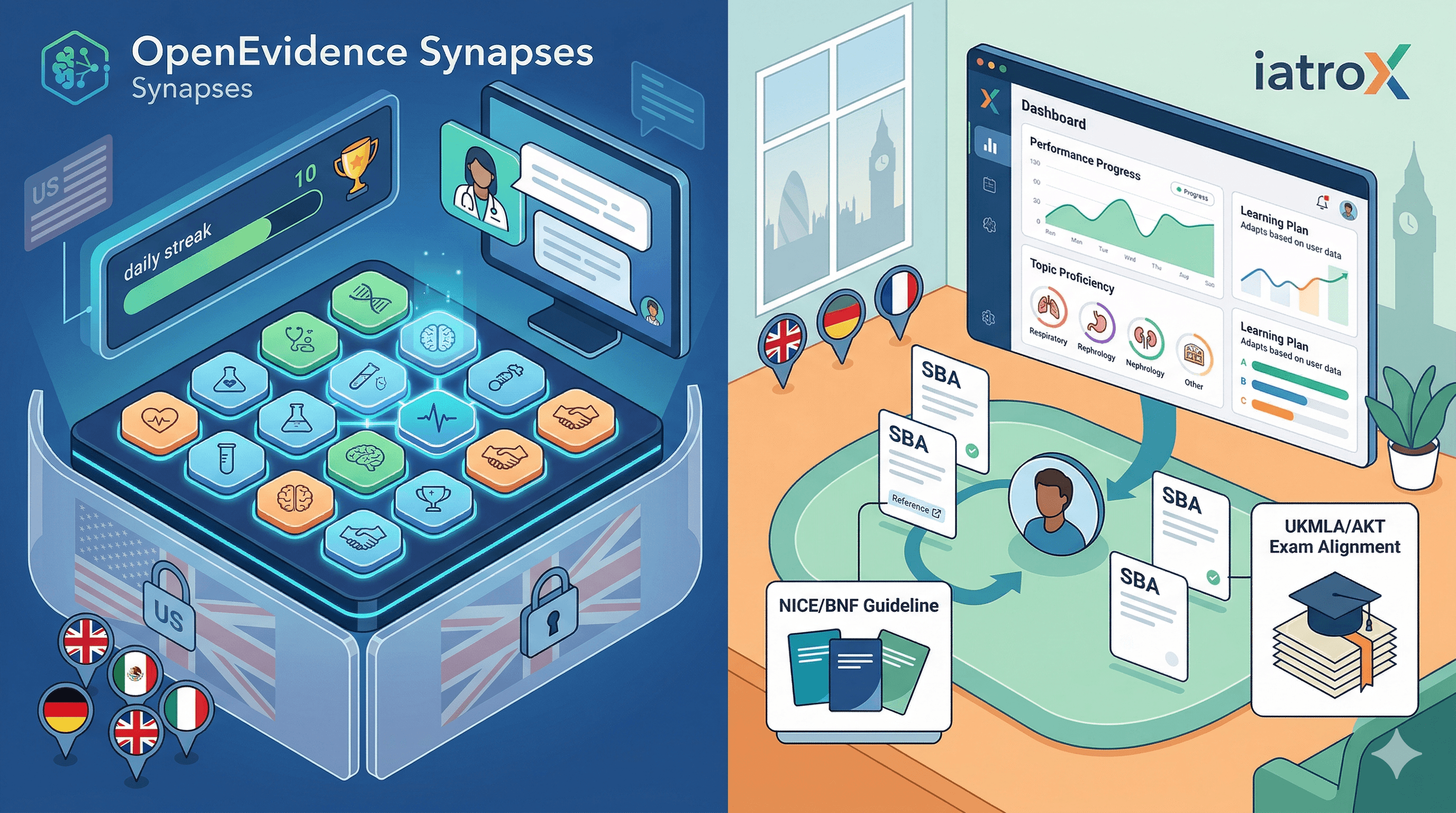
Synapses is genuinely clever. If you received that OpenEvidence email this week, you probably tried it — or tried to. The daily diagnostic reasoning puzzle, the grouping mechanic, the streak tracking, the seamless pivot to clinical AI conversation after each solved group. It is well-designed, educationally sound, and satisfying to play.
But if you are a UK doctor, you hit a wall. OpenEvidence requires US NPI (National Provider Identifier) verification. You cannot access the platform. You cannot play Synapses. You are locked out entirely — along with every doctor in the UK, Canada, Australia, Europe, and every other country outside the United States.
This article explains what Synapses does well, where it falls short for the global medical community, and how iatroX's approach to adaptive clinical learning compares — and where it goes further.
What OpenEvidence Synapses Does Well
Daily retrieval practice in a novel format. The grouping mechanic — 16 tiles sorted into 4 diagnostic sets of 4 — forces active recall rather than passive recognition. You must actively remember which investigation belongs to which diagnosis, which treatment pairs with which condition, and which risk factor is associated with which disease. This is structurally more demanding than selecting from five MCQ options, because you are allocating features to competing diagnoses simultaneously rather than evaluating one clinical scenario at a time.
Streak mechanics that drive habit formation. Daily drops with streak tracking exploit the same loss-aversion behavioural design that Duolingo and Wordle use to build daily habits. This is proven behaviour change design — clinicians who would not voluntarily open a Q-bank at 7am will open a puzzle game to protect a 30-day streak. The mechanic works because it transfers the motivation from "I should learn" (which is weak and easily deferred) to "I cannot break my streak" (which is immediate and emotionally charged).
The post-game pivot to clinical AI conversation. After solving each diagnostic group, Synapses offers a direct jump into an OpenEvidence AI conversation about that specific diagnosis. You solved the Guillain-Barré group? Now you can ask about the Miller Fisher variant, IVIG dosing, and the prognosis timeline. This transforms a 3-minute game into a 10-minute learning session — moving from retrieval (the puzzle) to elaboration (the conversation). Elaborative interrogation — asking "why?" after retrieving a fact — is one of the most effective encoding strategies identified in learning science.
Novel format that sustains engagement. The puzzle mechanic is fresh. It is not another MCQ. Not another flashcard. Not another video lecture. The novelty itself drives engagement in a way that traditional formats struggle to maintain over the 12-16 weeks of sustained revision that postgraduate exams require.
What Synapses Does Not Do
US-only access. NPI verification locks out every UK, Canadian, Australian, and international clinician entirely. Over 300,000 UK-registered doctors cannot use it. This is not a temporary beta limitation — it is a structural feature of OpenEvidence's verification architecture. There is no workaround, no international tier, and no indication that one is planned.
No exam alignment. Synapses is diagnostic reasoning practice — it is not mapped to any specific exam curriculum. Not the UKMLA content map. Not the MRCGP AKT blueprint. Not MRCP. Not DRCOG. For clinicians preparing for career-defining exams, the practice does not align to what the exam actually tests. You might solve a Synapses puzzle about Whipple's disease — a condition that appears rarely if ever in the MRCGP AKT — while your actual weak areas (neurology, data interpretation, controlled drug prescribing) remain untouched.
No personalisation. Every user receives the same puzzle regardless of their individual knowledge gaps. A consultant cardiologist with 20 years of experience and an FY1 in their first week solve the same puzzle. A candidate who consistently misses endocrine questions sees the same puzzle as one who consistently misses respiratory questions. The learning is undifferentiated — the puzzle designer decides what you practise, not your performance data.
No performance tracking over time. There is no dashboard showing your weak clinical domains across weeks and months. No proficiency map. No metacognitive awareness of where your knowledge gaps actually lie. You know your streak count. You do not know that you have missed 3 of the last 4 neurology groups, or that your pharmacology knowledge is consistently weaker than your anatomy knowledge.
One puzzle per day. The learning dose is inherently limited. One puzzle provides exposure to 4 diagnoses and 16 clinical features. A 30-minute adaptive Q-bank session covers 20-30 clinical scenarios with targeted difficulty adjustment, spaced repetition, and guideline-grounded feedback. The puzzle is a warm-up. The Q-bank is the workout.
No UK guidelines integration. After solving a group, you jump to OpenEvidence's AI chat — which draws on NEJM, JAMA, Lancet, and US clinical practice guidelines. Not NICE. Not CKS. Not BNF. Not SIGN. For UK doctors, the management pathways discussed after the puzzle may actively contradict the guidelines their exams test. A hypertension management discussion grounded in ACC/AHA guidelines will give different thresholds and first-line agents than NICE NG136. For exam preparation, this is not a neutral limitation — it is a potential source of error.
How iatroX Compares
| Feature | OpenEvidence Synapses | iatroX |
|---|---|---|
| Daily puzzle format | Yes — 4-group diagnostic reasoning | No — adaptive sessions (not puzzle format) |
| Streak/gamification | Yes — daily streak tracking | Dashboard + performance progression tracking |
| UK accessible | No (US NPI required) | Yes — designed for UK doctors, IMGs, pharmacists |
| Exam-mapped | No — general diagnostic reasoning | Yes — UKMLA, MRCGP AKT, MRCP, DRCOG, FFICM, DipIMC, DGM, DFSRH, GPhC, DTM&H |
| Adaptive personalisation | No — same puzzle for all users | Yes — true adaptive engine based on individual performance |
| NICE/BNF integration | No — US literature sources | Yes — NICE/CKS/SIGN/BNF via RAG |
| Postgrad diploma coverage | No | Yes — DRCOG, DCH, DipIMC, FFICM, DGM, DFSRH, DTM&H |
| Mobile app | Yes (iOS + Android) | Yes (iOS + Android) |
| Free access | US physicians only | Free for core UK exams (UKMLA, MRCGP, MRCP) |
| MHRA-registered | No | Yes |
| Performance dashboard | No — streak count only | Yes — topic-level proficiency across all domains |
| Clinical AI reference | Yes — OpenEvidence chat (US literature) | Yes — Ask iatroX (NICE/CKS/BNF grounded) |
The Learning Science Comparison
Synapses uses retrieval practice (good) through its grouping mechanic. It does not use spaced repetition at the concept level — if you miss the GBS group today, Synapses will not return to GBS in 3 days for you specifically. It does not use adaptive difficulty — the puzzles are editorially curated, not adjusted to your individual performance. The daily habit creates spacing at the session level (you return every day), but the content is not spaced according to your individual forgetting curve. The learning is real but undifferentiated.
iatroX uses all three core evidence-based learning mechanics simultaneously. Retrieval practice through active questioning in SBA format. Spaced repetition that revisits weak topics at scientifically optimal intervals based on your individual performance data — topics you have mastered are revisited less frequently, topics you struggle with are revisited more often. True adaptive difficulty that increases challenge as your competence grows, concentrated on your weakest domains rather than distributed uniformly across all content.
For exam preparation specifically — where the goal is not general clinical engagement but targeted knowledge building toward a specific assessment — iatroX's approach is more aligned with the evidence on exam performance. Bloom's 2 Sigma research (1984) demonstrated that personalised adaptive learning produces outcomes two standard deviations above conventional instruction. A static puzzle that treats every user identically is conventional instruction. An adaptive engine that targets your individual gaps is personalised instruction.
For general clinical engagement and daily habit-building, Synapses' puzzle format is more novel and more immediately engaging than a traditional Q-bank session. The ideal learning stack would combine both — if both were accessible to the same clinician.
For UK doctors: iatroX is the only option with this level of clinical learning infrastructure. Synapses is not accessible. iatroX fills the gap — and goes further on personalisation, exam alignment, and guideline integration.
Could iatroX Build a Synapses-Style Format?
The puzzle mechanic is genuinely engaging and well-suited to clinical learning. A "group four findings under one diagnosis" format maps naturally to iatroX's condition-based Q-bank architecture — every condition in the bank has associated symptoms, signs, investigations, and treatments that could be disaggregated into tiles for a grouping exercise.
iatroX already provides diagnostic reasoning practice through its Q-bank and Brainstorm features. The Synapses format would be an evolution of this — a complementary engagement layer rather than a replacement for the adaptive engine. The crucial difference: an iatroX version could be adaptive, presenting grouping puzzles based on your individual weak diagnoses rather than an editorial selection that is the same for everyone.
The Ask iatroX feature already provides the "go deeper on this diagnosis" experience that Synapses triggers via OpenEvidence conversation — except grounded in NICE/CKS/BNF rather than US medical literature. The infrastructure for the post-puzzle learning pivot already exists.
The Bottom Line
Synapses is a well-designed learning tool built for US physicians that UK doctors cannot access. iatroX is a UK-native, exam-aligned, adaptive learning platform that UK doctors can access — for free.
If you are a US physician with both available: use Synapses daily for diagnostic reasoning engagement. Use iatroX for targeted, adaptive exam preparation and UK-guideline-grounded clinical reference.
If you are a UK doctor, IMG, pharmacist, nurse, or physician associate: iatroX at iatrox.com/boards is your platform. Free for UKMLA, MRCGP AKT, and MRCP. Niche diploma banks for DRCOG, FFICM, DipIMC, DGM, DFSRH, DTM&H, and more. NICE/CKS/BNF-integrated. MHRA-registered. And accessible right now — no NPI number required.