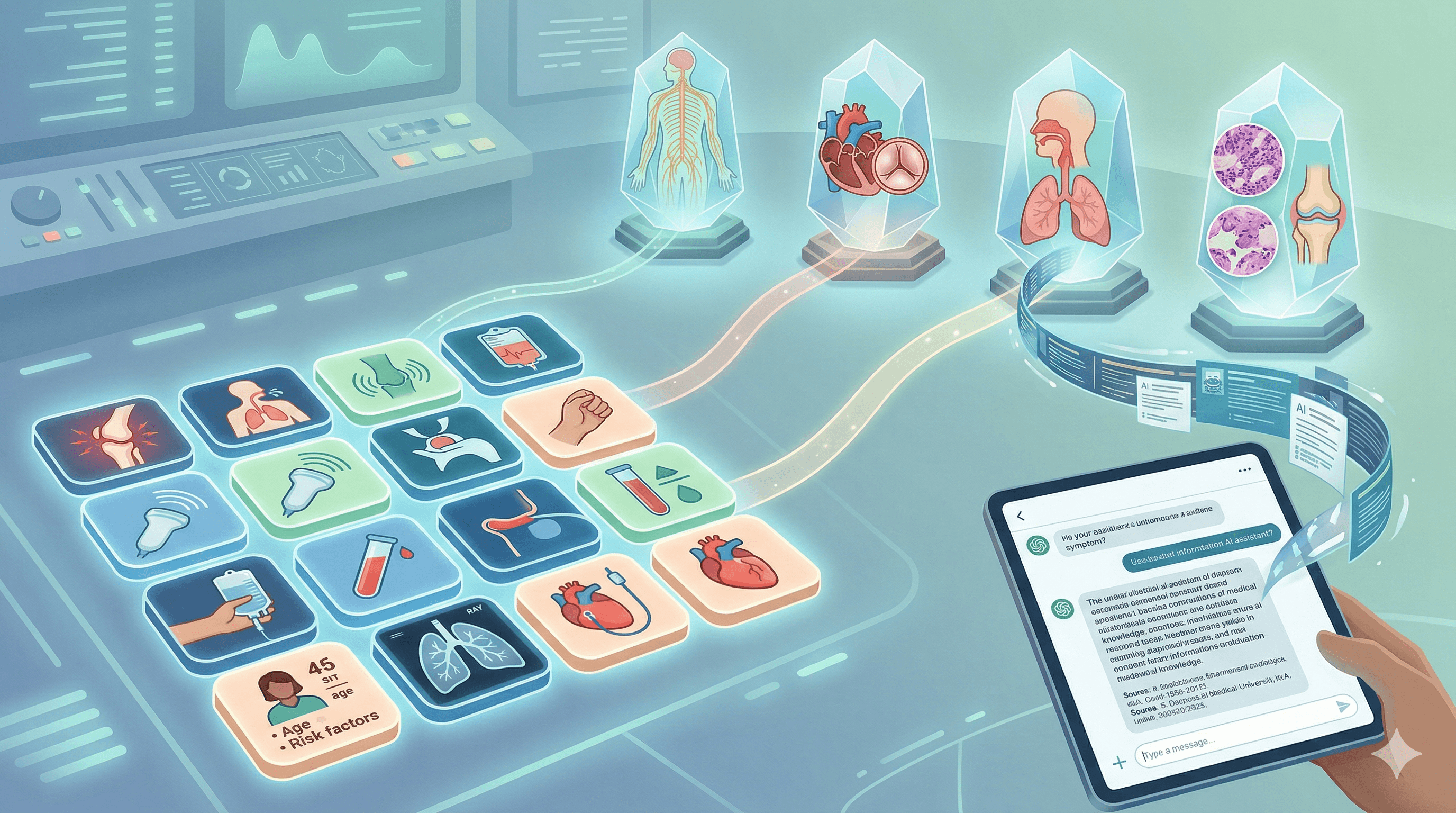
If you have ever played NYT Connections, you understand the format immediately. OpenEvidence has taken that mechanic and built a genuinely clinical version of it — and the first puzzle is wickedly good.
OpenEvidence is a $12 billion US medical AI company, used daily by over 40% of US physicians for clinical decision support. Synapses is their first foray into gamified learning, launching in their Discover tab on 5 April 2026. It is a daily medical puzzle that tests diagnostic reasoning through a grouping format — and it is more educationally interesting than most things happening in medical EdTech right now.
The question this article explores: is Synapses genuinely educational, or is it engagement theatre dressed in clinical clothing?
How Synapses Works
The format is elegant in its simplicity. You are presented with 16 tiles — each containing a symptom, sign, laboratory test, treatment, risk factor, or demographic descriptor. Your goal is to group these 16 tiles into 4 sets of 4, where each set is connected by a shared diagnosis.
You have 4 mistakes allowed before the game is over. A new puzzle drops daily. Streak tracking encourages return visits — the same loss-aversion mechanic that made Wordle a global habit. You are not trying to beat other players. You are trying to maintain your streak, which means you are trying to maintain a daily retrieval practice habit — whether you realise that is what you are doing or not.
The clever design decision is what happens after you solve each group. The game does not just congratulate you and move on. It offers a direct pivot into an OpenEvidence AI conversation about that specific diagnosis — transforming a 3-minute puzzle into a 10-minute learning session where you can explore the condition in depth, ask follow-up questions, and verify your understanding against the medical literature.
This pivot is the real product. The game is the acquisition hook. The clinical AI conversation is the retention mechanism. OpenEvidence understands that the puzzle gets you through the door — the conversation keeps you learning. The puzzle tests what you already know. The conversation teaches you what you do not.
Solving the Launch Puzzle — A Worked Example
The April 5th puzzle presents 16 tiles: Transthoracic Echo, IVIG Therapy, Ascending Paralysis, Hot Potato Voice, Cotrimoxazole, Opening Snap, Thumbprint Sign, Airway Protection, Adult Male Smoker, Campylobacter Jejuni, Rheumatic Fever, Caucasian Male, Migratory Arthralgia, PAS-positive Macrophages, CSF Protein Elevation, Balloon Valvuloplasty.
The challenge is to hold four differential diagnoses simultaneously and allocate each tile to the correct condition. Here is the reasoning:
Guillain-Barré Syndrome. Ascending paralysis is the hallmark presentation — weakness that begins in the lower limbs and ascends over hours to days. IVIG therapy is the first-line treatment (alongside plasma exchange). Campylobacter jejuni is the most common preceding infection trigger, typically 1-3 weeks before neurological onset. CSF protein elevation with a normal cell count — the classic albumino-cytologic dissociation — is the diagnostic cerebrospinal fluid finding. The grouping logic: symptom (ascending paralysis) + treatment (IVIG) + trigger (Campylobacter) + investigation finding (CSF protein elevation).
Mitral Stenosis. Opening snap is pathognomonic — the high-pitched sound heard after S2, caused by sudden tensing of the stenotic mitral valve leaflets during diastolic opening. Rheumatic fever is the most common cause worldwide, with mitral stenosis developing years to decades after the initial rheumatic episode. Balloon valvuloplasty (percutaneous mitral commissurotomy) is the interventional treatment for suitable candidates with pliable, non-calcified valves. Transthoracic echocardiography is the investigation of choice for assessing valve morphology, orifice area, and severity grading. The grouping logic: sign (opening snap) + aetiology (rheumatic fever) + treatment (balloon valvuloplasty) + investigation (TTE).
Epiglottitis. Hot potato voice (muffled, thick-sounding speech) is a characteristic clinical sign — the swollen epiglottis alters vocal resonance. Thumbprint sign on lateral neck X-ray shows the swollen epiglottis silhouetted against the pre-vertebral air column, resembling a thumbprint. Airway protection is the immediate clinical priority — this is a life-threatening airway emergency where the management hierarchy is airway first, antibiotics second. Cotrimoxazole provides antibiotic coverage including Haemophilus influenzae, historically the most common cause in children (though vaccination has shifted the epidemiology toward adults and non-typeable strains). The grouping logic: sign (hot potato voice) + imaging (thumbprint sign) + management priority (airway protection) + treatment (cotrimoxazole).
Whipple's Disease. PAS-positive macrophages on small bowel biopsy are the histological hallmark — foamy macrophages in the lamina propria staining positive with periodic acid-Schiff, containing Tropheryma whipplei organisms. Migratory arthralgia is often the earliest clinical feature, frequently preceding gastrointestinal symptoms (diarrhoea, weight loss, malabsorption) by years — a classic exam distractor because the joint symptoms seem unrelated to the eventual diagnosis. The classic demographic is a middle-aged Caucasian male — the "Caucasian male" and "adult male smoker" tiles capture this epidemiological pattern, which is one of the few conditions in medicine with such a strong demographic signature.
What makes this puzzle genuinely educational is the cognitive demand. You are not recognising a diagnosis from a clinical vignette (as in a standard MCQ). You are performing a fundamentally different cognitive operation: allocating individual clinical features to competing diagnoses simultaneously. This requires you to hold multiple diagnostic frameworks in working memory and discriminate between them — deciding whether "migratory arthralgia" belongs to rheumatic fever or Whipple's disease, whether "ascending paralysis" is GBS or a differential mimic, and whether "Caucasian male" is a demographic feature of Whipple's or an epiglottitis risk factor.
This is diagnostic reasoning in action. The puzzle format makes the cognitive process visible in a way that MCQs do not.
Is Synapses Actually Educational — Or Just Fun?
The learning science case for Synapses is strong. Retrieval practice — actively recalling information rather than passively recognising it — is one of the most evidence-supported learning techniques in cognitive science. Roediger and Karpicke (2006) demonstrated that active retrieval produces significantly better long-term retention than re-reading or passive study. The Synapses format forces you to actively recall which investigation belongs to which diagnosis, which treatment is first-line for which condition, and which risk factor is associated with which disease. This is genuine retrieval practice, not passive recognition from a list of five options.
The engagement case is also compelling. Streaks, daily drops, and social sharing mimic Wordle's viral loop — the same behavioural design that drove NYT Games to over 100 million monthly users. This drives return visits and habit formation. Whether it drives deep learning is a different question — and the answer depends on what happens after the puzzle.
The honest verdict. Synapses is a better learning activity than scrolling social media between patients. It is worse than a well-designed adaptive Q-bank that targets your specific knowledge gaps using spaced repetition and performance-based sequencing. Both have a place in a clinician's learning stack. The mistake would be treating Synapses as a substitute for structured exam preparation — it is not. It is a daily diagnostic reasoning warm-up that keeps clinical pattern recognition sharp.
The post-puzzle pivot to OpenEvidence's AI conversation is the smartest design decision. It turns a 3-minute puzzle into a 10-minute deep-dive on the diagnosis you just identified. You solved the GBS group? Now you can ask OpenEvidence about the indications for IVIG vs plasma exchange, the Miller Fisher variant, and the prognosis timeline. This moves the learning from retrieval (the puzzle) to elaboration (the conversation) — two complementary cognitive processes that together produce stronger encoding than either alone.
What Synapses Tells Us About Where Medical Education Is Heading
Synapses signals something significant: major medical AI platforms are moving beyond clinical decision support into the learning space itself. OpenEvidence did not need to build a game. They chose to — because their data presumably shows that learning-focused engagement drives physician retention on the platform better than passive reference use alone.
The consumer gamification model — Duolingo for language, NYT Games for general knowledge — is now actively influencing medical EdTech. The expectation is shifting. Clinicians do not want to read textbook chapters. They want daily, bite-sized, active learning moments that fit into the gaps between patients, on the commute, or during a quiet on-call shift.
This validates what iatroX has been building: the premise that doctors learn better through active, adaptive, spaced practice than through passive content consumption. The adaptive Q-bank, the instant clinical reference via Ask iatroX, the performance dashboard showing domain-level proficiency — these are all expressions of the same principle that Synapses has now made visible to a mass audience.
The Gap Synapses Does Not Fill
Synapses is a US-only product. OpenEvidence requires US NPI (National Provider Identifier) verification to access. UK doctors, international trainees, Canadian physicians, Australian doctors, and pharmacy or nursing professionals are entirely locked out. If you do not have a US NPI number, you cannot play Synapses, and you cannot use OpenEvidence's clinical AI.
This is not a minor limitation. The UK alone has over 300,000 registered doctors and tens of thousands of medical students who would benefit from this type of daily diagnostic reasoning practice — and they cannot access it.
iatroX is the UK-native alternative for clinical reference and adaptive learning. MHRA-registered. NICE/CKS/SmPC/emc/SIGN-integrated — meaning every clinical answer is grounded in the UK guidelines that UK exams actually test. Designed for UK doctors, IMGs, pharmacists, nurses, and physician associates. The adaptive Q-bank at iatrox.com/boards delivers the evidence-based learning that Synapses points toward — with exam alignment (UKMLA, MRCGP AKT, MRCP, DRCOG, FFICM, DipIMC, DGM, DFSRH, GPhC, and more) that Synapses does not offer even for its US audience.
What Synapses proves is that clinicians want this. The demand for gamified, diagnostic reasoning tools that respect clinicians' time and intelligence is real and growing. The platforms that meet this demand — whether through daily puzzles or adaptive Q-banks — are the ones that will define how the next generation of doctors learn.
Try iatroX's adaptive Q-bank — the UK's only NICE-integrated adaptive clinical revision platform.