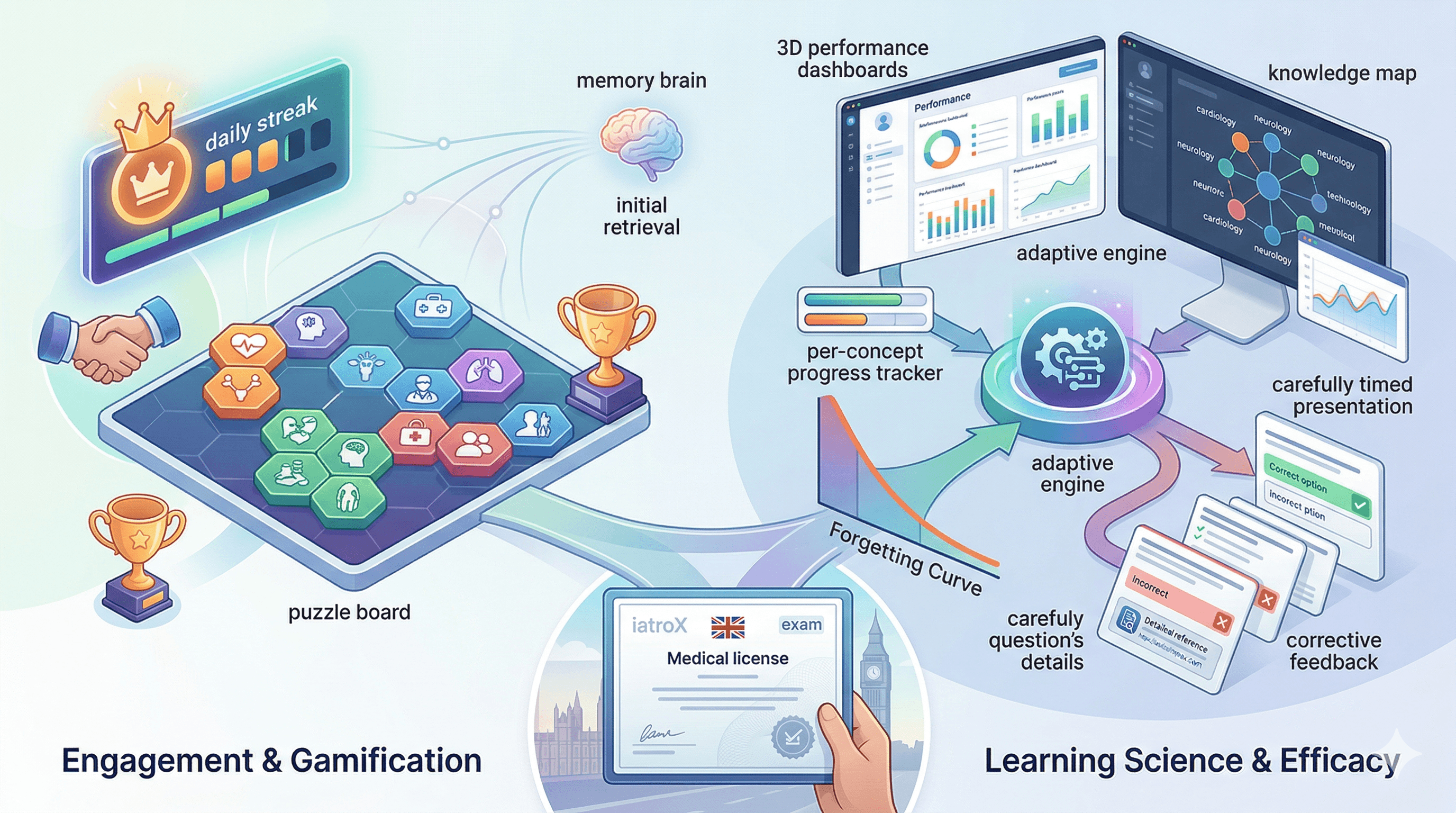
OpenEvidence's April 2026 launch of Synapses signals something significant: one of the world's best-funded medical AI companies has concluded that gamification belongs in clinical education. This is not a startup experiment. OpenEvidence is valued at $12 billion and used daily by over 40% of US physicians for clinical decision support. When they invest engineering resources in a daily puzzle game for doctors, they have data suggesting it will drive engagement and retention on their platform.
This is worth taking seriously. But the more interesting question is not whether clinicians enjoy gamified learning — they clearly do. The question is whether gamification in medical education actually produces better learning outcomes, or whether it produces better engagement metrics that may not translate into knowledge that sticks, exams that are passed, and patients who are safer.
This article examines both sides — and looks at where the science justifies the design decisions in tools like Synapses and iatroX.
The Engagement Problem in Medical Education
Postgraduate medical education has a compliance problem. Foundation trainees know they should revise for the UKMLA. GP registrars know they should prepare for the AKT. ICM trainees know they should build their physiology knowledge for the FFICM MCQ. But passive revision — re-reading BNF chapters, watching recorded lectures, skimming NICE guidelines in a browser tab — produces weak retention and, critically, weak engagement. Trainees start strong and drop off within weeks. The revision plan drawn up in week one is abandoned by week four. The Q-bank subscription purchased in January sits unused by March.
The forgetting curve, first described by Hermann Ebbinghaus in 1885 and replicated extensively in modern cognitive psychology, quantifies the problem with precision. Without active retrieval and spaced review, approximately 50% of newly learned information is lost within 24 hours and approximately 70-80% within one week. A GP registrar who reads the NICE hypertension guideline (NG136) on Monday and does not actively retrieve that information within the following week has retained perhaps 20% of the specific management thresholds, blood pressure targets, and medication sequencing by the following Monday. This is not a motivation problem. It is not a discipline problem. It is a cognitive architecture problem — a fundamental feature of how human memory works.
Traditional Q-banks solve the retrieval problem — answering questions is active retrieval by definition. Every time a candidate selects an answer and checks whether they were correct, they are performing a retrieval attempt that strengthens the memory trace. But Q-banks struggle with sustained engagement over the 12-16 weeks of preparation that postgraduate exams typically require. The experience of working through a static bank of 2,000 questions, topic by topic, session by session, is monotonous. The questions blur together. The interface feels mechanical. The dopamine hit of getting a question right fades. Candidates burn out, skip sessions, and procrastinate. The tool works when it is used. The human compliance mechanism fails to keep it in use long enough.
This is the gap that gamification promises to fill: not replacing the proven learning mechanism (active retrieval) but wrapping it in an engagement layer that sustains the behaviour over time.
What Game Mechanics Actually Do to Learning
Not all gamification is educationally equal. Some mechanics directly enhance learning through established cognitive science principles. Others enhance engagement without meaningfully affecting knowledge retention. The distinction matters enormously for medical education design — because the stakes (patient safety, career progression) are too high for empty engagement metrics.
Retrieval Practice (the Testing Effect)
Actively recalling information — rather than passively re-reading or recognising it — produces dramatically better long-term retention. This is one of the most robustly replicated findings in educational psychology. Roediger and Karpicke (2006) demonstrated that students who practised retrieval retained approximately 80% of material after one week, compared to just 36% for those who re-read the same material the same number of times. The effect is not marginal — it is transformative.
Brown, Roediger, and McDaniel's "Make It Stick" (2014) synthesised decades of research confirming that testing is not just assessment — it is one of the most powerful learning tools available. Every time you attempt to recall a fact and succeed, the memory trace strengthens. Every time you attempt to recall and fail (then receive corrective feedback), the subsequent correct encoding is stronger than if you had simply read the answer.
Any game mechanic that forces active recall — answering questions, grouping tiles into diagnostic categories, matching findings to conditions, completing clinical scenarios from memory — is leveraging the testing effect. This is educationally sound regardless of whether the activity "looks like" a game.
Spaced Repetition
Presenting material at increasing intervals — rather than massing practice in a single session — aligns review timing with the forgetting curve. The principle is simple: review material just before you would have forgotten it, and the memory trace strengthens more efficiently than if you reviewed it either too early (wasting time on material you still remember) or too late (having to re-learn from near-zero).
Cepeda et al. (2006) conducted a meta-analysis of 254 studies confirming that distributed practice consistently outperforms massed practice for long-term retention. Cepeda et al. (2008) extended this with a large-scale experiment demonstrating that the optimal spacing interval depends on the target retention period — for an exam in 12 weeks, concepts should be revisited at intervals of approximately 1-2 weeks for optimal retention at the exam date.
Game mechanics that enforce daily return visits (streaks, daily challenges, limited-time events) create the behavioural framework for spaced repetition — they get the learner back to the platform at regular intervals. However, they do not guarantee that the spaced repetition is applied to the right content. Returning daily to do a puzzle that covers different diagnoses each time is session-level spacing. Returning daily to be re-tested on the specific diagnoses you previously failed is concept-level spacing. The learning science evidence strongly favours the latter.
Immediate Feedback
Knowing you were wrong — and specifically why — within seconds of answering reinforces correct knowledge far more effectively than delayed correction. Immediate feedback prevents incorrect associations from solidifying in memory and provides the corrective information at the moment of maximum cognitive receptivity (the "desirable difficulty" window when the learner is actively engaged with the question). Any game format that provides instant feedback after each response — correct/incorrect with explanation — is leveraging this principle.
Streak Mechanics
Daily return behaviour driven by loss-aversion (the psychological pain of breaking a streak) is a well-documented behavioural design pattern. Duolingo's streak mechanic is credited as a primary driver of its 100+ million daily active users. The mechanic is psychologically powerful because losing a streak feels worse than gaining a day feels good — a direct application of Kahneman and Tversky's loss-aversion findings from prospect theory.
The mechanic transfers to medical apps: clinicians who would not voluntarily open a Q-bank at 7am will open a game with a 47-day streak at stake. Streaks drive engagement, which creates the conditions for learning — but they do not directly cause learning. A learner who opens the app to protect their streak, answers carelessly, and closes the app has maintained their streak without meaningful retrieval. Implementation matters: the learning activity must be substantive enough that mere streak maintenance requires genuine cognitive effort.
Social Comparison
Leaderboards, peer performance percentiles, and competitive elements can drive engagement through competitive motivation. However, the evidence is mixed. Social comparison can increase anxiety and discourage lower-performing learners, potentially causing the least-prepared candidates — who need the most practice — to disengage. Careful implementation matters: displaying percentile rank ("you are performing better than 72% of AKT candidates in your cohort") tends to be more motivating than absolute rank ("you are 847th of 1,200") which can be demoralising for anyone outside the top quartile.
What Synapses Gets Right From a Learning Science Perspective
The diagnostic grouping format is a genuine retrieval practice exercise. Allocating 16 tiles to 4 diagnostic categories requires active recall of which features belong to which condition — this is cognitively harder than recognising the correct answer from five options in a standard MCQ, because you must simultaneously hold four competing diagnostic frameworks and discriminate between them. The cognitive demand is higher, and the learning encoding is likely deeper as a result.
Immediate correct-group feedback after each solved category activates the testing effect at the point of maximum receptivity. You discover whether your allocation was correct within seconds, while the reasoning is still active in working memory.
The post-puzzle pivot to an OpenEvidence AI conversation deepens encoding by moving from recall (the puzzle) to elaboration (the conversation). Elaborative interrogation — asking "why does this feature belong to this diagnosis?" after retrieving the association — is among the most effective encoding strategies identified in educational psychology (Dunlosky et al., 2013, "Improving Students' Learning With Effective Learning Techniques").
Daily repetition creates the habit architecture that spaced repetition requires. One puzzle per day prevents binge behaviour (cramming all retrieval into one session) and forces the retrieval to happen across multiple days — the session-level spacing that the evidence supports.
The one-puzzle-per-day limit is psychologically astute. Unlimited access would allow candidates to binge, exhaust the novelty, and abandon the tool. Scarcity (one new puzzle every 24 hours) creates anticipation, protects the engagement curve, and ensures that no single session exceeds the attention window of a busy clinician.
Where Synapses Falls Short of Optimal Learning Design
No personalisation. Every user receives the same puzzle regardless of their knowledge state. A consultant cardiologist with 20 years of experience and an FY1 in their second week solve the same puzzle at the same difficulty. Learning science is unambiguous on this point: the most effective learning environments adapt to the individual learner. Bloom's 2 Sigma problem (1984) demonstrated that personalised one-to-one tutoring produces outcomes two standard deviations above conventional group instruction — the equivalent of moving a 50th-percentile student to the 98th percentile. Synapses provides zero personalisation. Everyone gets the same puzzle.
No spaced repetition of individual concepts. If you failed to identify the GBS group today, Synapses will not return to GBS in 3 days for you specifically. The concepts tested are editorially selected based on what the puzzle designers choose — not selected based on your individual forgetting curve. This means the spaced repetition principle is applied at the session level (you return every day) but not at the concept level (the concepts you specifically need to review may not appear for weeks or months, if ever again). Concept-level spacing is where the strongest evidence for improved retention lies.
No adaptive difficulty progression. The puzzles are set at a fixed difficulty by the editorial team. They do not become harder as you improve, easier as you struggle, or specifically targeted at your zone of proximal development. Vygotsky's concept of the zone of proximal development — the range of tasks just beyond the learner's current independent capability — is foundational to effective learning design. Optimal learning occurs when the challenge is calibrated to the learner. Synapses' challenge is calibrated to the puzzle designer's editorial judgment, which is the same for all learners.
The fundamental limitation. The most effective learning systems know what you do not know and teach you that first. Synapses does not know what you do not know. It shows you what the puzzle designer chose. This may or may not align with your actual knowledge gaps — and for exam preparation, alignment with your specific gaps is the variable that most strongly predicts score improvement.
What the Evidence Says About Adaptive Learning Specifically
The evidence for adaptive learning in medical education is robust, growing, and directly relevant to the Synapses vs adaptive Q-bank comparison.
Bloom's 2 Sigma problem (1984) established the theoretical ceiling: personalised instruction produces dramatically better outcomes than group instruction. Adaptive digital learning systems are the most scalable approximation of personalised instruction currently available — they cannot replicate the full richness of one-to-one human tutoring, but they can approximate the most important component: knowing what the learner does not know and concentrating instruction there.
Cepeda et al. (2006, 2008) established through meta-analysis that distributed practice with optimal spacing consistently outperforms massed practice for long-term retention, with optimal spacing dependent on the target retention interval. Adaptive systems that calculate individual spacing intervals based on per-concept performance data implement this principle more precisely than either fixed scheduling algorithms (like Quesmed's daily feed) or editorial puzzle selection (like Synapses).
In medical education specifically, Kerfoot et al. (multiple studies from Harvard/BIDMC, 2009-2015) demonstrated that adaptive spaced repetition significantly improved knowledge retention in surgical residents, urology trainees, and gastroenterology fellows compared to conventional Q-banks. The effect sizes were clinically meaningful — not just statistically significant. Trainees using adaptive spaced repetition retained knowledge better at 6 months and 12 months than those using conventional study methods, even when total study time was held constant.
Shaw et al. (2015) found that adaptive learning in medical education improved both knowledge retention and transfer — the ability to apply learned knowledge to novel clinical scenarios not previously encountered. This is particularly relevant for exam preparation, where questions present familiar knowledge in unfamiliar clinical contexts.
How iatroX Applies the Science
iatroX is built on the evidence base described above — not as a theoretical alignment but as a direct implementation of adaptive learning principles in a medical education platform.
True adaptive engine. Not a fixed rotation, not a daily scheduling algorithm, not an editorial puzzle selection. The next question is determined by your real-time performance profile across all content areas. If you are consistently scoring below proficiency in endocrinology but above proficiency in respiratory medicine, the engine serves more endocrine questions — not because it is scheduled, but because your performance data identifies endocrinology as the domain where additional practice will produce the greatest marginal improvement. This is Bloom's 2 Sigma principle implemented at scale.
Spaced repetition built into the adaptive logic. Topics you have mastered are revisited at increasing intervals — maintaining the knowledge without wasting study time. Topics you are weak in are revisited more frequently, at intervals optimised by the algorithm based on your individual performance trajectory. This implements the Cepeda et al. spacing principles at the individual concept level — something neither Synapses' editorial model nor Quesmed's fixed scheduling can achieve.
Immediate, guideline-anchored feedback. Not just "wrong" — but "wrong, and here is what NICE NG136 actually says about this specific management threshold, with a citation link." The feedback is corrective (addresses the specific error), specific (references the exact guideline), and grounded in the authoritative source the exam tests. Ask iatroX extends this further — providing instant elaborative interrogation when you need to understand why a guideline recommends what it does, what the evidence base is, and how it applies to the clinical scenario you just encountered.
Performance dashboard. Translates the learning science concept of metacognitive awareness — knowing what you know and what you do not know — into a visual proficiency map across all exam domains. Metacognitive awareness is itself a predictor of learning success: learners who can accurately identify their own knowledge gaps learn more efficiently than those who cannot (the constructive application of the Dunning-Kruger effect). The dashboard makes the invisible visible — transforming a vague sense of "I think I'm okay at cardiology" into a precise proficiency metric that either confirms or corrects your self-assessment.
The Verdict — What Synapses Proves and What iatroX Adds
Synapses proves: The format works. Clinicians want daily, gamified, diagnostic reasoning practice. The demand for learning tools that respect clinicians' time, intelligence, and clinical identity is real, growing, and commercially validated by a $12 billion company's investment. This is not a niche interest — it is a market signal.
iatroX adds: Personalisation (the learning adapts to you, not you to it), spaced repetition at the concept level (not just the session level), exam alignment (UKMLA, MRCGP AKT, MRCP, DRCOG, FFICM, DipIMC, DGM, DFSRH, GPhC, and more), UK guideline integration (NICE/CKS/BNF/SIGN — the sources UK exams actually test), and performance tracking that turns engagement into measurable learning outcomes you can act on.
The ideal learning stack would combine a daily Synapses-style engagement habit with an adaptive, personalised system that fills your specific knowledge gaps based on performance data. For US physicians who can access both, this combination is available now.
For UK clinicians: Synapses is not accessible. iatroX fills the gap — and goes further on every dimension of learning science that the evidence supports. Free for UKMLA, MRCGP AKT, and MRCP at iatrox.com/boards.
What Is Next — Will Medical Education Fully Gamify?
Duolingo reached 100 million daily active users through gamification of language learning. The medical equivalent does not exist yet — but the direction of travel is clear. Synapses is OpenEvidence's first step. iatroX's adaptive engine is another step. The convergence of gamification mechanics (engagement) with adaptive learning science (efficacy) is the trajectory that will define the next decade of medical education technology.
The open question is not whether gamification works in medical education — the evidence says it does, when implemented with sound learning science principles rather than superficial engagement mechanics. The open question is whether gamification can sustain the depth of engagement needed for career-defining exams like the MRCGP AKT (160 questions, 160 minutes, 4 attempts maximum) or UKMLA (180 SBAs, pass/fail for medical registration) — or whether it is best positioned as a daily habit-building complement to more structured adaptive revision.
The platforms that answer this question will define how the next generation of doctors learn. The evidence strongly suggests that the answer is not one or the other — it is both, integrated into a single learning experience where engagement mechanics sustain the behaviour and adaptive science optimises the learning.
iatroX's adaptive engine applies the science behind both spaced repetition and retrieval practice — free for UKMLA, MRCGP AKT, and MRCP at iatrox.com/boards.