Dr Kola Tytler (MBBS CertHE MBA MRCGP)|21 April 2026|7 min read
The MCCQE Part I (Medical Council of Canada Qualifying Examination Part I) is the licensing exam that all physicians must pass to obtain the Licentiate of the Medical Council of Canada (LMCC). It is taken by Canadian medical graduates (CMGs) and international medical graduates (IMGs) seeking to practise in Canada.
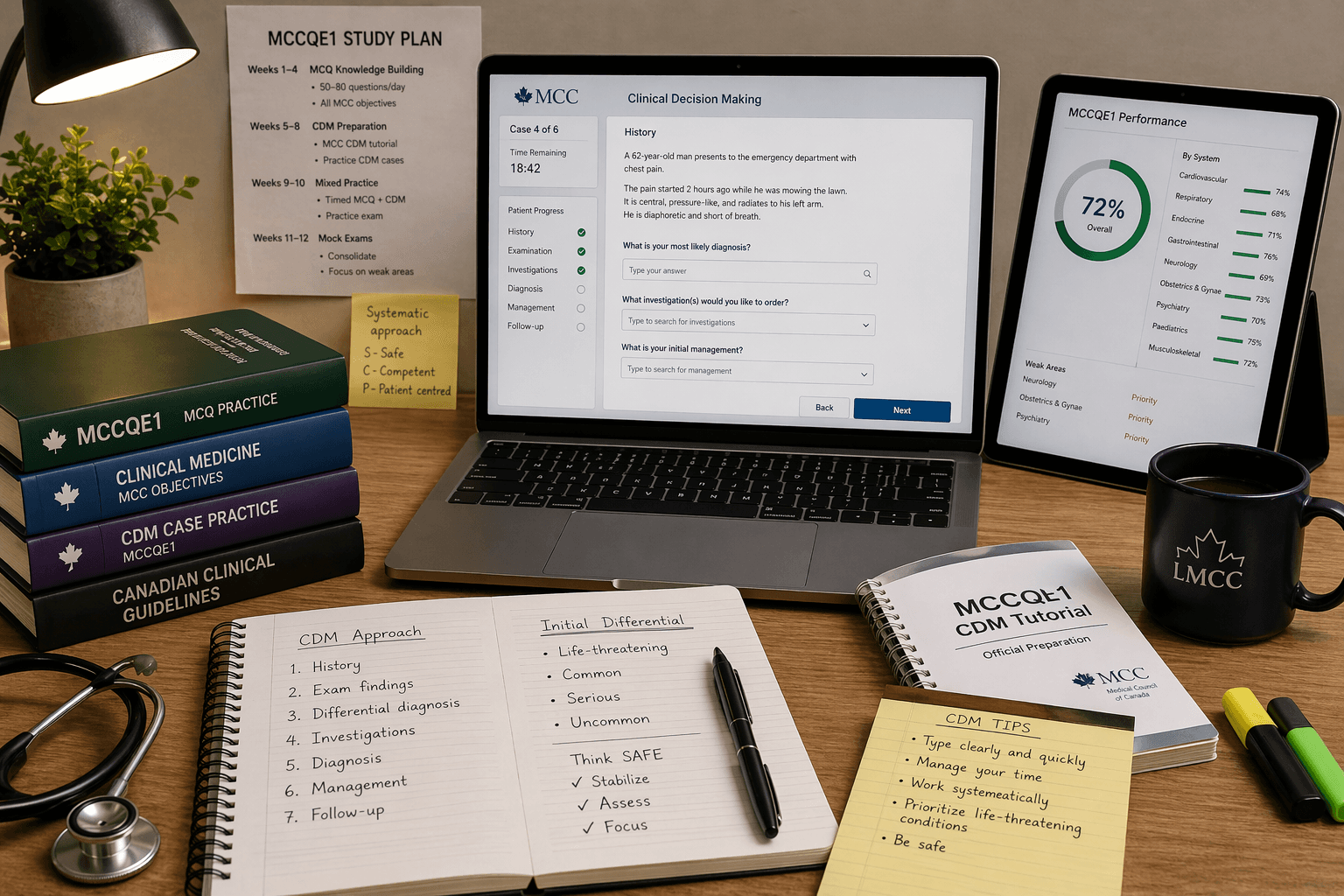
The exam has two components: a multiple-choice question section testing medical knowledge across all disciplines, and a Clinical Decision Making (CDM) section that presents clinical scenarios requiring you to manage patients through a series of short-menu and write-in questions. The CDM component is what distinguishes the MCCQE1 from purely MCQ-based licensing exams.
Understanding the CDM Component
The Clinical Decision Making section is the most unfamiliar component for candidates who have prepared for MCQ-only exams. CDM cases present evolving clinical scenarios where you must enter diagnosis, investigation, and management decisions using a short-menu interface — typing terms and selecting from a dropdown rather than choosing from predefined options.
The CDM rewards clinical reasoning over pattern recognition. You need to demonstrate that you can work through a case systematically: history, examination findings, differential diagnosis, key investigations, initial management, and follow-up. Simply knowing the correct diagnosis is not enough — you must demonstrate the reasoning pathway.
CDM preparation requires dedicated practice with the specific format. Standard MCQ Q-banks do not replicate the CDM experience.
The Resources
CanadaQBank — The Canadian Standard
CanadaQBank is the established Canadian Q-bank for MCCQE1 preparation. It offers a dedicated MCCQE1 bank with both MCQ and CDM-style practice, covering the MCC objectives. It is the most widely used resource among Canadian medical graduates.
CanadaQBank also covers CCFP and RCPSC exams, making it relevant across the full Canadian exam pathway.
AMBOSS — The Global Platform with Canadian Coverage
AMBOSS offers a dedicated MCCQE1 track within its global platform. The integrated knowledge library is useful for Canadian candidates because it provides clinical reference alongside exam practice. Study plans and performance analytics are included.
AMBOSS's strength for MCCQE1 is the breadth of its knowledge library — when a question exposes a knowledge gap, you can immediately read the corresponding AMBOSS article.
ACE QBank — Budget Alternative
ACE QBank offers a MCCQE1 Q-bank at a competitive price point. It provides MCQ practice with detailed explanations aligned to MCC objectives.
Compare ACE QBank vs CanadaQBank
QBankMD
QBankMD is another Canadian Q-bank option for MCCQE1 preparation, offering practice questions aligned to MCC objectives.
MCC Official Preparation
The Medical Council of Canada offers official preparation resources including practice questions and an online CDM tutorial. These are essential for understanding the CDM format and interface. Always work through the official CDM tutorial before sitting the exam.
Compare MCC Official vs CanadaQBank
iatroX — Free Adaptive Canadian Banks
iatroX offers free AI-adaptive Q-banks for Canadian exams including MCCQE1. The adaptive algorithm identifies weak areas across the MCC objectives and targets them automatically. Spaced repetition schedules reviews at optimal intervals.
iatroX is the only free adaptive option for MCCQE1 preparation. It covers MCCQE1, CCFP, and RCPSC IM/EM under a single free account. The clinical AI can be used to query Canadian clinical guidelines alongside international evidence.
12-Week Study Plan
Weeks 1–4: MCQ knowledge building. Work through your primary Q-bank (CanadaQBank or AMBOSS) systematically. Do 50–80 questions per day covering all MCC objectives. Supplement with daily iatroX adaptive sessions for weak-area targeting.
Weeks 5–8: CDM preparation begins. Work through the MCC official CDM tutorial. Practise CDM cases from CanadaQBank or your primary resource. Focus on the systematic approach: history → exam → differential → investigations → management. Continue MCQ practice.
Weeks 9–10: Mixed MCQ and CDM practice under timed conditions. Take a practice exam if available.
Weeks 11–12: Mock exams and consolidation. Focus on CDM format familiarity and your weakest MCC objective areas.
CDM Tips
Type common medical terms quickly and accurately — the short-menu interface requires you to type search terms. Practise typing medical terms under time pressure.
Manage the clock actively. Each CDM case has a time limit. Move through the case systematically and do not spend disproportionate time on any single decision.
Prioritise life-threatening conditions. In the initial differential, always consider and address life-threatening possibilities first — the scoring rewards safe clinical reasoning.
Information based on MCC publications and public sources as of 21 April 2026. Trademarks belong to their owners.