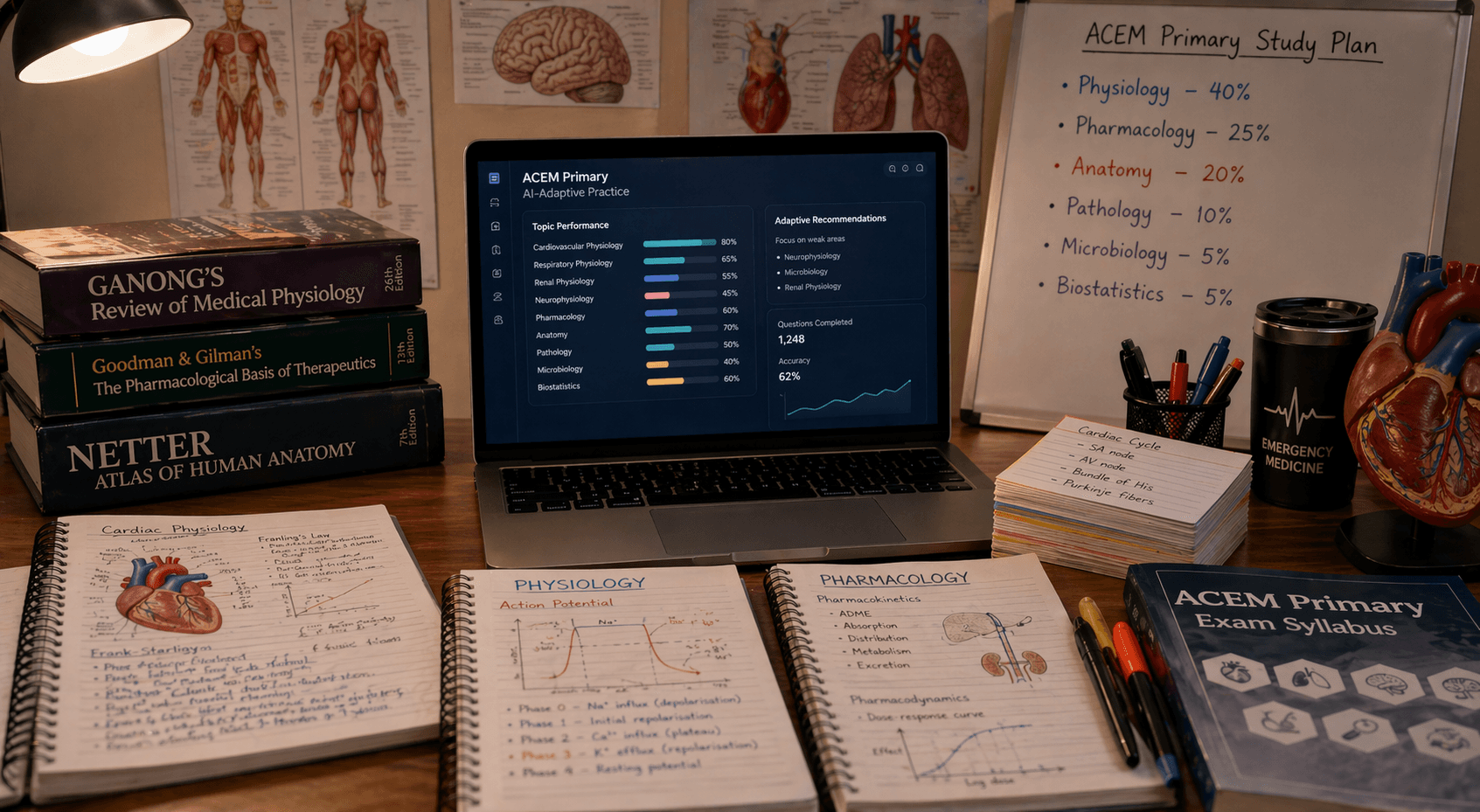
The ACEM Primary Examination is the first of three exams required for Fellowship of the Australasian College for Emergency Medicine. It tests the basic sciences that underpin emergency medicine: anatomy, physiology, pharmacology, pathology, microbiology, and biostatistics.
The ACEM Primary is notoriously physiology-heavy. Candidates who have completed a medical degree with limited physiology teaching often find this exam more demanding than expected. Dedicated physiology revision is not optional — it is the core of the exam.
The Resources
Clintix
Clintix offers a dedicated ACEM Primary Q-bank with exam-style questions covering the basic sciences syllabus.
MedExHub
MedExHub offers ACEM Primary preparation resources including practice questions and study materials.
Primary Exam Preparation
Primary Exam Preparation offers structured ACEM Primary revision resources with a focus on the physiology and pharmacology components.
Textbooks
Ganong's Review of Medical Physiology, Goodman and Gilman's Pharmacological Basis of Therapeutics, and Netter's Atlas of Human Anatomy are standard references for ACEM Primary preparation. The depth of physiology required exceeds clinical-level knowledge — you need to understand mechanisms at a physiological level, not just clinical management.
iatroX — Fellowship clinical revision
iatroX’s ACEM bank targets Fellowship clinical revision. For Primary preparation, choose resources mapped to the Primary basic-science syllabus. iatroX also offers AMC CAT and RACGP AKT banks through all-access, with free samples to inspect each bank.
Inspect the iatroX ACEM Fellowship bank
Study Strategy
Allow 6–12 months for ACEM Primary preparation. The basic sciences syllabus is deeper than most candidates expect from their medical school experience.
Physiology should consume approximately 40% of your revision time. Focus on cardiovascular physiology, respiratory physiology, renal physiology, and neurophysiology — the most heavily tested areas.
Pharmacology should consume approximately 25%. Focus on pharmacokinetics and pharmacodynamics principles, anaesthetic agents, analgesics, cardiovascular drugs, and antimicrobials.
Anatomy should consume approximately 20%. Focus on clinically relevant surgical anatomy — the anatomy you need to know for emergency procedures.
The remaining 15% covers pathology, microbiology, and biostatistics.
Use a dedicated Primary question bank alongside textbook reading, and check its coverage against the official Primary syllabus. The current iatroX ACEM bank targets Fellowship clinical revision, so it should not be selected as a Primary-specific basic-science bank.
Information based on ACEM publications and public sources as of 21 April 2026. Trademarks belong to their owners.