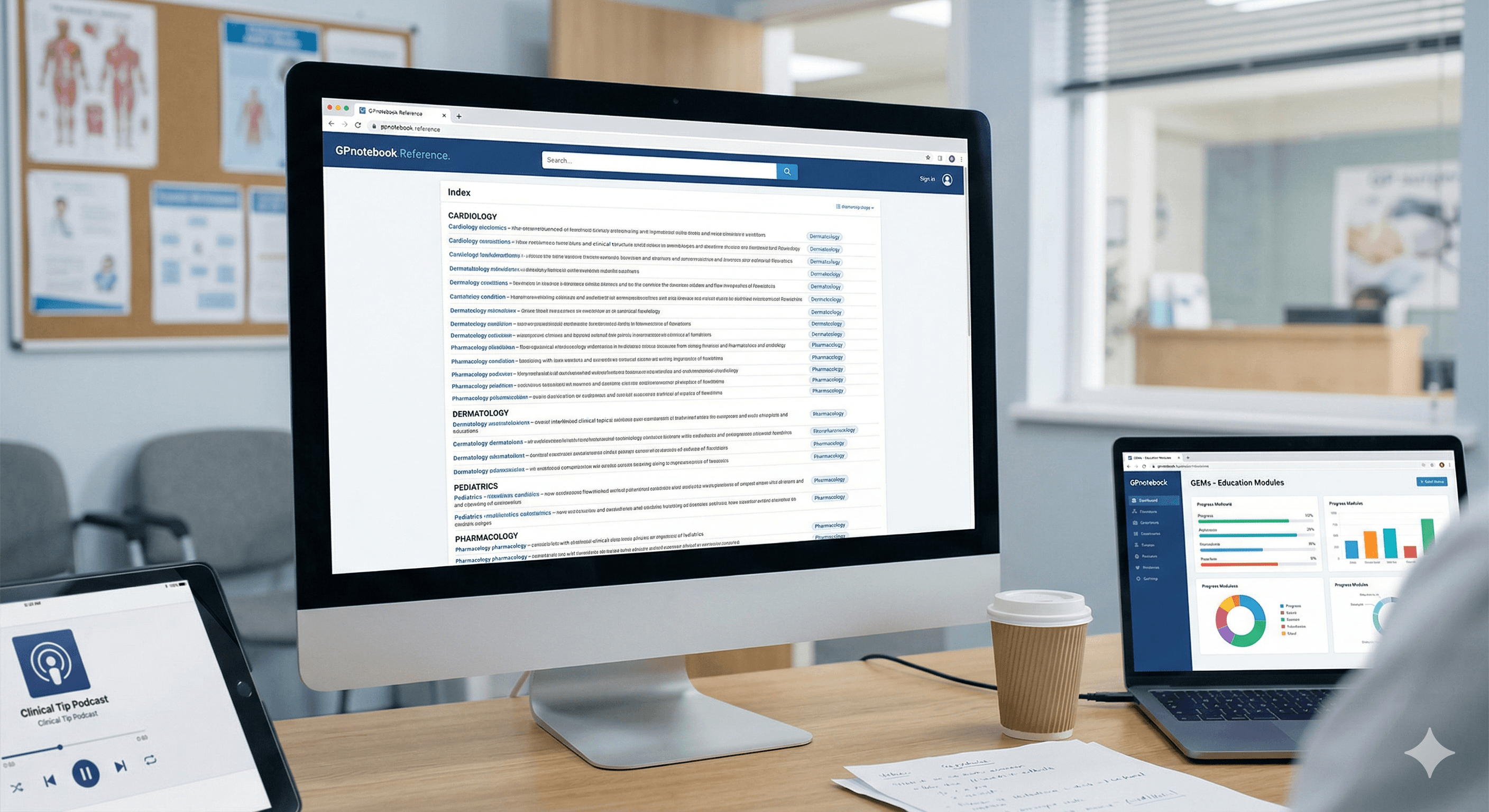
GPnotebook has been open on GP desktops since 2001. It is the instinctive "I'll just check GPnotebook" of a generation of primary care professionals. The platform provides over 30,000 concise, interlinked clinical reference pages — each designed to be scannable during a 10-minute consultation.
What GPnotebook Offers
The core product is the clinical reference library — 30,000+ topic pages covering the breadth of primary care conditions. Pages are short, structured for speed, and interlinked so you can navigate from one condition to related topics quickly. The content is written by practising GPs and updated regularly.
GPnotebook Education Modules (GEMs) — 70+ interactive modules covering clinical and non-clinical topics — add a structured learning layer. These are useful for tutorials, self-directed learning, and filling specific knowledge gaps identified through clinical practice.
The Pro tier adds quizzes with CPD credits, full content access (the free tier has monthly page limits), and reading pattern analytics comparing your usage with other GPnotebook users. The podcast provides bite-sized clinical tips.
Strengths
Breadth and speed. If you need to check the differential for raised ALP during a consultation, GPnotebook provides a concise answer in 15 seconds. The 30,000-page library covers conditions that newer platforms may not yet address. The GEMs are genuinely useful for tutorial preparation — you can work through a module on, say, paediatric respiratory conditions before a paediatrics tutorial and arrive with structured knowledge.
Pro CPD tracking turns daily reading into documented CPD activity — every page view logged, generating evidence for appraisal and revalidation. At £7.99/month or £71.88/year, Pro is reasonably priced for a tool you use daily. The reading pattern analytics — comparing your usage with other GPnotebook users — provide an interesting (if not clinically essential) insight into how your reference habits compare with peers.
Limitations
GPnotebook is a reference tool — it does not have adaptive learning, exam preparation features, or clinical AI. In 2026, with NICE CKS providing authoritative guideline-based management pathways for free, and AI reference tools providing natural-language clinical Q&A, GPnotebook's unique value proposition has narrowed. The evidence quality can vary — some pages may not reflect the most current NICE guidance, and the editorial update cadence is reactive rather than real-time. For guideline-critical decisions (prescribing, referral thresholds), NICE CKS remains the authoritative source rather than GPnotebook.
Who Should Use GPnotebook
GPnotebook remains useful for trainees who want a quick, comprehensive reference during consultations — particularly for rare or unfamiliar conditions where CKS may not have a dedicated page. The GEMs add genuine learning value for tutorials. Pro is worth considering if you use GPnotebook daily and value CPD tracking from your clinical reference activity.
Where iatroX Fits
GPnotebook provides broad reference. iatroX provides guideline-grounded, citation-first answers from NICE/CKS/SmPC — with adaptive revision built in. GPnotebook tells you about a condition. Ask iatroX answers your specific clinical question with a cited guideline reference. Complementary rather than competitive — use GPnotebook for encyclopedic depth, iatroX for guideline-anchored clinical Q&A and adaptive exam preparation.
The Bottom Line
GPnotebook remains a useful clinical reference — particularly for its breadth (30,000+ pages covering rare conditions) and its GEMs (structured learning modules for tutorials). The Pro tier adds CPD tracking value for daily users. In 2026, it faces increasing competition from AI-powered reference tools that provide natural-language clinical Q&A with guideline citations — a workflow that is faster for specific queries than searching an encyclopedic article library. The strongest approach uses both: GPnotebook for comprehensive condition overviews, iatroX for specific clinical questions with cited NICE/CKS/SmPC answers.