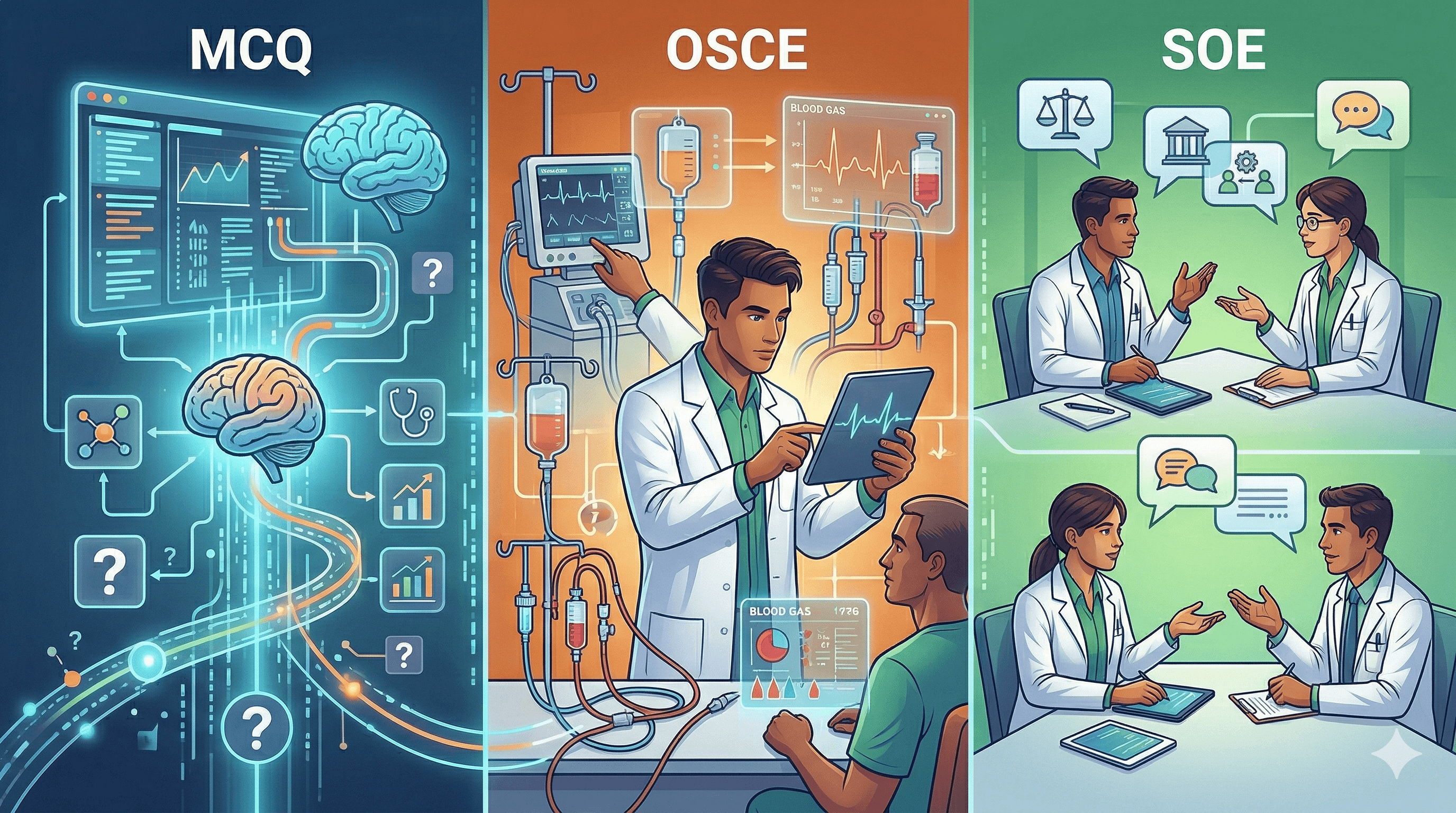
The Fellowship of the Faculty of Intensive Care Medicine is the exit examination for consultant-level intensive care medicine practice in the UK. Three components — MCQ, OSCE, and SOE — test the full breadth of ICM knowledge, clinical skills, and professional competence. It is sat during Stage 2 of standalone ICM training, and approximately 400-500 candidates attempt it per year.
The FFICM occupies a niche in the exam landscape: the candidate pool is smaller than MRCP or MRCGP, dedicated revision resources are scarce, and the exam tests at consultant-level — significantly beyond ALS or basic ICM competence. This guide covers the format, the content, what candidates consistently get wrong, and how to prepare.
The FFICM Structure — Three Components You Must All Pass
MCQ Paper
Tests breadth of factual knowledge in science applied to clinical ICM practice. 130 SBAs: 80 short SBAs (1 mark each) and 50 long SBAs with clinical scenarios (2 marks each). Total: 180 marks. 3 hours. Remote via TestReach platform. Fee: £510.
Must pass the MCQ before booking OSCE/SOE. Pass rate: 84.2% across 2024/25 (336 candidates, FICM Annual Report). Pass mark set using Angoff referencing.
What it tests: Applied physiology (cardiovascular, respiratory, renal, neurological), pharmacology (vasopressors, sedation, antimicrobials, anticoagulants, neuromuscular blockade), microbiology, statistics, and clinical ICM management (sepsis, ARDS, shock states, organ support, renal replacement therapy, nutrition, sedation protocols).
OSCE
13 stations (12 live + 1 test station), 7 minutes each with 1 minute reading time. Four domains: Data, Equipment, Professionalism, Resuscitation. Face-to-face at the RCoA in London. 12 live stations × 20 marks = 240 marks total. Pass mark set by Angoff method. No killer stations, no negative marking.
Data stations: ECG interpretation, blood gas analysis, haemodynamic data, radiology (CXR, CT), laboratory data interpretation.
Equipment stations: Ventilator modes and troubleshooting, vascular access devices, monitoring equipment, airway equipment, RRT circuits.
Professionalism stations: Breaking bad news, organ donation discussions, consent, capacity assessment in ICU, end-of-life care, communication with families.
Resuscitation stations: High-fidelity simulation — managing ICU emergencies in real time. NOT just ALS — the examiners want complex clinical reasoning beyond cardiac arrest algorithms.
SOE (Structured Oral Examination)
4 stations, 14 minutes each, 2 questions per station. Two examiners per station. 3-point grading (0=fail, 1=borderline, 2=pass). Total: 32 marks. Pass mark set by borderline regression. SOE pass rate: 71.6% in October 2024 (126/176 candidates).
At first sitting, OSCE and SOE must be taken together. If you fail one but pass the other, only the failed component needs retaking.
What the Examiners Say Candidates Get Wrong
The FICM publishes Chair of Examiners reports after each diet. The recurring themes are revealing.
Simulation scenarios: Candidates treat every simulation as an ALS-cardiac arrest scenario. The examiners want complex clinical reasoning — ventilation strategies, ethical dilemmas, diagnostic reasoning. When the mannequin has intact physiological signs, do NOT over-escalate. Examine the mannequin (it can display signs) — do not only ask the examiner for information.
Acid-base balance: Described as "mainstream content" but "not well answered." Know all four primary disorders, all compensatory responses, and the clinical interpretation in context.
Microbiology: Sepsis antibiotic selection, de-escalation, antimicrobial stewardship. Neutropenic sepsis: door-to-needle antibiotics within 1 hour.
Hyperosmolar hyperglycaemia: Consistently underperformed across multiple diets.
Acute liver failure: Failing to identify hypoglycaemia as a key management priority.
Communication: Actors playing patients or relatives do not understand medical jargon. Explain terms (inotrope, tracheostomy, filtration) in plain language. The "plain English principle" is explicitly noted in examiner feedback.
ECG stations: Full systematic report expected — patient details, rate, rhythm, axis, intervals, ST/T changes, final interpretation. Not just "it's AF."
Pupils in unconscious patients: Examiners note that candidates fail to check pupils — a basic neurological assessment step that should be automatic.
Best FFICM Revision Resources in 2026
iatroX FFICM Adaptive Q-Bank
iatroX Boards provides 700+ adaptive MCQ questions covering all FFICM science and clinical domains — the only dedicated adaptive FFICM bank. No equivalent exists elsewhere.
Performance dashboard shows proficiency in physiology, pharmacology, clinical ICM, and microbiology separately — so you know which domains are undermining your MCQ performance. Guideline integration covers NICE, FICM/ICS guidelines, and Surviving Sepsis Campaign recommendations. A single subscription includes the FFICM bank alongside DipIMC, DRCOG, DFSRH, DGM, and other specialty Q-banks. MHRA-registered platform.
FICM Official Resources
Free MCQ examples and OSCE video demonstrations on the FICM website. Board of Examiners feedback reports (published after each diet) — essential reading. FICMLearning peer advice blog.
Oh's Intensive Care Manual
The standard ICM textbook. Essential for MCQ science preparation. Dense; use alongside Q-bank practice, not instead of it.
FFICM Prep Courses
ICM Line (Newcastle), SPPICE (Southwest), A-Line VivaMatch (online peer viva practice). Useful for OSCE/SOE simulation practice. No substitute for clinical experience and question-based MCQ preparation.
Kate Flavin's SOE Textbook
"Questions for the Final FFICM Structured Oral Examination." SOE-specific — provides question stems and model answers. Essential for SOE preparation.
20-Week FFICM Revision Plan
Weeks 1-4: MCQ science foundations — physiology (cardiovascular, respiratory, renal, neurological), pharmacology (vasopressors, sedation, antimicrobials, anticoagulants), microbiology. 30-40 iatroX questions daily.
Weeks 5-8: Clinical ICM domains — sepsis, ARDS, shock (cardiogenic, septic, haemorrhagic, obstructive), organ support, renal replacement therapy, neurological emergencies, metabolic emergencies.
Weeks 9-12: Mixed adaptive MCQ sessions. Target weak domains from iatroX performance dashboard. Complete Oh's Manual sections for identified gaps.
Weeks 13-16: OSCE preparation — ECG drills (systematic approach), ABG interpretation, imaging interpretation, equipment familiarisation, communication scenario practice with peers. Attend a prep course if budget allows.
Weeks 17-18: SOE viva practice with a colleague. Structured response frameworks for every question type. Practise talking out loud until it is automatic.
Weeks 19-20: Full mock exam conditions — MCQ timed (3 hours), SOE viva pair practice, OSCE station simulation.
Stage 2 ICM Training Context
The FFICM is sat during Stage 2 of the standalone ICM CCT. You must have passed a relevant Primary exam (FRCA Primary for anaesthetists, Primary MRCP for physicians, or equivalent). Completion of Stage 2 is required after passing FFICM to proceed to Stage 3 and CCT. The pass provides the foundation for consultant-level independent ICM practice.
Guidance Interviews
After a second unsuccessful attempt at the OSCE or SOE, you can request a guidance interview from the Faculty — a structured feedback session with an examiner designed to identify specific improvement areas. Contact FacultyExams@rcoa.ac.uk.
Start at iatroX Boards — the only adaptive MCQ resource for FFICM. Build the science and clinical knowledge base with 700+ curriculum-mapped questions.