For the last twenty years, "clinical search" meant one thing: browsing. You opened a trusted website, typed in a keyword, and scrolled through a summary page to find the paragraph you needed.
In 2026, the paradigm has shifted. We have moved from Information Retrieval (finding a document) to Answer Engines (finding a decision).
While this new technology offers unprecedented speed, it introduces new risks. The clinician who treats an AI answer as "truth" without verification is practicing dangerously. This guide outlines the new hierarchy of search and provides a safe workflow for the modern "10-minute consultation."
The old model (still valuable): encyclopaedias and point-of-care summaries
The "Encyclopaedia" model isn't dead; it has just moved to a specific part of the workflow. When you need to browse a topic to understand its shape, nothing beats a curated, human-authored summary.
GPnotebook = “fast, concise, linked” browsing
GPnotebook remains the archetype of this model. It describes itself as helping busy GPs save time with concise information and frequent updates.
- The Trust Factor: It publishes its editorial process and explicitly cites sources such as journals and national guidance bodies like NICE.
- The Use Case: It is excellent when you know exactly what you are looking for (e.g., "What is the DVLA visual field standard?"). You want a static, immutable fact, not a conversation.
Key Point: Encyclopaedias optimise for certainty. If you need to read the specific wording of a rule, use an encyclopaedia.
The new model: answer engines (AI + retrieval) for point-of-care questions
The "Answer Engine" model optimises for synthesis. It is designed for the questions that don't fit neatly into a single guideline page.
What an “answer engine” is
In plain English, an answer engine is a system where:
- You ask a question in natural language ("How do I switch from citalopram to sertraline?").
- The system retrieves relevant chunks from a controlled trusted corpus (not the open web).
- It generates a structured response with inline citations.
ClinicalKey AI and OpenEvidence as category exemplars
This category has matured rapidly.
- ClinicalKey AI: Elsevier describes ClinicalKey AI as combining trusted clinical content with conversational search powered by generative AI. It is powerful because it sits on top of massive textbook libraries.
- OpenEvidence: Peer-reviewed literature describes OpenEvidence as generating conversational responses using LLMs and drawing from trusted sources for evidence-based medicine recommendations.
Key Point: Answer engines reduce "tab switching" by synthesising three different pages into one answer—but you must verify the linkage between the claim and the citation.
The 2026 search hierarchy
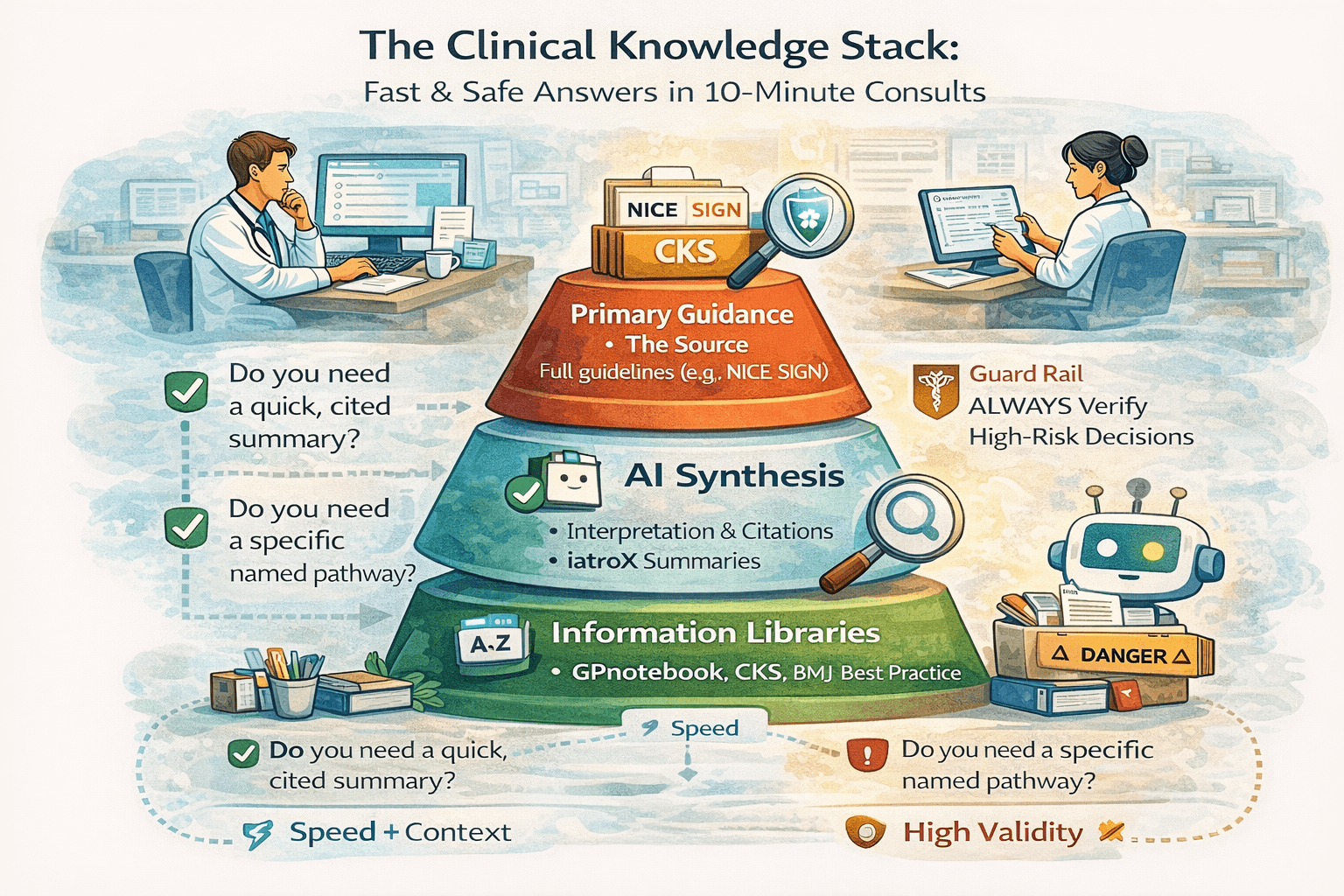
In 2026, smart clinicians do not use one tool for everything. They use a tiered hierarchy depending on the risk and complexity of the question.
The 5-layer clinical search hierarchy (2026)
- Local policy: When it’s a pathway/process decision (e.g., "Which hospital accepts this referral?").
- National guidance: The authoritative UK position (NICE/SIGN).
- Point-of-care summaries / encyclopaedias: Fast browsing for static facts (GPnotebook).
- Primary literature search: When you need the raw data (PubMed / TRIP).
- Answer engine synthesis: Fast structured response + citations (ClinicalKey AI / iatroX).
A safe “10-minute consultation” workflow
How do you use this safely when you are running 20 minutes late? Use this decision tree to start your search.
Start with one of three question types
- “What’s the rule/process?” → Go straight to Guidance / Policy. Do not ask an AI to guess a phone number or a referral criteria that changes locally.
- “What does the evidence say?” → Go to TRIP / PubMed. If you are researching a rare condition, go to the source.
- “What should I do next?” → Use an Answer Engine, then verify. This is the "synthesis" query where AI shines (e.g., "Management of hypertension in a patient with gout").
Verification protocol (anti-hallucination)
Never blindly trust the output. Run this 5-second scan:
- Citation Check: Hover over the citation number. Does the source actually support the specific claim made in the sentence?
- Context Check: Does it match the UK context? (Watch out for "mg/dL" units or US drug names).
- Date Check: Is the source from 2024 or later?
- Change Check: Ask yourself, "What single fact would make this answer wrong?" (e.g., pregnancy status).
- Documentation: If you use the advice, document the source (e.g., "As per NICE NG136"), not the tool.
Where iatroX fits in the 2026 model
iatroX isn't just a search bar; it is a closed-loop knowledge system designed specifically for the UK clinician.
- Grounded Answers: iatroX positions itself as providing "clear, cited answers" by checking a curated library of national guidelines, ensuring it never fabricates advice.
- Triangulation: It triangulates guidelines with peer-reviewed research to provide a complete picture when guidelines are silent.
- Precedent: You can browse the Q&A Library, an index of previously answered questions referencing guidelines and SmPCs, to see how others managed similar cases.
- Retention: Uniquely, iatroX closes the loop. Once you find an answer, you can reinforce it via quiz modes, including adaptive spaced repetition.
- CPD: Every search counts. The system supports CPD logging, reflection prompts, and report generation for your appraisal.
iatroX as a “closed loop” search system: Ask (Answer Engine) → Verify (Citations) → Save (Q&A Library) → Reinforce (Spaced Repetition) → Log (CPD)
Practical toolkit: the “open this first” menu
Set your browser bookmarks to these five entry points.
- Need NHS-funded journals/books? → NHS OpenAthens
- Need biomedical literature searching? → PubMed
- Need evidence-ranked results quickly? → TRIP Database
- Need systematic review synthesis? → Cochrane Library
- Need a structured cited answer fast? → iatroX / ClinicalKey AI / OpenEvidence.
FAQs
What is a clinical answer engine? An answer engine is a tool that uses AI to understand a natural language question, retrieves relevant medical documents, and synthesises a direct answer with citations, rather than just providing a list of links.
Is GPnotebook reliable? Yes. GPnotebook is highly reliable for point-of-care reference. It uses a transparent editorial process and cites trusted national guidance.
Are AI medical search tools safe to use? They are safe if they are used as decision support, not decision makers. Always use tools that provide direct citations to the source text (like iatroX or OpenEvidence) and verify the information before acting.
How do I verify AI answers quickly? Hover over the citation numbers provided in the answer. If the popup text or link matches the statement made by the AI, and the source is a recognised body (like NICE), the answer is likely accurate.
What is the best free evidence search tool for NHS clinicians? For primary research, PubMed is the standard. For guidelines and secondary evidence, the TRIP Database is often faster and groups results by evidence quality.
What’s the difference between PubMed and TRIP? PubMed searches the raw biomedical literature (millions of abstracts). TRIP searches trusted resources and organises them by hierarchy (Guidelines first, then Systematic Reviews, then Primary Research), making it faster for clinical queries.
Ready to upgrade your search workflow? Start by asking iatroX your first clinical question today, or browse our Knowledge Centre to see the new answer engine in action.