Introduction
"ChatGPT" has become a shorthand for AI in healthcare, but for clinical tasks, a general-purpose chatbot is often the wrong tool. While powerful for drafting emails, ChatGPT (even with browsing) lacks the specific safety guardrails, verified knowledge bases, and governance required for safe medical practice.
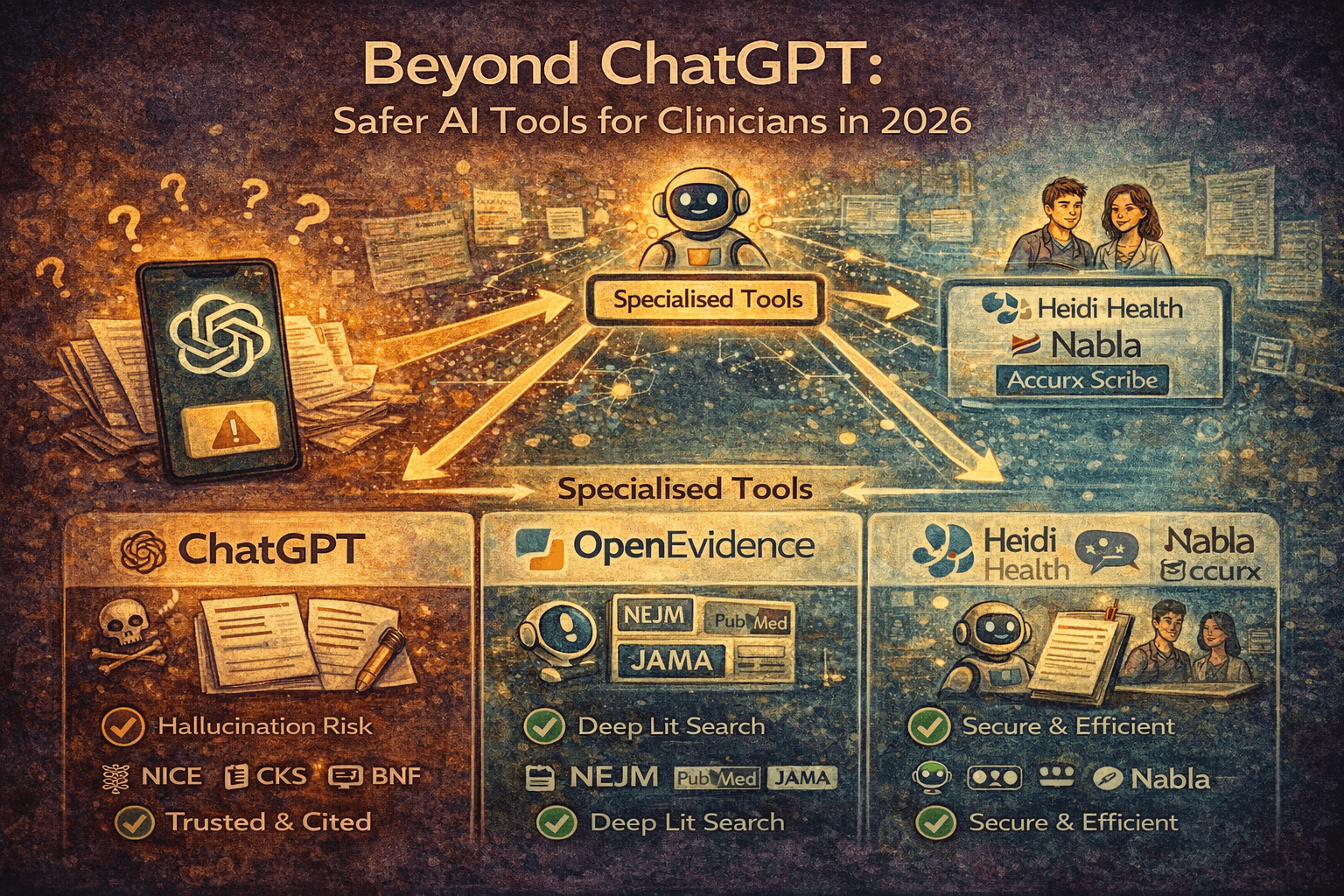
In 2026, the market has matured into specialised tools that outperform general chatbots in accuracy, safety, and workflow integration. This guide provides a practical shortlist of the best alternatives, categorised by the job you need them to do: retrieving evidence or documenting care.
The reliability test (6 signals clinicians should look for)
Before trusting any AI tool with a clinical question or patient data, apply this 6-point reliability test. If a tool fails these, it is a "red flag" for clinical use.
- Bounded Knowledge: Does the AI search the open internet (risky) or a curated "walled garden" of trusted sources like NICE, CKS, and peer-reviewed journals?
- Mandatory Citations: Does every single claim come with a clickable link to the primary source? (Provenance-first design).
- Abstention: Does the model say "I don't know" or "No guideline found" when the evidence is weak, rather than hallucinating an answer?
- Data Sovereignty: For UK clinicians, does the data stay in the UK/EU? Is it GDPR compliant?
- Human-in-the-Loop Workflow: Is the tool designed to force you to verify the output (e.g., reviewing a note before saving)?
- Governance: Does the vendor have a DTAC (Digital Technology Assessment Criteria) pack and a DCB0129 clinical safety case?
Evidence retrieval copilots (vs general chatbots)
These tools are designed to answer clinical questions safely. They replace the "search and sift" process with "ask and verify."
iatroX (Best for UK Clinicians)
- The Difference: Unlike ChatGPT, iatroX is built on a UK-centric knowledge graph. It grounds its answers in NICE, CKS, SIGN, and SmPCs via eMC.
- Why use it: It provides citation-first answers that allow you to verify the guidance instantly. It is free for all users and includes features like an adaptive quiz and CPD logging, making it a comprehensive "clinical companion" rather than just a chatbot.
- Best for: Daily ward queries, GP triage decisions, and exam revision.
OpenEvidence (Best for US/Global Literature)
- The Difference: OpenEvidence is a US-led platform that excels at synthesizing complex peer-reviewed literature from journals like NEJM and JAMA.
- Why use it: It is free for verified healthcare professionals and offers deep, evidence-based summaries for complex questions where guidelines might be silent.
- Best for: Deep research, complex case preparation, and academic queries.
Medwise AI (Best for Local Policy)
- The Difference: Medwise AI specialises in indexing not just national guidance, but local Trust policies and formularies.
- Why use it: If your organisation has deployed it, it is the fastest way to find your hospital's specific protocol for a condition.
Documentation/ambient scribing tools
This is the most mature "real-world" category, where AI listens to a consultation and writes the notes.
The landscape
- Accurx Scribe (powered by Tandem): A leading choice for UK primary care due to its integration with the Accurx toolbar and write-back capability to EMIS/SystmOne.
- Heidi Health: A highly flexible, clinician-friendly tool that allows for customisable templates and "human-in-the-loop" editing.
- Nabla: Known for its speed and privacy-first architecture (no audio retention).
- Tortus: A UK-based tool that has been central to major NHS pilots in secondary care.
The governance mandate
The adoption of these tools is now governed by the NHS England guidance on ambient scribing. This guidance mandates that:
- Patient consent must be explicit.
- The clinician must verify the note before it enters the record.
- The tool must have a clinical safety case (DCB0129) and the deploying organisation must have a risk assessment (DCB0160).
How to choose based on your workflow
For the GP
Priority: Speed and Integration.
- Choice: Accurx Scribe for notes (due to integration) + iatroX for rapid guideline checks between patients.
- Why: You don't have time to switch tabs. You need tools that fit into your existing 10-minute slot.
For the hospital doctor
Priority: Depth and Guidelines.
- Choice: iatroX or OpenEvidence for ward round questions + Tortus or Heidi (if Trust-approved) for clinic letters.
- Why: You need to cite national guidelines in your plans and manage long, complex clinic letters.
For the student / trainee
Priority: Learning and Retention.
- Choice: iatroX (for Q&A + Adaptive Quiz).
- Why: You need to not just find the answer, but learn it. iatroX's ability to turn a clinical query into a revision question helps you prepare for exams like the UKMLA while you work.
FAQ
Is ChatGPT HIPAA/GDPR compliant? The standard, free version of ChatGPT is not compliant for patient-identifiable data. You should never enter patient names or details. Specialised tools like Accurx Scribe or enterprise versions of AI models are designed with these protections in place.
Can AI replace my clinical judgement? No. All these tools are "decision support," not "decision makers." The NHS guidance is explicit: the human clinician remains fully accountable for the final decision and the clinical record.
Are these tools free? iatroX is free for all users. OpenEvidence is free for verified professionals. Most scribing tools (Heidi, Nabla) offer a freemium model with a limited number of consults per month, while enterprise tools like Accurx Scribe are often funded by the practice or PCN.