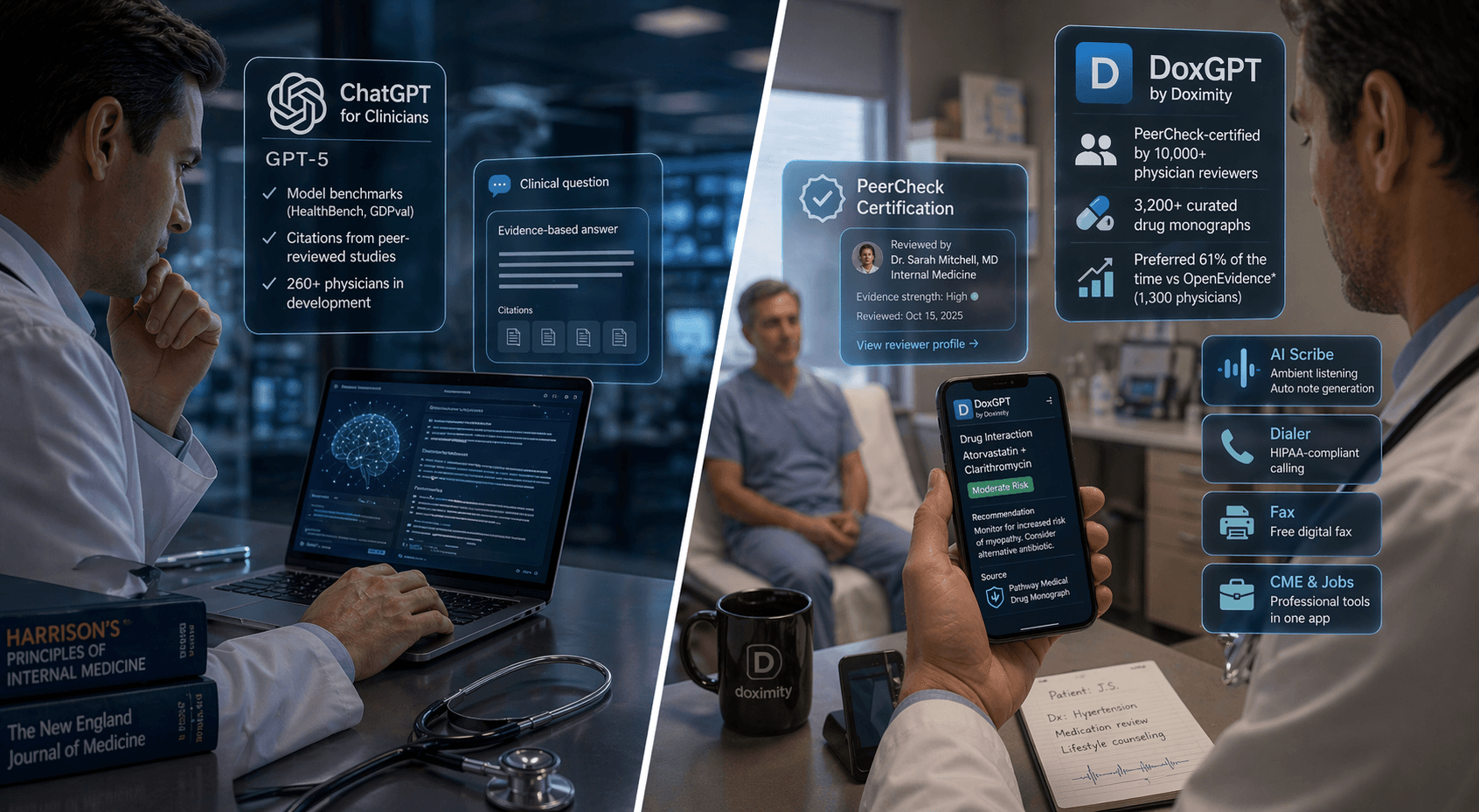
Doximity is where 85% of US physicians already are — over 3 million registered members, 300,000+ clinicians using Doximity's AI tools in the most recent quarter. DoxGPT, bolstered by the August 2025 acquisition of Pathway Medical ($63 million), now includes 3,200+ drug monographs and evidence-based clinical answers verified through PeerCheck by over 10,000 physician reviewers. ChatGPT for Clinicians enters with GPT-5 model power but without a physician network, peer-review layer, or verified drug monograph library.
Trust Model: The Core Distinction
ChatGPT for Clinicians builds trust through model performance — GPT-5 evaluated via HealthBench and GDPval, citations from peer-reviewed studies, 260+ physicians contributing to development. No human peer-review layer on individual answers.
DoxGPT builds trust through physician verification — PeerCheck, co-founded by Eric Topol (cardiologist, Scripps Research) and former US Surgeon General Regina Benjamin. Over 10,000 physician reviewers evaluate and refine DoxGPT's outputs for accuracy, evidence strength, and potential bias. PeerCheck-certified answers display a certification badge with links to reviewer profiles — you can see which physician reviewed the specific answer you are reading. Over 10,000 outputs have been reviewed and verified through PeerCheck to date.
ChatGPT says "trust the model." DoxGPT says "trust the physicians who reviewed the model's output." Both approaches have merit, but the PeerCheck model adds a human verification layer that no other clinical AI offers.
Doximity's own side-by-side evaluation (1,300 physicians comparing DoxGPT against OpenEvidence, UpToDate, and ChatGPT) found DoxGPT preferred as the best clinical answer 61% of the time versus OpenEvidence at 26%. This is company-published data, not independently validated — but the sample size is meaningful.
Ecosystem Integration
ChatGPT for Clinicians is standalone. Clinical Q&A only — no surrounding professional platform.
DoxGPT sits within the Doximity ecosystem: integrated AI Scribe (ambient listening, automated note generation — free, HIPAA-compliant), Dialer (HIPAA-compliant calling from mobile with office caller ID), Fax (free digital fax), professional networking, CME tracking, and job board. DoxGPT is one tap away for physicians who already open Doximity every day for messaging, CME, and career management. The clinical AI is embedded in a platform physicians already live in — not a new app to adopt.
Drug Information
ChatGPT for Clinicians generates drug information from training data and literature. Hallucination risk on doses, interactions, and contraindications — the model may produce plausible but incorrect pharmacological information without structured verification.
DoxGPT includes 3,200+ curated drug monographs acquired through Pathway Medical. Structured, verified reference entries — not AI-generated. When you query a drug interaction on DoxGPT, the answer may draw from a verified monograph rather than a generated response. For pharmacological queries where accuracy is critical, curated monographs are meaningfully safer than AI-generated drug information.
AI Scribe
ChatGPT for Clinicians: None.
DoxGPT: Integrated AI Scribe — ambient listening during patient encounters with automated clinical note generation. Free, HIPAA-compliant. Clinical Q&A and documentation in one app — the scribe captures the consultation while DoxGPT answers the clinical question that arises during it. No context-switching between separate tools.
Geographic Scope and the UK
Both tools are US-focused. ChatGPT for Clinicians is US-first. DoxGPT is US-only (Doximity's network covers US physicians exclusively). Neither serves UK clinicians with UK-specific guideline content.
iatroX is the UK-native clinical AI — MHRA-registered, NICE/CKS/SmPC-grounded, free, with exam preparation and calculators that neither US tool offers.
When to Use Each (for US Physicians)
ChatGPT for Clinicians: Complex clinical reasoning across multiple studies. Literature synthesis. Administrative writing and drafting. Tasks benefiting from GPT-5's broad intelligence.
DoxGPT: Quick lookups within the Doximity app. Drug queries with verified monographs. PeerCheck-certified answers where physician verification matters. AI Scribe alongside clinical Q&A — documentation and decision support in one interface.
UK clinicians: Try Ask iatroX — your clinical AI, built for UK guidelines →