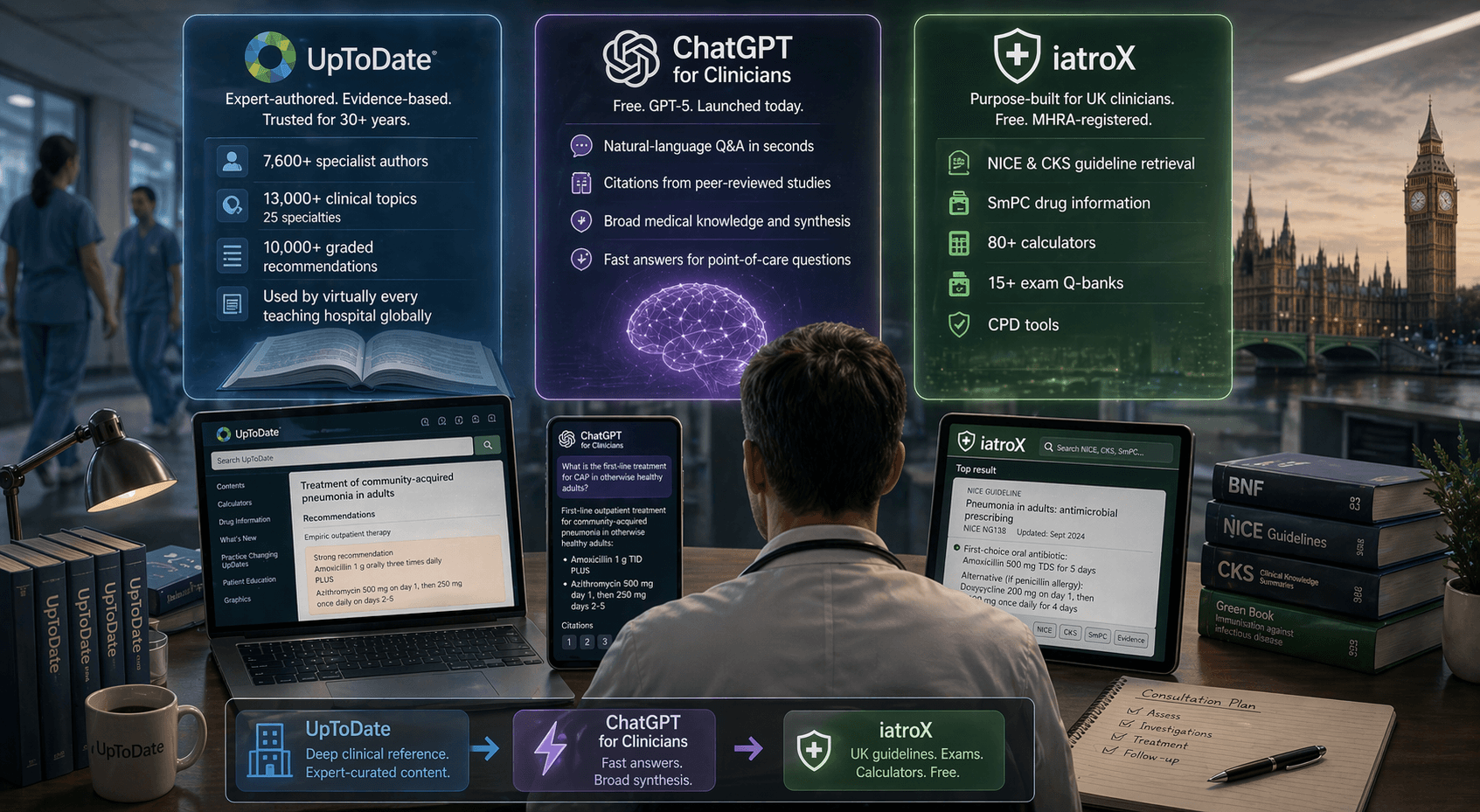
UpToDate has been the gold standard in clinical decision support for over thirty years. More than 7,600 specialist physician authors. Over 13,000 clinical topics across 25 specialties. 10,000+ graded clinical recommendations. Trusted by virtually every teaching hospital globally. Institutional and individual subscriptions costing $500+/year.
ChatGPT for Clinicians is free. And it launched today. The existential question: a tool that is 80% as good at 0% of the cost will capture usage — not because it is better, but because it is good enough.
Content Provenance: The Core Differentiator
UpToDate is expert-authored and peer-reviewed. Over 7,600 specialist clinician authors synthesise evidence and write clinical recommendations. This is not raw literature retrieval — it is expert interpretation, graded by evidence quality, updated continuously, and reviewed through a rigorous editorial process. When UpToDate recommends a treatment, that recommendation has been through the same calibre of expert review as a major textbook chapter — but updated in real time.
ChatGPT for Clinicians uses GPT-5 models trained on broad medical literature, guidelines, and studies. Citations provided. But the synthesis is model-generated, not human-expert-authored. The model may hallucinate, misweight evidence, miss nuance, or fail to contextualise a study's limitations. AI synthesis is fast and broad; expert curation is slow and deep. Both have value. They are not the same thing.
Speed vs Depth
UpToDate requires navigating to a topic page and scanning structured content to find the specific recommendation — comprehensive but potentially slow for point-of-care queries during a 10-minute consultation.
ChatGPT for Clinicians takes a natural-language question and returns a direct answer in seconds — faster for the quick query between patients.
UpToDate Expert AI is Wolters Kluwer's response to this speed gap. Launched late 2025, adopted by 70% of UpToDate's largest enterprise systems, it delivers generative AI responses grounded exclusively in UpToDate's expert-curated content — "UpToDate answers at ChatGPT speed." It now awards CME credits directly within the AI workflow, adding a professional development incentive to every point-of-care interaction.
Wolters Kluwer's Defence Strategy
Wolters Kluwer is not standing still. Their multi-layered defence addresses every angle of competitive threat.
UpToDate Expert AI. GenAI trained exclusively on curated UpToDate content. 70% adoption across largest enterprise systems. CME credit integration — earn professional development credits while making clinical decisions.
Microsoft partnership (March 2026). UpToDate integrated into Microsoft Dragon Copilot (600,000+ users), Microsoft 365 Copilot, and Microsoft Teams. Evidence-based clinical intelligence embedded directly in documentation, communication, and collaboration workflows. All Microsoft-generated content citing UpToDate includes full source citations.
Abridge partnership. UpToDate embedded in ambient scribe workflows — clinical intelligence surfaced at the point of documentation.
UpToDate Connect. API extending UpToDate content into EHRs, HIT systems, and patient-facing applications — making UpToDate the knowledge infrastructure underneath third-party platforms.
The meta-strategy: Make UpToDate the authoritative knowledge layer underneath every AI interface. If ChatGPT, Dragon Copilot, or ambient scribes cite UpToDate as their source, Wolters Kluwer wins regardless of which interface clinicians use. The content becomes infrastructure.
UK Guideline Alignment
UpToDate is a global reference — expert-authored, evidence-based, but not explicitly aligned to NICE, CKS, or UK-specific guidelines. ChatGPT for Clinicians has the same gap — global, not UK-specific.
iatroX fills this gap. Ask iatroX retrieves NICE guidelines, CKS summaries, peer-reviewed literature, and SmPC data — purpose-built for the "what does NICE say?" question UK clinicians ask dozens of times per week.
The Three-Tool Stack for UK Clinicians
UpToDate (via institutional access, for deep clinical reference) + iatroX (free, for UK guideline retrieval, exams, calculators) + ChatGPT (free, for administrative tasks and general research). Three tools, three purposes, comprehensive coverage.
Try Ask iatroX — UK guideline retrieval, free, MHRA-registered →