Introduction
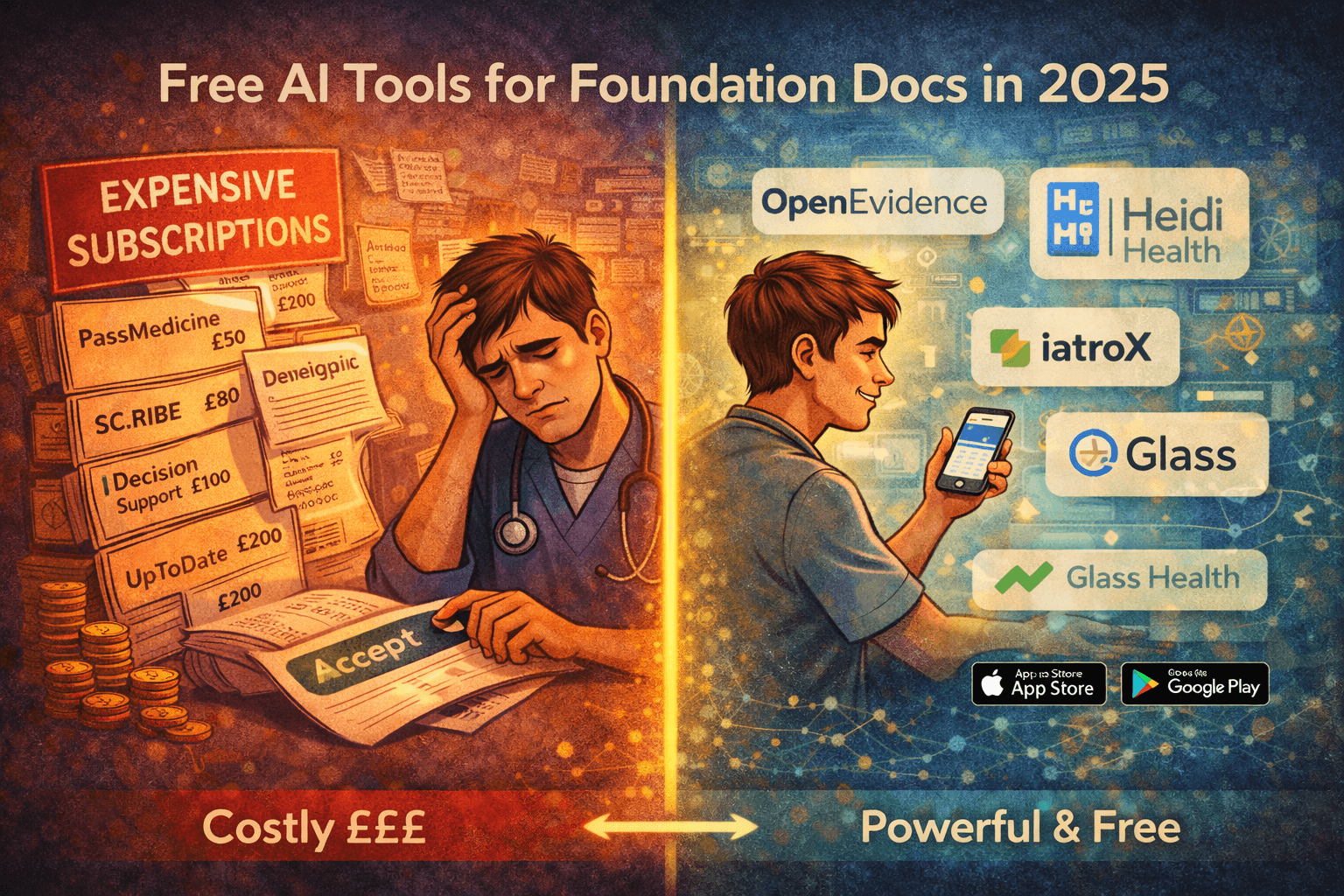
Being a medical student or a Foundation Doctor is expensive. Between exams, indemnity, and GMC fees, your disposable income is non-existent. Yet, the medical industry expects you to pay hundreds of pounds a year for "essential" digital tools.
The good news? In 2025, the best AI tools are often free. You can build a world-class digital stack—covering evidence search, note-taking, and revision—without spending a penny. This guide shows you how to replace the expensive legacy subscriptions with smarter, free AI alternatives.
1. The "UpToDate" alternative: OpenEvidence / iatroX
The Cost: UpToDate Personal Subscription (~£200+/year). The Pain Point: It is the gold standard, but if your Trust or medical school doesn't pay for it, it is unaffordable.
The Free Fix:
- For Guidelines (NICE/CKS): Use iatroX (Free Tier). It gives you instant, cited answers from UK national guidance. It’s perfect for the "what is the first-line antibiotic?" question on the ward.
- For Deep Research: Use OpenEvidence. It is currently free for verified healthcare professionals. Think of it as the AI version of UpToDate. It scans the peer-reviewed literature (The Lancet, NEJM, JAMA) and synthesises a fully referenced answer. It is deeper than a guideline check and perfect for researching complex cases for a presentation.
2. The "scribe" alternative: Heidi Health / Nabla
The Cost: Paid AI Scribes (~£30-£100/month). The Pain Point: You spend 50% of your day typing discharge summaries or clinic letters. You want an AI scribe, but you can't afford the enterprise tools consultants use.
The Free Fix:
- Heidi Health: Offers a generous "Free Forever" tier. It listens to your consult (with consent) and turns it into a structured note, referral letter, or patient summary in seconds. It has usage limits, but for a student or junior doctor doing a few complex clerkings a week, it is a game-changer.
- Nabla: Another powerful option with a robust free tier for individual clinicians. It focuses on speed and safety, generating notes instantly.
- Note: Always check your local hospital's information governance policy before using ambient listening tools.
3. The "tutor" alternative: iatroX (vs. PassMedicine)
The Cost: Q-Bank Subscriptions (~£30-£60 per exam). The Pain Point: You need to revise for the UKMLA or AKT, but your subscription has expired, or you just want to test yourself on a specific topic without buying a whole new bank.
The Free Fix:
- iatroX Adaptive Questioning. iatroX isn't just a search engine; it's a quiz master. Its unique "Ask & Learn" loop allows you to say: "Quiz me on the asthma guidelines I just looked up."
- It generates high-quality, single-best-answer questions based on the actual guidelines, adapting to your level. It turns passive reading into active retrieval practice for free.
4. The "brainstorming" alternative: Glass Health (or ChatGPT)
The Cost: Clinical Decision Support Systems (~£100s/year). The Pain Point: Sometimes you don't need a fact; you need a sounding board. You have a patient with a weird constellation of symptoms and you need to widen your differential.
The Free Fix:
- Glass Health: Offers a free tier for its "AI Differential Diagnosis" tool. You input a one-liner ("30F, recurring fever, joint pain, negative ANA"), and it generates a structured schema of differentials to consider. It’s like having a registrar in your pocket to check your thinking.
- ChatGPT (Free Version): While you should never trust it for facts or doses (it hallucinates), it is excellent for communication. Use it to draft empathetic scripts for breaking bad news, simplify jargon for patient leaflets, or summarise long papers into bullet points.
Conclusion
You don't need to be rich to be efficient. By stacking OpenEvidence for research, Heidi for notes, iatroX for guidelines and testing, and Glass for diagnosis, you have a suite of tools that outperforms most paid subscriptions—for £0.