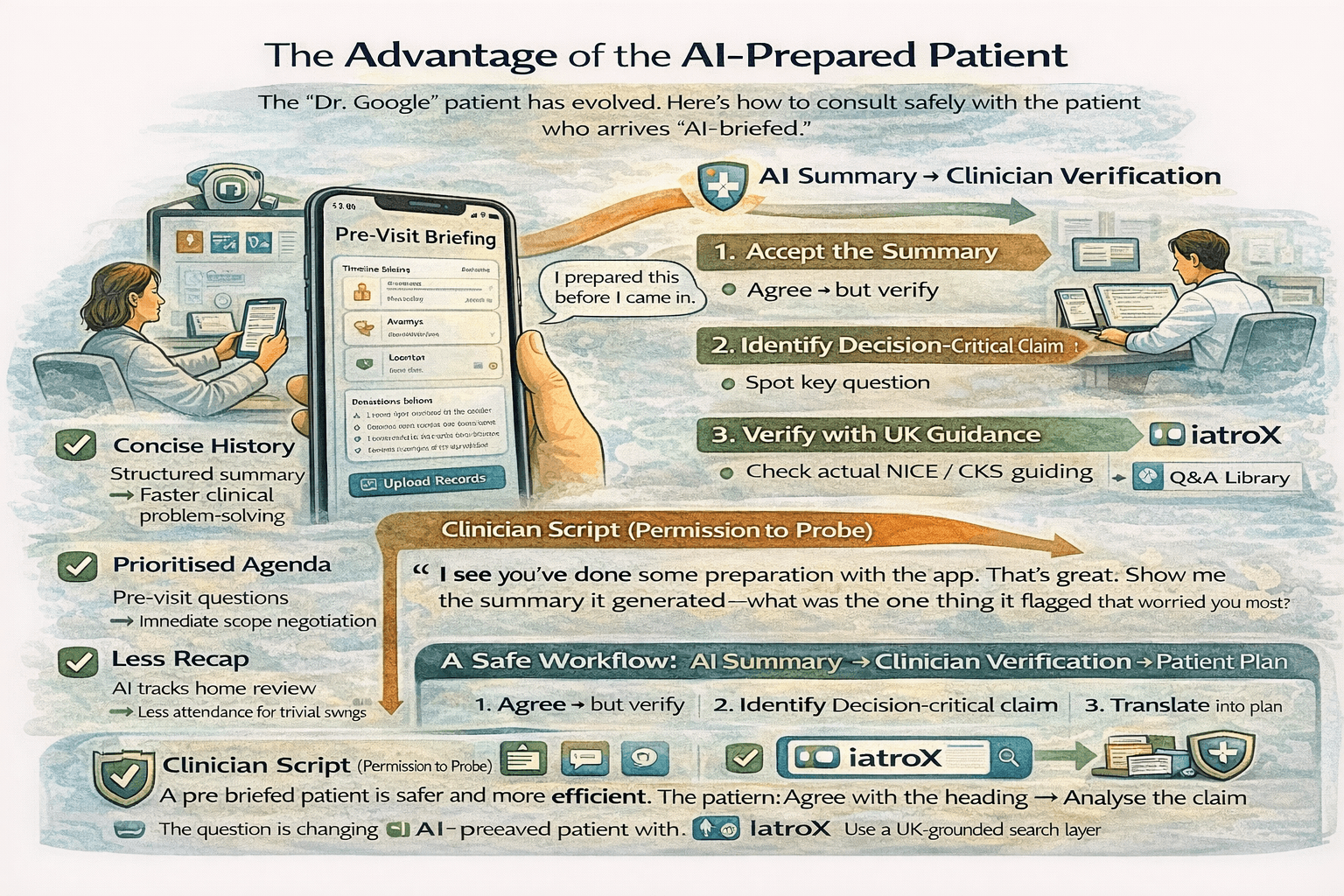
The "Dr. Google" patient is gone. They have been replaced by something far more competent, and potentially far more complex: the "AI-prepared patient."
With the launch of ChatGPT Health, patients can now connect their wearables, blood results, and hospital letters into a single conversational interface before they even step into your room. They won't just arrive with a symptom; they will arrive with a structured narrative, a list of "optimisation" questions, and a tentative hypothesis generated by an LLM that has read their last five years of medical notes.
For the unprepared GP, this is a nightmare of broken 10-minute boundaries. But for the clinician who has a playbook, the AI-prepared patient is actually an opportunity to practice at a higher level.
Here is how to harness the pre-briefed patient without letting the machine run the consultation.
What ChatGPT Health is optimised for
OpenAI has been explicit: this tool is not a diagnostic engine. It is a comprehension and preparation engine.
- Pattern Recognition: It excels at spotting trends over time (e.g., "Your migraines seem to correlate with weeks where your sleep debt exceeds 5 hours").
- Translation: It turns "medicalese" hospital letters into plain English summaries.
- Preparation: It is specifically designed to prompt patients: "What are the top 3 questions you want to ask your doctor tomorrow?"
Three “green zone” benefits in primary care
If you can steer the patient away from "diagnosis" and toward "summary," the AI does the heavy lifting of the first 3 minutes of the consult.
1. Better history structure Instead of a rambling 5-minute narrative starting in 1994, the AI-prepared patient often presents a "Timeline, Meds, Concerns" structure.
- Benefit: You get to the core clinical problem in 60 seconds.
2. Better agenda setting The "doorknob question" (the issue raised as the patient leaves) is a major cause of late running. ChatGPT Health encourages users to generate an agenda list before the appointment.
- Benefit: You can negotiate the consultation scope at the start: "I see you have 4 questions here; let's tackle the chest pain and the medication review today."
3. Improved follow-up adherence Patients often forget safety-netting advice. A patient using ChatGPT Health can record (with permission) or input your summary to generate a "What to monitor at home" checklist.
- Benefit: Reduced unnecessary re-attendance for minor variations in symptoms.
Three predictable failure modes
The tool is not perfect. You need to be ready to intercept these three specific errors.
1. Overinterpretation of labs (False Certainty) The AI sees a lymphocyte count of 0.9 (ref 1.0–4.0) and flags it as "Low / Immune Compromise," not understanding that in the context of a viral URTI, this is irrelevant.
- Risk: You spend 8 minutes reassuring a well patient rather than treating a sick one.
2. Context loss The AI might suggest "optimising sleep hygiene" for fatigue, missing the fact that the patient is a new mother or has undiagnosed anaemia. It lacks the "whole person" intuition.
3. Health anxiety amplification While OpenAI has tuned the model to avoid alarmism, it can still create "spirals" where a patient monitors benign physiological variance (like HRV dips) and interprets it as pathology.
The clinician’s script
Do not fight the AI; validate it, then verify it. Use these verbatim scripts to take control back.
To set the agenda: "I see you've done some preparation with the app. That's great. Show me the summary it generated—what was the one thing it flagged that worried you most?"
To handle a specific AI claim: "That's an interesting pattern it spotted. Let's look at the raw data together. The AI is good at finding trends, but I need to check if that trend is actually medically significant for you."
To close the consultation: "The app suggested X, but based on your examination today, the UK guidance actually recommends Y. I want us to follow the national safety guidance on this one."
A safe workflow: ‘AI summary → clinician verification → patient plan’
Don't let the AI dictate the flow. Use this 4-step mental model:
- Accept the summary: Treat the AI output like a referral letter from a junior colleague—useful, but requires checking.
- Identify decision-critical claims: Is the patient asking for antibiotics because the AI said "bacterial probability high"? Isolate that specific claim.
- Verify with UK sources: Check the actual guideline (NICE/CKS).
- Translate into plan: Give the definitive clinical decision, explicitly overriding the AI if needed.
Where iatroX fits
If the patient is using a US-trained consumer AI to prepare, you cannot just use "memory" to respond. You need a tool that is faster and more accurate than theirs.
iatroX is the clinician’s verification-speed layer.
- While they look at their "Health Summary," you use Ask iatroX to retrieve the specific NICE CKS management protocol.
- It allows you to say: "I checked the current UK guidelines just now, and for this specific heart rate trend, we don't need to treat unless you have symptoms."
- Use the Q&A Library to see how other GPs are handling "wearable-induced anxiety" without over-investigating.
Summary for GPs ChatGPT Health will increase the number of patients who arrive "pre-briefed." The clinician advantage is to treat AI outputs as agenda-setting and comprehension tools, not decisions. A safe consultation pattern is: AI summary → identify decision-critical claims → verify in UK guidance → convert into a plan with safety-netting.