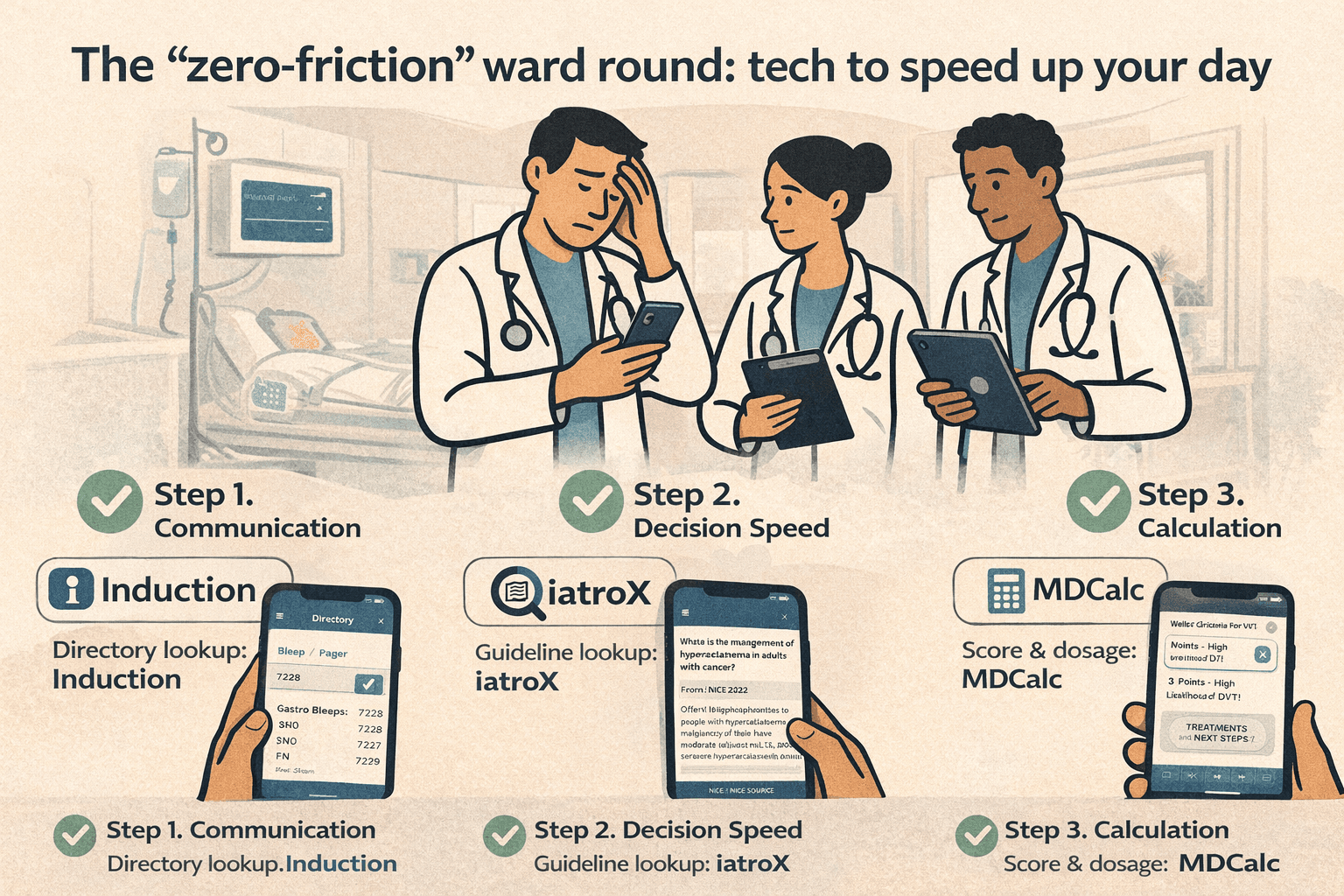
The "zero-friction" ward round: tech to speed up your day
The problem: "the crumpled patient list"
We all know the feeling. It’s 11 AM, the ward round is dragging, and you are clutching a crumpled, coffee-stained patient list. You need to call a registrar, but you don't know the bleep number. You need to check a guideline, but the only computer on the ward is being used by a pharmacist. You need to calculate a score, but your brain is foggy from a night shift.
This friction—the accumulated seconds and minutes lost to "scut work"—is what makes the day feel endless. It pulls you away from the patient and turns you into an administrator. But there is a better way. By building a "zero-friction" tech stack on your phone, you can automate the admin and get back to the medicine.
Step 1: communication (stop waiting for switchboard)
The biggest time-sink in a hospital is communication. Waiting for the switchboard to connect you, or chasing a bleep that never answers, is wasted time.
- The Directory: Induction (or Accurx Switch) Stop calling "0". These apps act as a crowdsourced directory for almost every hospital in the UK. You can find extension numbers for wards, labs, and secretaries in seconds. If you need the gastro registrar on-call, the number is likely there. It turns a 5-minute ordeal into a 10-second dial.
- The Messenger: Pando or Siilo WhatsApp is great for your social life, but it’s a governance nightmare for clinical data. Secure messaging apps like Pando or Siilo are GDPR-compliant and designed for the NHS. They allow you to share photos of wounds, X-rays, or ECGs securely with your team or a specialist, speeding up referrals and decision-making without breaching confidentiality.
Step 2: decision speed (stop log-ins)
The second biggest bottleneck is the "intranet hunt." When a consultant asks a question, the old way involves finding a PC, logging in with a smartcard, navigating a slow intranet, and searching for a PDF.
- The "Pocket Registrar": iatroX
Think of iatroX as your digital registrar in your pocket. Instead of queuing for a computer, you can check a dose, verify a guideline, or review a management pathway while walking between beds.
- Example Scenario: On a ward round, the consultant asks for the "hypercalcaemia protocol." Instead of saying "I'll go check the intranet" and disappearing for 15 minutes, you pull out your phone, ask iatroX, and have the summary in 10 seconds. You look efficient, the round keeps moving, and the patient gets the right care faster.
Step 3: calculation (maths is risky)
Mental arithmetic is dangerous, especially when you are tired or stressed. A small error in a risk score can change a patient's management pathway.
- The Standard: MDCalc Never calculate a Wells Score, CHA₂DS₂-VASc, or CURB-65 in your head. MDCalc is the gold standard. It not only does the maths for you but also provides the evidence behind the score and "next step" advice. It ensures your documentation is robust and your risk stratification is accurate.
The "zero-friction" philosophy
The goal of this tech stack is not to have more apps; it's to have less friction. The philosophy is simple: if an app takes more than three taps to get you an answer, delete it.
Your tools should be instant, reliable, and invisible. They should handle the directory lookups, the guideline searches, and the calculations so that your brain is free to focus on what actually matters: the patient in front of you.