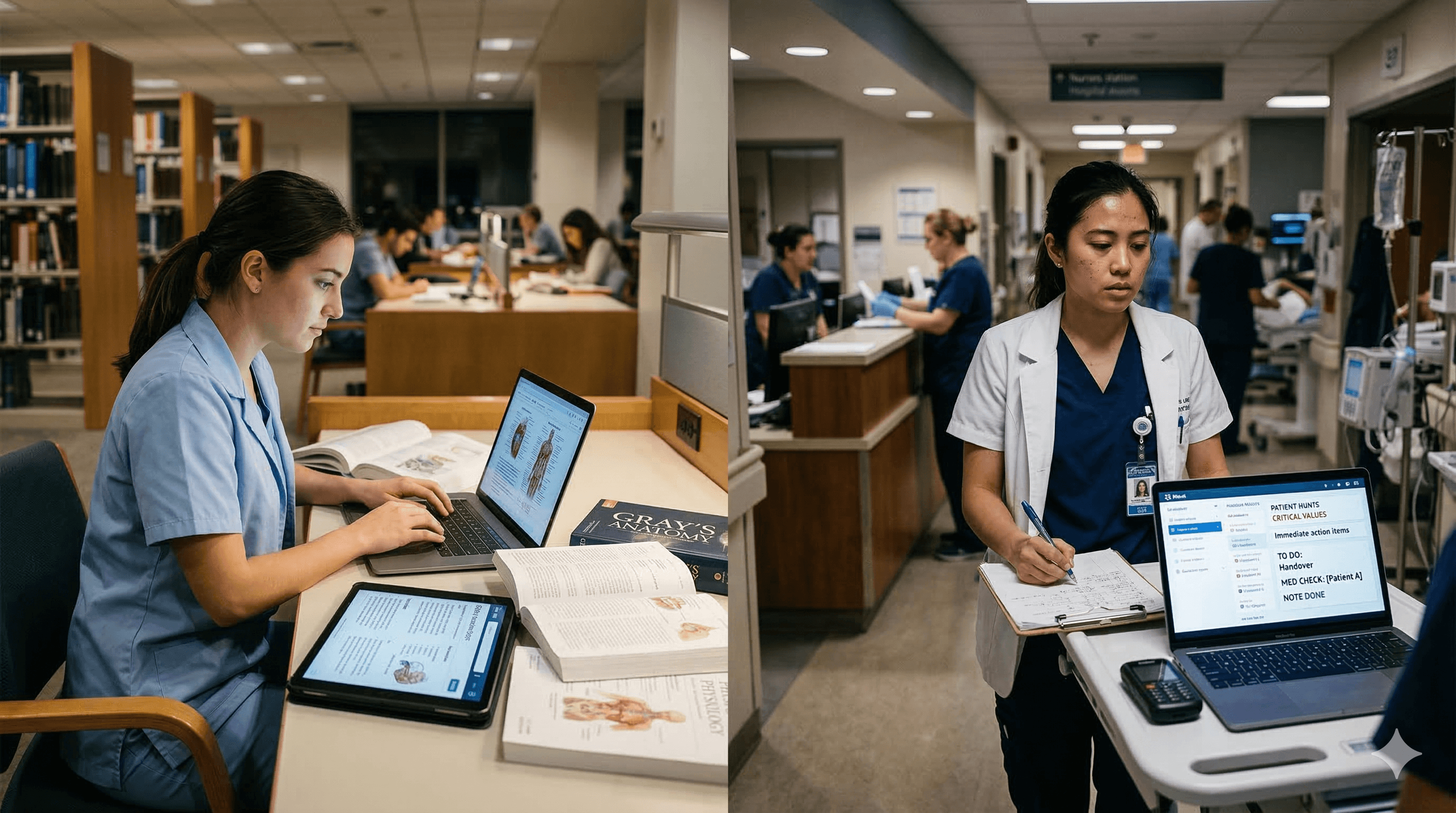
Medical students usually use AI to understand more.
Residents use AI because they must act faster, document better, remember under pressure, and make fewer mistakes.
That distinction is more important than it sounds. A great deal of discussion about AI in medicine still assumes a simple progression model: students use the basic tools, then residents use the more advanced versions of the same tools. In practice, that is not how the transition feels.
Residency does not merely increase complexity. It changes the job.
The resident is not just a student with less time. The resident works inside interruption, handover, cross-cover, documentation burden, ambiguous responsibility, escalating urgency, and persistent fatigue. That changes what “useful AI” actually means.
A student can tolerate a long explanation. A resident often cannot.
A student may want conceptual depth first. A resident often needs an answer path first.
A student can study in blocks. A resident often learns in fragments.
A student uses AI to build understanding. A resident often uses AI to protect performance under pressure.
That is why residents do not simply need smarter flashcards or more polished study copilots. They need an AI layer that respects clinical time, uncertainty, and fatigue.
The role shift changes everything
The environment of residency is structurally different from the environment of medical school.
The student’s day is still, to a meaningful degree, organised around learning. Even on placement, there is more room for observation, slower explanation, and delayed consolidation. The resident’s day is organised around responsibility under supervision. Learning still happens, but it happens while carrying more operational burden.
That changes the shape of demand.
Residents work in a world of:
- interruptions
- handovers
- cross-cover
- partial information
- inboxes and messages
- note-writing
- time-compressed decisions
- “what do I need to do first?” problems
- uncertainty that has to be managed before it is fully resolved
This is why an AI tool that feels brilliant in finals or board-style prep can suddenly feel too slow, too verbose, or too detached once residency starts.
The question is no longer only, “Can this explain the concept well?”
It becomes:
- can this help me orient quickly?
- can it reduce friction?
- can it make my next move clearer?
- can it support judgment without creating more work than it removes?
That is a different standard.
What students mainly want from AI
Medical students usually want AI for one of five broad jobs.
1) Explanation
They want difficult material turned into something clearer and more digestible.
2) Tutoring
They want stepwise teaching, simplification, analogies, and help filling conceptual gaps.
3) Summarisation
They want notes, lectures, or dense topics compressed into something easier to review.
4) Question-bank support
They want help understanding why an answer was right or wrong, and what pattern they missed.
5) Exam planning
They want structure: what to study, how to revise, what resources to use, how to organise the next few weeks.
These are all legitimate needs. But they are needs shaped by an educational environment in which the primary output is still learning performance.
That is why many “student AI” tools lean towards:
- fuller explanations
- greater verbosity
- more pedagogical tone
- broad summarisation
- high tolerance for theoretical depth
Those same features can become liabilities in residency.
What residents mainly want from AI
Residents still need explanation and learning. But the centre of gravity moves.
What residents often want most is:
1) Fast clarification
Not a chapter. Not a long tutorial. A concise, usable orientation that helps them move.
2) Concise evidence lookup
They need something closer to point-of-care reinforcement than to abstract study.
3) Hypothesis broadening
When the case is still vague, they need help avoiding premature closure and asking better next questions.
4) Note and message support
Residents often need help reducing admin drag: concise wording, structured summaries, clearer communication.
5) Prescribing cross-check prompts
Not blind trust in general AI, but help recognising where medication decisions deserve extra caution and verification.
6) Memory reinforcement during clinical work
They are still learning, but the learning is now entangled with service. The useful tool is the one that helps them retain while working, not only revise after hours.
That is why the best resident tools are usually not the most “educational” in the traditional sense. They are the ones that convert compressed time into safer action and cleaner understanding.
The seven resident-specific needs
This is the central shift.
Residents need AI that is shaped around seven realities that matter less in student life and much more in residency.
1) Time compression
Residents do not simply have less time. They have more fragmented time.
A student may have two focused hours to understand a topic. A resident may have ninety seconds before a page, five minutes between tasks, or a brief pause after sign-out. That means the useful AI layer is often the one that works under compression without collapsing into noise.
2) Handover quality
Students rarely live and die by handover clarity in the same way residents do. Residents need tools that help sharpen summaries, clarify active issues, and support the transfer of responsibility without bloating the communication.
The issue is not eloquence. It is usable precision.
3) Uncertainty framing
Students often study after the problem has already been framed by the lecturer, the stem, or the textbook chapter. Residents often begin in the fog.
“What is this likely to be?” is only part of the problem.
“What should I be considering?” and “what would make me more worried?” are often the more urgent questions.
That is why residents need tools that help with uncertainty management, not just answer retrieval.
4) Escalation support
Residents constantly face the practical question: what do I do myself, what do I monitor, and what do I escalate now?
This is not purely a knowledge issue. It is a communication-and-prioritisation issue. The useful AI layer is one that helps make the next move clearer rather than simply displaying more content.
5) Documentation assistance
Documentation is not just administrative overhead. It is part of safe workflow, continuity, communication, and medicolegal clarity.
Students can often ignore this layer until late. Residents cannot.
That is why documentation support becomes much more central in residency than it is in medical school.
6) Cognitive offloading under fatigue
This point is underrated.
Residents do not use AI only because they are busy. They use it because fatigue changes cognition. Memory retrieval becomes less reliable. Working memory becomes thinner. Premature closure becomes easier. Small phrasing and checking tasks feel heavier.
A good resident AI layer is not only informative. It is cognitively relieving.
7) Retention in parallel with service work
Residents are still in a learning-heavy phase, but they cannot keep using student-style study systems unchanged. They need reinforcement that lives closer to the workflow.
The ideal tool does not ask them to choose between service and memory. It helps clinical friction become educationally useful.
Why some “student AI” fails in residency
This is where many people feel vaguely disappointed without being able to name why.
A tool that worked beautifully in finals can fail in residency because it is:
Too verbose
Residents do not always need the fully expanded answer. They often need the shortest answer that is still safe and useful.
Too pedagogical
A tutor voice can feel helpful when you are learning a system from scratch. It can feel inefficient when you are trying to manage five active jobs and one urgent uncertainty.
Too abstract
Residents often do not need a beautifully explained disease. They need a practical route through the presenting problem in front of them.
Too detached from workflow
If the tool does not understand note logic, escalation logic, cross-cover, medication caution, or clinical prioritisation, it may still be educationally strong and operationally weak.
Too explanation-first when the user needs answer-path first
This is the clearest failure mode. A resident often needs:
- orientation
- next-step logic
- then explanation
Many student tools reverse that order.
That reversal is not wrong in education. It is often wrong in residency workflow.
The best AI stack for residents is narrower and sharper
A common misconception is that residents need a larger stack than students.
In one sense that is true: residency introduces more jobs. But the useful stack is usually narrower and sharper, not broader and more cluttered.
Residents usually do better with a small system in which each layer has a clear purpose:
Documentation layer
For notes, letters, summaries, inbox-type work, or admin drag.
Evidence and quick-clarification layer
For fast source-aware orientation when the likely problem is already forming.
Differential-broadening layer
For the early uncertainty window, when the main job is not management yet but better framing.
Medication-verification layer
For safety, especially in high-risk prescribing zones.
Reinforcement and learning layer
So that clinical uncertainty becomes memory and not just momentary reassurance.
That is why the strongest resident AI setup is usually not maximalist. It is low-friction.
If you want the broader stack logic already laid out, the most relevant internal route is The AI stack for new residents: documentation, evidence, differential, prescribing, revision.
What this means by resident type
Not every resident needs the same emphasis.
Busy prelim or transitional year resident
Usually needs:
- quick clarification
- documentation help
- medication caution support
- low-friction reinforcement
Medicine intern
Usually needs:
- evidence lookup
- differential broadening
- medication verification
- retention support
- note logic
Surgical intern
Usually needs:
- fast workflow help
- concise communication support
- documentation efficiency
- targeted clarification rather than long-form teaching
IMG entering a new system
Usually needs:
- explanation that stays clinically practical
- help with local workflow expectations
- stronger reinforcement of reasoning and communication norms
- support that reduces cognitive load rather than adding more content
Outpatient-heavy resident
Usually needs:
- documentation support
- quick evidence checks
- medication safety
- concise patient-facing and clinician-facing communication help
This matters because the right stack is shaped by role friction, not only by specialty prestige or product marketing.
Where iatroX fits
This section works best when it is disciplined.
iatroX should not be framed here as a universal replacement for documentation tools, evidence tools, DDx tools, or dedicated medication references. That would weaken the article and flatten the category.
A much stronger framing is this:
iatroX is especially useful for the clinician who still wants educational depth, but in a more practice-oriented and workflow-relevant form.
That is an important distinction.
Residents still need learning. But they need learning that respects:
- time compression
- uncertainty
- fatigue
- practical clinical reasoning
- movement between service work and retention
That is where iatroX fits most naturally.
If a documentation layer helps you record, and an evidence layer helps you check, iatroX fits best as the layer that helps you understand, reinforce, and think more clearly through what you are actually seeing in practice.
That makes it especially relevant for residents who want:
- clinician education that stays operational
- structured knowledge reinforcement
- a bridge between question-bank logic and clinical reasoning logic
- guidance-aware explanation rather than pure answer generation
The cleanest internal links here are:
- How iatroX works
- Clinical Q&A Library
- A-Z Clinical Knowledge Centre
- Academy
- What AI tool should a doctor actually use?
- The AI stack for new residents
Common mistakes people make in this transition
Mistake 1: assuming student tools scale automatically into residency
They often do not. The workflow changes too much.
Mistake 2: choosing AI by cleverness rather than by job
Residents need the right tool for the right phase of thinking, not the most impressive general demo.
Mistake 3: overvaluing explanation and undervaluing friction
A slightly less beautiful answer that is faster, clearer, and easier to use may be more valuable in residency.
Mistake 4: using one tool for every task
Documentation, quick clarification, DDx broadening, medication checking, and learning remain meaningfully different jobs.
Mistake 5: forgetting that residents still need retention
The form changes, but memory still matters. Residency is not post-learning. It is parallel learning under service pressure.
FAQs
Do residents need different AI tools from medical students?
Usually yes. Residents do not just need more advanced student tools. They often need different things: speed, prioritisation help, uncertainty framing, documentation support, and memory under fatigue.
What is the biggest difference between student AI and resident AI?
Student AI is often explanation-heavy and tutoring-oriented. Resident AI needs to be more workflow-aware, concise, and useful under time pressure.
Should residents prioritise documentation tools or evidence tools?
It depends on where the main friction sits. If admin drag is the pain point, documentation tools may matter more first. If uncertainty and rapid clinical clarification are the main issue, evidence or reasoning tools may matter more.
Do residents still need educational AI?
Absolutely. But it needs to be more practice-oriented. The best educational layer in residency is the one that fits alongside clinical work rather than demanding a separate study universe every day.
Where does iatroX fit if I already use an evidence tool?
iatroX fits best as the reinforcement and structured-clarification layer: the part of the stack that helps connect quick answers to deeper understanding and more practical clinical reasoning.
Conclusion
Residents do not need a smarter flashcard.
They need an AI layer that respects clinical time, uncertainty, and fatigue.
That is the real shift.
Medical students usually use AI to understand more.
Residents use AI to act more safely, document more cleanly, remember under pressure, and make fewer mistakes while still learning in parallel.
That is why the best resident tools are not simply “more advanced student tools”. They are different in shape:
- faster
- sharper
- more workflow-aware
- more tolerant of interruption
- more useful under uncertainty
- more realistic about cognitive load
Choose AI by job and context, not by the assumption that student tools will scale automatically into residency.