Executive summary
Ubie is a rapidly growing AI symptom checker that differentiates itself with a strong emphasis on physician supervision and clinical evidence. For UK clinicians, it represents a sophisticated "digital front door" tool that patients are increasingly using before they arrive in primary care.
While Ubie boasts an impressive editorial policy and a database built on 50,000+ publications, it is critical to understand its limitations. It is a patient information tool, not a diagnostic device for clinicians. This guide reviews Ubie's reliability, its UK governance status, and how to manage the patient who presents with a Ubie report, while positioning professional tools like iatroX as the correct choice for evidence-based clinical decision support.
What Ubie is (and what it says it is)
Ubie is a free AI symptom checker available via web and app.
- The Workflow: Patients answer a series of questions about their symptoms. The AI generates a report listing potential causes and advice on "when to see a doctor."
- The Positioning: Ubie highlights its rigorous development process, stating that its algorithms are continuously monitored and refined by a team of over 50 medical experts. It claims to be used by over 100 million people globally (Ubie Symptom Checker).
The transparency assets: why Ubie is worth discussing
Ubie stands out for its transparency regarding its data sources, which is a key indicator of quality in the AI space.
- Clinical Data Sources: Ubie states that its symptom checker is built on a database of over 50,000 medical publications. It lists authoritative sources, and notably, it references the NHS among its data inputs, suggesting relevance to the UK context (Ubie Symptom Checker).
- Editorial Policy: The company publishes a clear editorial policy committing to precision, neutrality, and doctor supervision. This transparency doesn't guarantee correctness in every case, but it is a meaningful differentiator from "black box" apps that hide their workings.
What Ubie explicitly says it cannot do
It is vital for UK clinicians to read the fine print. Ubie's Terms of Service are explicit:
"The Services are for informational purposes only... The Services do not constitute medical advice or a diagnosis... The Services are not a substitute for a qualified professional."
The Clinical Takeaway: You cannot treat a Ubie report as a clinical handover or a diagnostic referral. It is patient-reported context, nothing more.
Evidence: how Ubie talks about accuracy
Ubie references internal and external validation studies, often citing metrics like "top-10 hit accuracy" (how often the correct condition appears in the top 10 suggestions). While some studies, such as those on medRxiv, show promising results, clinicians should interpret "vignette studies" with caution. Real-world patients are messier than textbook vignettes. Systematic reviews of symptom checkers generally show that while they are improving, they still lag behind human physicians in diagnostic accuracy (Nature).
UK practice lens: what happens when patients use Ubie
When a patient arrives with a Ubie report, use this opportunity to build trust:
- Acknowledge: "It's great you've thought about your symptoms. Let's look at what you found."
- De-risk: "Ubie suggested [Rare Condition X]—let's check for the specific red flags that would make us worry about that."
- Documentation: "Patient presented with symptom checker report suggesting [X]. Clinical history and exam rule out [X] due to [Y]. Safety netting provided."
The reliability checklist: 12 questions to ask any symptom checker
If your practice or PCN is considering recommending a tool, apply this test:
- Source Transparency: Can you see where the data comes from? (Ubie: Yes).
- Update Discipline: Does it show when the content was last reviewed?
- Pathway Localisation: Does it know your local A&E is closed at night? (Most global apps: No).
- Governance Posture: Is it regulated as a medical device in the UK?
- Data Privacy: Is patient data sold or shared?
- Uncertainty: Does it say "I don't know"?
- Red Flags: Does it reliably catch sepsis/MI/stroke?
- Authorship: Are the medical directors named?
- Funding: Is the business model transparent?
- Accessibility: Does it work for non-native English speakers?
- Escalation: Does it tell patients to call 999/111 in an emergency?
- Evidence: Is there peer-reviewed validation?
Where iatroX fits
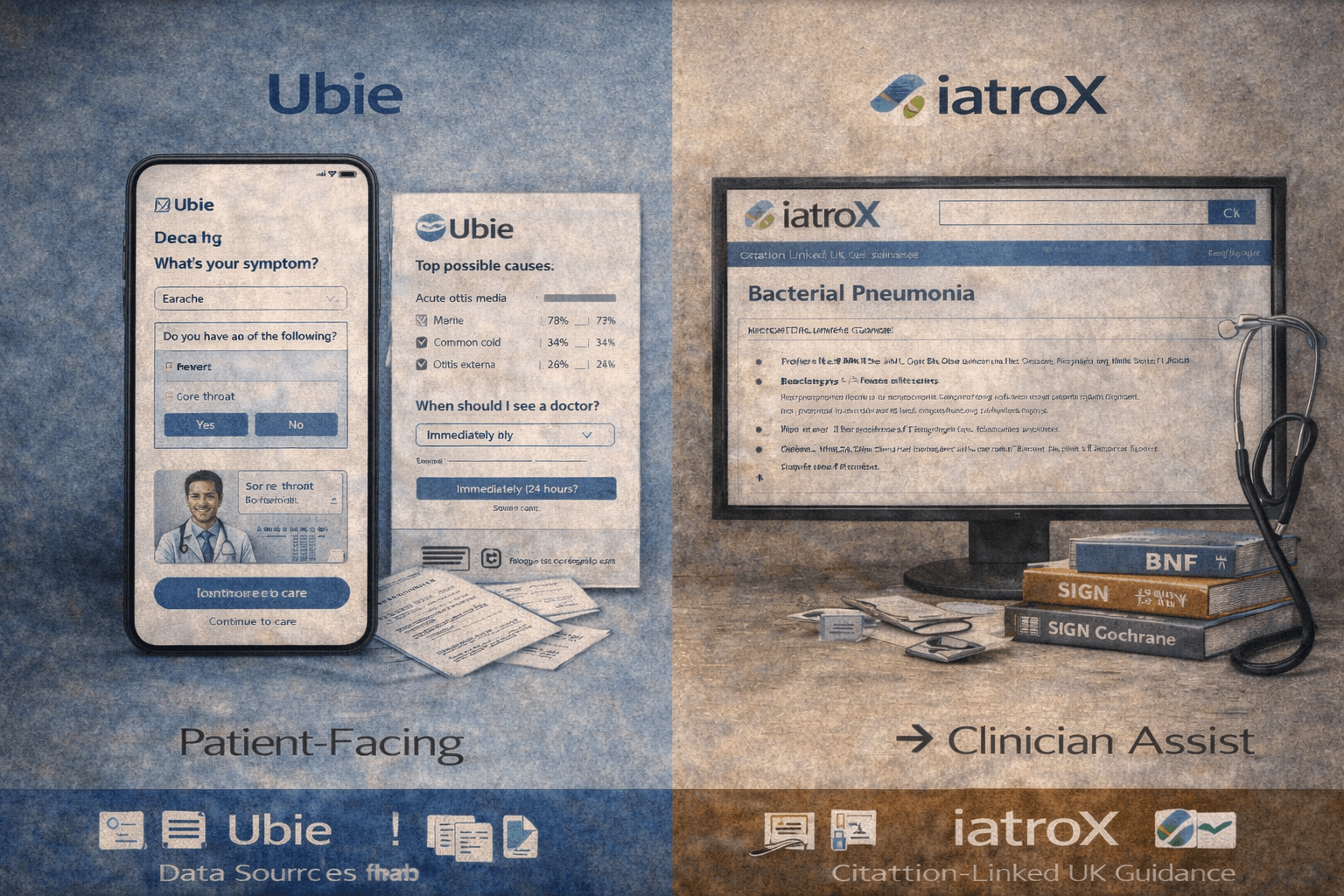
iatroX and Ubie sit on opposite sides of the consultation desk.
- Ubie: A patient-facing tool to help them articulate symptoms and decide if they need care.
- iatroX: A clinician-facing tool to help you verify the diagnosis and management plan once they are in the room.
iatroX positions itself as a UKCA-marked and MHRA-registered Class I medical device for informational use. It is free, has no ads, and is designed to provide "citation-first" answers from NICE, CKS, and the emc.
- The Workflow: Patient uses Ubie → Patient sees you → You use iatroX to check the latest UK guidance → You make a safe decision.
FAQs
- Is Ubie regulated in the UK?
- Ubie is a global tool. While it may hold regulatory clearance in other jurisdictions, you should check the MHRA register for its specific status in the UK before treating it as a medical device.
- Is Ubie safe to use in the NHS?
- As a patient information tool, it is generally safe for patients to use on their own initiative. However, NHS organisations should conduct a DTAC assessment before formally commissioning or recommending it.
- Does Ubie use NHS sources?
- Ubie cites the NHS as one of its data sources, which suggests its content is relatively aligned with UK health information.
- What’s the difference between symptom checkers and clinical decision support?
- Symptom checkers (Ubie) are for patients to assess possibilities. Clinical Decision Support (iatroX, BMJ Best Practice) is for clinicians to determine actions based on evidence.