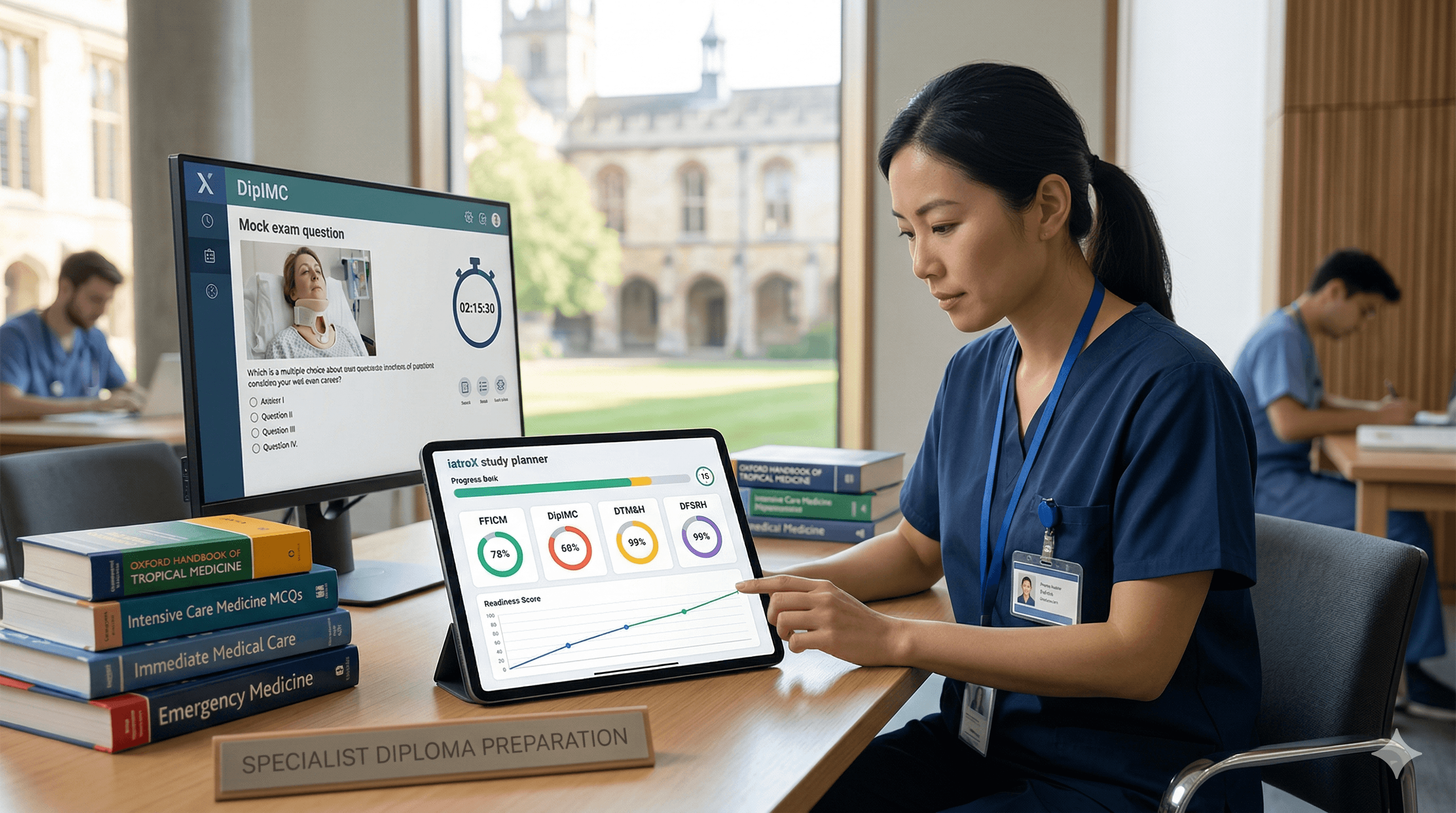
The specialist diploma exam market has a preparation problem that no other platform has solved until now. Passmedicine does not cover any of these exams. Pastest does not cover them. BMJ OnExamination does not cover them. Quesmed does not cover them. If you are sitting the FFICM, DipIMC, DTM&H, DFSRH, DRCOG, or DGM, your Q-bank options have historically been limited to one or two niche platforms with static question banks and no mock simulation.
iatroX now provides timed mock exams for all six specialist diploma banks — matching each exam's real format — alongside the AI study planner that generates a personalised revision schedule for your specific diploma exam date.
What Is Available
FFICM (Fellowship of the Faculty of Intensive Care Medicine). 727+ questions. Mock exam simulating the FFICM MCQ paper format. Covers critical care medicine, organ support, trauma, perioperative care, and ethics. The study planner supports FFICM preparation with daily adaptive tasks weighted to the FFICM curriculum.
DipIMC (Diploma in Immediate Medical Care, RCSEd). 601+ questions. Mock exam simulating the Part A written paper — 180 SBAs in 3 hours. Covers trauma, medical emergencies, paediatric emergencies, environmental emergencies, major incidents, and pre-hospital pharmacology. See our dedicated DipIMC exam guide for study strategy.
DTM&H (Diploma in Tropical Medicine and Hygiene). 700+ questions. Mock exam simulating the written paper format. Covers tropical infections, parasitology, entomology, microscopy, public health, and global health. Before iatroX, there was literally no commercial Q-bank for this exam. See our DTM&H preparation guide.
DFSRH (Diploma of the Faculty of Sexual and Reproductive Healthcare). 850+ questions. Mock exam simulating the Online Theory Assessment (OTA) — 64 SBAs covering contraception, UKMEC, STIs, early pregnancy, and cervical screening. Mapped to FSRH guidelines including the 2025 UKMEC update.
DRCOG (Diploma of the Royal College of Obstetricians and Gynaecologists). 600+ questions. Mock exam simulating the SBA paper format. Covers antenatal care, labour and delivery, postnatal care, gynaecology, and family planning.
DGM (Diploma in Geriatric Medicine). 400+ questions. Mock exam simulating the Part 1 knowledge-based assessment — 100 best-of-five questions in 3 hours. Covers CGA, frailty, falls, dementia, delirium, polypharmacy, end-of-life care, and stroke.
Why This Matters
For candidates sitting these niche exams, the preparation resources have been limited: a specialist textbook, course notes, and perhaps a small static Q-bank with no timed simulation. The consequence is that candidates arrive at the exam having never experienced the time pressure, the topic randomisation, and the cognitive fatigue of a full-length timed paper.
To be specific about what "limited" means: Passmedicine does not cover FFICM, DipIMC, DTM&H, DFSRH, DRCOG, or DGM. Pastest does not cover them. BMJ OnExamination does not cover them. Quesmed does not cover them. AMBOSS does not cover them. For the DTM&H, before iatroX there was literally zero commercial Q-bank available — candidates prepared entirely from Manson's Tropical Diseases and course notes. For the FFICM, the only alternative was a small specialist Q-bank without adaptive learning or timed simulation. For the DipIMC, DIMCPrep existed as a niche competitor with limited question volume.
iatroX mock exams change this equation fundamentally. A DipIMC candidate can now sit a full 180-question, 3-hour mock under real exam conditions — discovering their time management weaknesses and topic gaps before exam day, not during it. A DTM&H candidate can now test their parasitology and microscopy knowledge under timed conditions — where the difference between "I think I know the malaria lifecycle" and "I can identify the diagnostic features of P. falciparum on a thick film in 90 seconds" becomes apparent. A DFSRH candidate can simulate the full 64-question OTA under timed conditions — practising the UKMEC-heavy question style that the real exam uses.
Diploma-Specific Mock Strategies
FFICM: The FFICM MCQ paper covers the breadth of intensive care — from ventilator management to ethics to trauma to pharmacology. The study planner distributes preparation across all ICM domains, with mocks scheduled to identify whether your weakness is in specific clinical areas (trauma, neuro-ICM) or in the broader knowledge base (pharmacology, physiology, ethics). Start mocking 8 weeks before the exam.
DipIMC: The Part A paper is 180 SBAs in 3 hours — identical time pressure to PLAB 1. The breadth is narrower (pre-hospital and immediate care) but the depth is greater. Mock strategy: first mock at 8 weeks, then fortnightly. The half-length mock (90 questions, 1.5 hours) is valuable for mid-week practice — particularly for candidates who are also working clinical shifts in emergency departments.
DTM&H: The written paper includes MCQs, SAQs, and parasitology identification. The mock format on iatroX covers the MCQ component. For parasitology, supplement with microscopy image practice from your DTM&H course materials. The study planner targets your weakest tropical medicine topics — if your malaria knowledge is strong but your neglected tropical disease knowledge is weak, the planner addresses this imbalance.
DFSRH: The OTA is 64 questions — a short exam with high content density. The mock can be completed in under 90 minutes, making it feasible for weekly mock practice even for candidates with limited study time. The UKMEC 2025 update is heavily represented — ensure your mock review includes checking any UKMEC-related questions against the current guidance.
DRCOG: The SBA paper covers the full O&G curriculum relevant to primary care. Mock strategy follows the standard schedule — first mock at 8 weeks, fortnightly thereafter. The study planner ensures coverage of antenatal, intrapartum, postnatal, and gynaecological domains in proportion to exam weighting.
DGM: The Part 1 paper is 100 best-of-five questions in 3 hours — a comfortable time allowance that means time management is rarely the limiting factor. The challenge is knowledge breadth across geriatric medicine — CGA, frailty, falls, dementia, delirium, polypharmacy, end-of-life care, and stroke. The study planner's curriculum coverage tracker ensures none of these domains is neglected.
The study planner adds the scheduling layer for every diploma. Set your exam date. Choose your daily study time. The planner generates a daily revision schedule with adaptive targeting, spaced repetition, and mock exams at increasing frequency. The readiness score tracks your trajectory.
One Subscription, All Diplomas
One Subscription, All Diplomas
All six specialist diploma banks — FFICM, DipIMC, DTM&H, DFSRH, DRCOG, DGM — plus the DCH Q-bank, are included in a single iatroX subscription (£29/month or £99/year). The subscription also includes mock exams and study planner access for all diploma exams.
For GPs pursuing multiple diplomas (DRCOG + DFSRH + DGM is a common portfolio combination), one subscription covers the entire diploma portfolio — with adaptive targeting, timed mocks, and personalised study plans for each exam. No separate purchases. No switching platforms. No starting from scratch.
For specialist trainees (FFICM, DipIMC), the iatroX subscription provides the only adaptive, mock-integrated preparation tool available — at a fraction of the cost of the exam fees themselves. The FFICM exam fee alone exceeds the annual iatroX subscription cost several times over — making the subscription a marginal investment relative to the stakes of the exam itself. The same logic applies to every single diploma: the exam fee, the study leave cost, and the career opportunity cost of failure all dwarf the subscription price.
Unlock diploma mocks with an iatroX subscription at iatrox.com/boards.