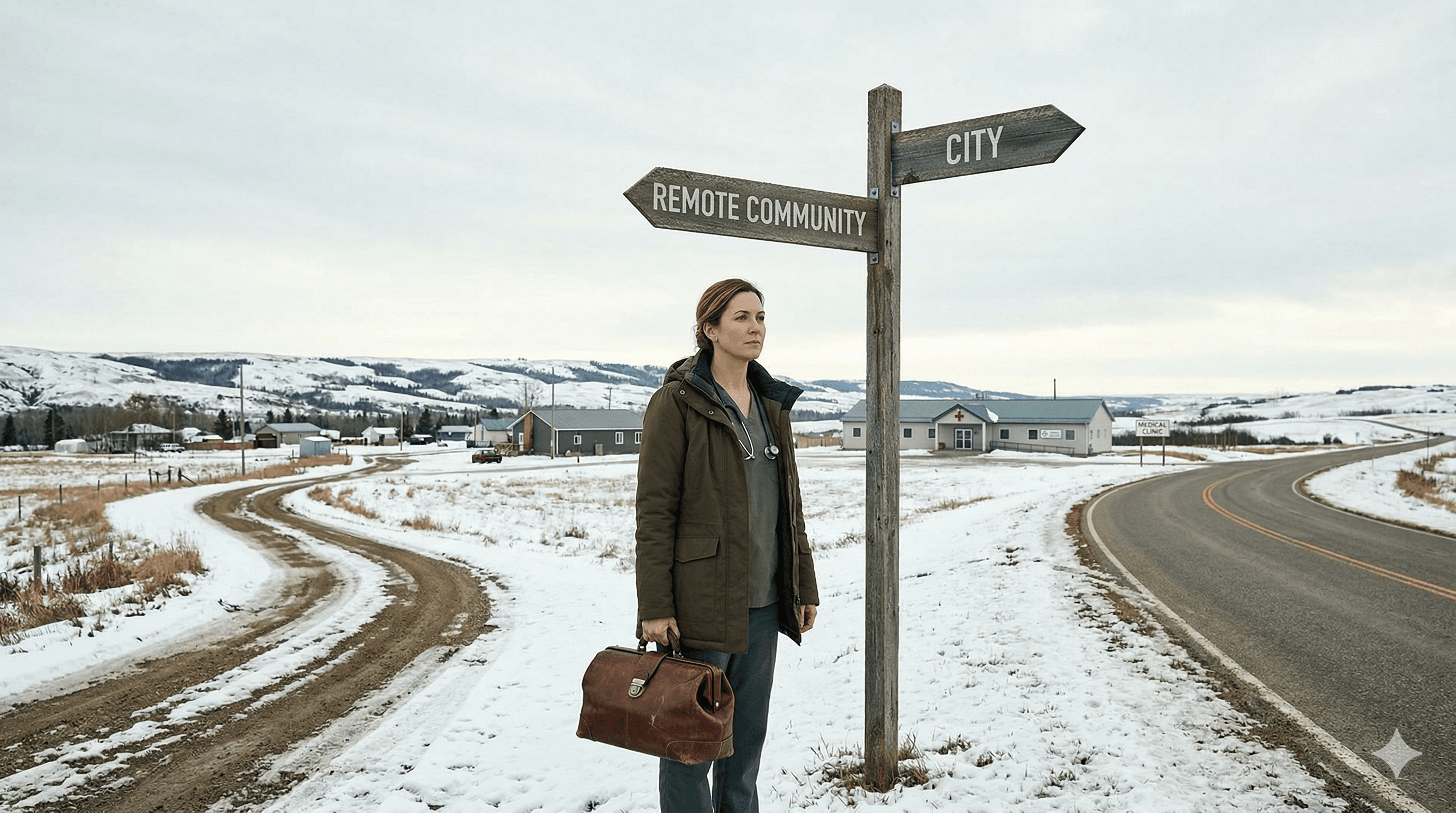
The return-of-service agreement is the price of the PRA shortcut. Instead of completing a full Canadian residency (2+ years), you complete a 12-week assessment and receive a provisional licence — in exchange for committing to practise in an underserved community for a defined period, typically 3 years.
On paper, this sounds reasonable. In practice, UK doctors sometimes sign ROS agreements without fully understanding what they're committing to — and the consequences of underestimating this commitment can be financially devastating and personally miserable.
What ROS actually means
A return-of-service agreement is a legally binding contract between you and the provincial government (or health authority). You agree to practise in a specific community or region for a specified period — typically 3 years for PRA-associated ROS, though some provincial recruitment incentives offer 2-year or 5-year terms.
You don't choose the community freely. The province assigns you to a community from their list of underserved areas. You typically get to express preferences and there's some matching, but you're not guaranteed your first choice. Communities range from small towns (population 5,000–15,000, 1–2 hours from a city) to genuinely remote settlements (population 500–2,000, accessible only by plane in winter).
You must practise there for the full term. Part-time practice or splitting time between the ROS community and a city doesn't satisfy the obligation in most provinces. You live and work in the community for the duration.
The penalties for breaking ROS are severe. Most contracts include financial penalties of CAD $50,000–$150,000 for early departure, depending on the province and how much of the term remains. Some provinces also restrict your ability to obtain a full licence in the province if you break ROS. In BC, the penalty can approach CAD $100,000+. In Saskatchewan, the financial and licensing consequences are similarly substantial.
What rural Canadian practice actually looks like
For a UK GP whose experience is suburban or urban NHS practice, rural Canada is a different clinical world.
Scope of practice. Rural Canadian GPs typically provide: walk-in and rostered primary care, emergency department coverage (including trauma), inpatient care (admitting and managing hospital patients), obstetric care (deliveries, sometimes caesarean sections under supervision), anaesthesia for minor procedures, and community mental health. You are genuinely the doctor — for everything. If you enjoyed the variety of foundation year rotations, this is the closest thing to that in independent practice.
Isolation. The nearest specialist may be a 3-hour drive or a medevac flight. You make clinical decisions that in the UK would involve a phone call to a registrar — because there is no registrar. Telemedicine is improving access to specialist advice, but the physical isolation is real.
Community integration. In a town of 2,000 people, you will be known. Your patients are your neighbours. You will see the person you intubated in the ER at the grocery store. This is either deeply rewarding or deeply uncomfortable, depending on your personality.
Climate. Most underserved communities are in northern or prairie regions. Winters of -30°C to -40°C, lasting 5–6 months, are normal in Saskatchewan, Manitoba, northern Alberta, and northern Ontario. If you've never experienced genuine cold, this is not a minor lifestyle detail.
Amenities. Small-town Canada has surprisingly good basics — grocery stores, schools, recreation centres, outdoor activities. What it doesn't have: diverse dining, cultural events, specialist shopping, or the anonymity of a city. Internet connectivity in remote areas can be poor. If your partner works in a field that requires urban infrastructure, this is a significant constraint.
How to evaluate a specific ROS community
Visit before you sign. If at all possible, visit the community during winter (not summer — summer in rural Canada is glorious and misleading). Meet the other doctors. See the hospital and clinic. Talk to the community.
Ask the right questions. How many other physicians are in the community? (Being the only doctor is very different from being one of three.) What specialist support is available by telemedicine? What's the on-call frequency? Is there locum coverage for holidays? What's the housing situation? Are there schools if you have children?
Talk to doctors who've done it. Every PRA programme has graduates. Ask the programme to connect you with physicians who completed their ROS in the community you're considering. Their honest assessment is worth more than any recruitment brochure.
Understand the contract termination provisions. Under what circumstances can you leave without penalty? (Medical emergency, family crisis, and practice closure are sometimes carved out.) What happens if the community closes the clinic? What if the province reassigns you to a different community?
When ROS is right
For the right person — someone who values clinical breadth, community connection, outdoor living, and a clear pathway to full Canadian licensure — ROS is not a punishment. It's a launchpad. Many ROS physicians stay in their communities long after the obligation ends because they've built a practice, relationships, and a life they don't want to leave.
The doctors who struggle are those who see ROS as a sentence to endure rather than a phase to embrace, who have partners or families who weren't fully consulted, or who signed up for a community they'd never visited based on a map and a salary number.
The bottom line
ROS is a fair trade: accelerated licensure in exchange for service where it's needed most. But it's a trade you need to make with open eyes, full information, and genuine buy-in from everyone it affects — not just yourself.
iatroX supports doctors navigating Canadian pathways with MCCQE1 preparation, AI clinical search, and IMG pathway guides. Built by a practising NHS GP.