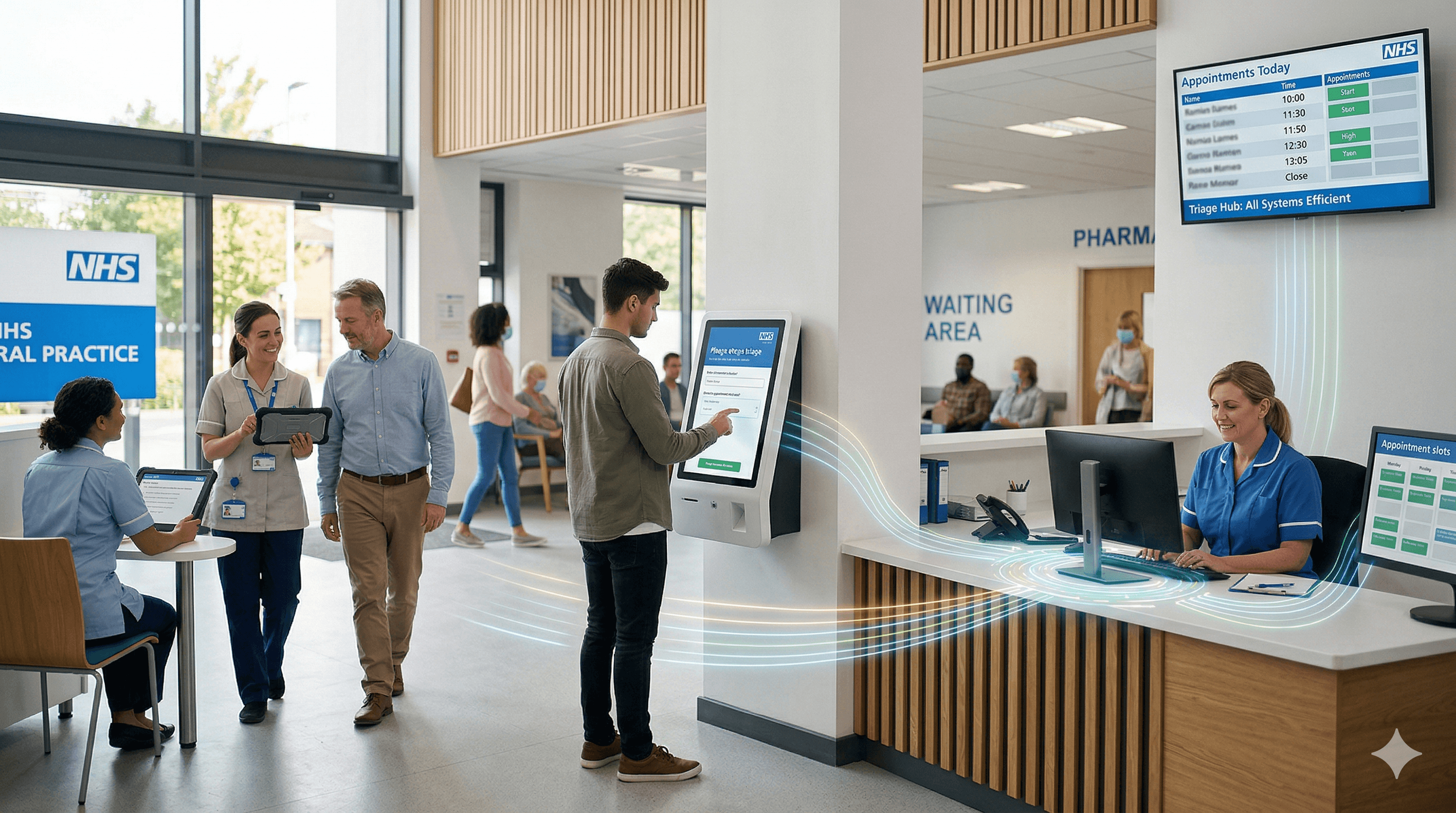
Rapid Health is making the boldest claim in UK primary care AI: not just triage assistance, but fully autonomous patient navigation. Their Smart Triage product does not collect information for a receptionist to process — it assesses symptoms, determines urgency, identifies the appropriate care pathway, and books the patient into an appointment, all without staff intervention.
The company calls this "Autonomous Clinical Intelligence." It is deployed across more than 30 Integrated Care Systems in England, is supported by the NHS Innovation Accelerator, and has independent real-world evaluation data. In a market full of tools promising to "reduce workload," Rapid Health is one of the few with published, third-party-validated outcomes.
What Smart Triage Actually Does
Smart Triage sits at the front door of a GP practice — the point where patient demand enters the system. It works across three access channels.
Online: The patient visits the practice website or NHS App, answers a series of clinically structured questions about their presenting concern, receives an urgency assessment, and is offered appointment slots to self-book into. The whole process takes 3-5 minutes.
Phone: A patient advisor walks the caller through the same structured questions. The AI processes the answers and provides the routing decision. The caller can be offered self-booking or booked by the advisor.
In person: Tablets in the waiting area guide walk-in patients through the same questionnaire, ensuring equitable access for patients who cannot or prefer not to use online systems.
The AI asks structured clinical questions based on the patient's presenting concern. Based on the responses, it assesses clinical urgency, determines the most appropriate care setting (GP, nurse, pharmacist, self-care, emergency services), and offers the patient an appointment slot to book. The practice does not need to intervene for the majority of requests.
This is architecturally different from traditional online consultation tools (Accurx, eConsult, Anima), which collect patient information and deposit it in a queue for practice staff to triage manually. Smart Triage removes the manual triage step for approximately 91% of requests.
The system integrates natively with EMIS and SystmOne in the cloud, requiring no local software installation.
The Evidence
The strongest published evidence comes from an independent evaluation at The Groves Medical Centre, funded by Health Innovation Kent Surrey Sussex and conducted by Unity Insights. The evaluation covered October 2023 to February 2024 and assessed acceptability, implementation, effectiveness, and impact on health inequalities.
The headline findings are striking. Patient waiting times fell from 11 days to 3 days — a 73% reduction. 91% of appointments were allocated without any staff intervention. Phone calls at peak hours fell by 47%, with a 58% reduction in the maximum number of calls, effectively eliminating the "8am rush." Urgent same-day requests fell from 62% to 19% of total demand — meaning the system correctly identified that most requests previously classified as urgent were not clinically urgent. Repeat appointments dropped by 70%.
Separate data from Manor Court Surgery found that 77% of patients preferred having the ability to choose their own appointment times and 69% preferred automated clinical triage over the previous system.
The Tony Blair Institute's 2025 analysis of AI in NHS navigation cited Rapid Health's data approvingly, noting that the system enabled GPs to increase time spent with each patient by 50% and offer 8% more appointments overall without additional staffing.
These are strong numbers. The evaluation methodology — pre-post comparison with defined metrics at a single site — is more rigorous than most health-tech evaluations. The consistency of reported outcomes across multiple practice sites is encouraging, though larger-scale controlled studies (one is registered with the Health Research Authority across 40 practices) will strengthen the evidence further.
How It Meets the 2026/27 GP Contract
Smart Triage is remarkably well-aligned with the contract requirements.
Online access during core hours: The contract mandates online consultation access 8am-6:30pm. Smart Triage provides this natively, with 24/7 capability if enabled. Critically, it addresses the safety concern that drove the BMA's October 2025 dispute — it distinguishes between urgent and non-urgent requests through structured clinical questioning, rather than depositing everything in an undifferentiated queue.
Same-day urgent access: The contract requires all clinically urgent patients to be dealt with same-day. Smart Triage's clinical assessment identifies urgency and routes urgent patients to same-day slots automatically. The reduction of urgent requests from 62% to 19% shows it differentiates genuine urgency from perceived urgency — preserving same-day capacity for the patients who actually need it.
Data collection: Every triage decision, urgency classification, and appointment allocation is tracked — providing the five access metrics the contract requires without additional reporting infrastructure.
Clinical urgency determination: The contract specifies urgency is determined by the practice, not the patient. Smart Triage's structured clinical questioning provides a consistent, auditable urgency assessment — more reliable than receptionist-led triage under pressure.
What Smart Triage Does Not Do
Smart Triage handles the front door brilliantly. It does not handle what happens inside the consultation.
It does not provide clinical reference during the appointment. It does not document the consultation. It does not support prescribing decisions or guideline retrieval. It does not help with QOF achievement, CPD, or clinical knowledge maintenance.
These functions require separate tools. iatroX provides the clinical knowledge layer — instant NICE-grounded guideline reference for the questions that arise during consultations, structured clinical reasoning for complex cases via Brainstorm, and knowledge maintenance through the Q-Bank. An ambient scribe (Heidi, TORTUS, Accurx Scribe) handles documentation.
Smart Triage optimises who gets seen and when. iatroX optimises what happens when they are seen. The two are complementary layers, and the strongest practices deploy both.
What Practices Should Consider Before Adopting
Patient demographics. Smart Triage works across online, phone, and in-person channels, addressing digital exclusion better than online-only tools. However, practices with large elderly or digitally-excluded populations should evaluate whether the tablet and phone-assisted routes genuinely work for their specific patient mix — observe real patients using the system, not just test it internally.
Clinical safety governance. Autonomous triage means the AI makes routing decisions without human review for 91% of requests. This requires robust governance: regular audit of triage outcomes, clear escalation protocols for emergency presentations, LFPSE reporting for AI-related safety incidents, and a named clinical lead overseeing the system. The evidence supports safety, but ongoing monitoring is non-negotiable.
Workflow transformation. Smart Triage replaces the reception-led triage model rather than supplementing it. This is a significant operational change requiring staff role redefinition, training, and patient communication. Reception staff shift from gatekeeping to exception handling and patient support. This transition needs active management.
Procurement route. Rapid Health is typically procured at ICB or PCN level. Individual practices may not be able to adopt unilaterally. Check whether your ICS already has a Rapid Health contract — many of the 30+ ICSs do.
Cost. Pricing varies by procurement arrangement and is not publicly listed. Evaluate against the capacity the tool creates — if it genuinely delivers the published outcomes, the return on investment from reduced workload, improved access metrics, and potential QOF-adjacent improvements is substantial.
Conclusion
Rapid Health Smart Triage is the most ambitious and best-evidenced AI triage product in UK primary care. The outcomes — 73% reduction in waiting times, 91% autonomous allocation, near-elimination of the 8am rush — are independently validated and directly aligned with the 2026/27 GP contract requirements.
It is not a complete practice AI solution. It handles the front door. The consultation itself still needs clinical reference (iatroX), documentation (ambient scribes), and knowledge maintenance (iatroX Q-Bank). The strongest practice stack combines Smart Triage for demand management with iatroX for clinical quality — and the clinical knowledge layer is free.