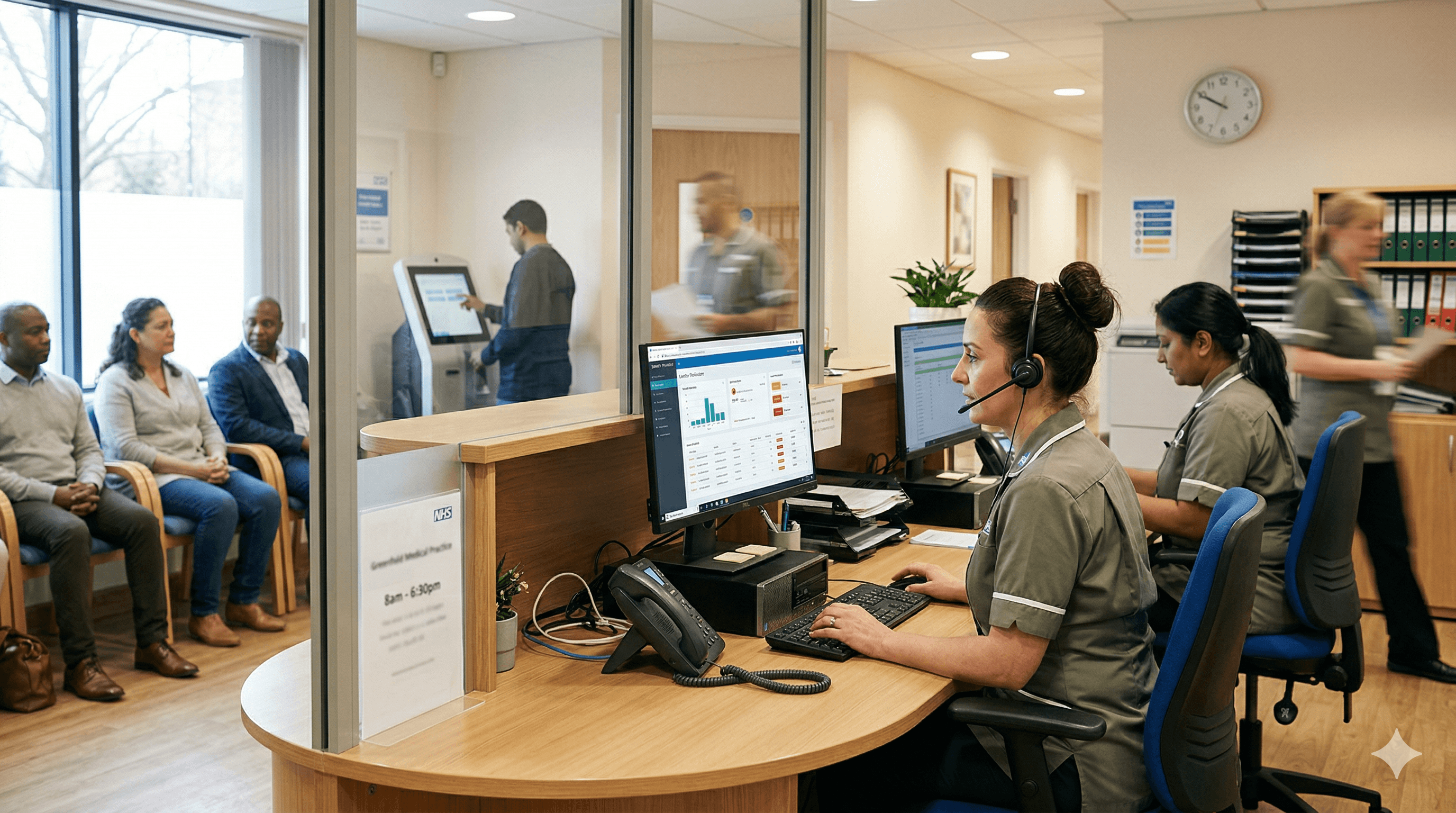
The 2026/27 GP contract introduces operational requirements that many practices will struggle to meet with traditional workflows. Same-day urgent access for all clinically urgent patients. Online consultation access throughout core hours. Data collection against five standardised access metrics. Clinical urgency determined by the practice, not the patient. Risk-based allocation rather than first-come-first-served.
Rapid Health's Smart Triage is one of the tools most directly aligned with these requirements. Here is how it maps to each — and where the gaps remain.
Same-Day Urgent Access
The requirement: All patients identified as clinically urgent must be dealt with on the same day. Practices cannot ask patients to contact the practice at a later date for urgent needs.
How Smart Triage helps: The AI's structured clinical assessment identifies urgency using defined clinical criteria and routes genuinely urgent patients to same-day slots automatically. In the published evaluation at The Groves Medical Centre, urgent same-day requests fell from 62% to 19% of total demand.
This dual effect is crucial for contract compliance. Smart Triage correctly identifies genuine urgency (ensuring those patients get same-day care) while reducing false urgency (preserving same-day capacity for the patients who actually need it). Without this differentiation, the same-day requirement risks overwhelming capacity — every patient who perceives their request as urgent would consume a same-day slot. Smart Triage's clinical assessment prevents this while ensuring genuinely urgent patients are not missed.
The 91% autonomous allocation rate means that same-day urgent slots are filled by clinically appropriate patients without staff needing to manually review and route each request — a significant operational efficiency that makes the same-day requirement practically achievable.
Online Access During Core Hours
The requirement: Online consultation tools must remain open 8am-6:30pm, Monday to Friday. Patients must be able to submit routine requests, medication queries, and administrative requests digitally throughout working hours.
How Smart Triage helps: Smart Triage provides online access natively and can operate 24/7 if the practice enables it. Unlike basic online consultation tools that deposit requests into an unprocessed queue, Smart Triage assesses each submission in real time — meaning the online channel does not create a growing backlog that overwhelms staff when they start processing.
Critically, Smart Triage addresses the core safety concern that drove the BMA's dispute over the October 2025 changes. The BMA's objection was that online tools could not distinguish between urgent and non-urgent requests at submission. Smart Triage's structured clinical questioning does exactly this — identifying urgency within the online submission itself, rather than relying on downstream manual triage to catch urgent presentations buried in a routine queue.
Data Collection Against Five Metrics
The requirement: NHS England will collect practice-level data on call waiting times (8am-10am and during core hours), percentage of clinically urgent patients seen same-day, and percentage of non-urgent patients seen within one and two weeks.
How Smart Triage helps: Every triage decision, urgency classification, and appointment allocation is tracked within the system. Practices using Smart Triage have the data infrastructure the contract demands built into their access workflow — not bolted on as a separate reporting exercise.
The 47% reduction in peak-hour phone calls also directly improves the call waiting time metrics, since fewer calls during 8am-10am means shorter waits for those that do come through. And the system's appointment allocation data provides the same-day and one/two-week metrics natively.
What Smart Triage Does Not Cover
The contract also requires QOF achievement aligned with current NICE guidance (diabetes 8 care processes, heart failure four pillars, obesity indicators, vaccination improvement thresholds), risk stratification for continuity of care, Advice and Guidance prior to referral, clinical documentation, and professional development.
Smart Triage is a demand management and access tool — the most effective one available — but it is one layer of a multi-layered stack. It does not address what happens inside the consultation.
For QOF and clinical reference: iatroX provides instant NICE-grounded answers for the clinical domains that QOF indicators test. Free.
For knowledge maintenance: iatroX Q-Bank provides spaced repetition across clinical domains, keeping knowledge current year-round. Free.
For CPD: iatroX CPD module documents professional development from daily clinical queries. Free.
For documentation: Ambient scribes (Heidi, TORTUS, Accurx Scribe) reduce per-consultation documentation time. Paid.
For risk stratification: Eclipse, QAdmissions, or embedded EMIS/SystmOne tools. Usually ICB-funded.
The Complete 2026/27 Contract Stack
The practice fully equipped for the new requirements combines Smart Triage for access and demand management (the patient-facing layer), iatroX for clinical knowledge, QOF support, learning, and CPD (the clinician-facing layer), an ambient scribe for documentation efficiency, and risk stratification tools for continuity of care planning.
Smart Triage handles the front door. iatroX handles the consultation. Together they cover the contract from patient access through to clinical quality — and the clinical knowledge layer is free.