Executive summary
As artificial intelligence becomes more integrated into clinical workflows, ensuring its outputs are safe, reliable, and trustworthy is a non-negotiable requirement. The most promising architecture for achieving this today is Retrieval-Augmented Generation (RAG). By grounding the answers of large language models (LLMs) in a curated library of up-to-date clinical sources, RAG dramatically reduces the risk of factual "hallucinations" and creates an auditable trail of evidence, which is vital for any high-stakes healthcare setting (arXiv, ACM Digital Library).
However, for this technology to be deployed safely in the UK, it must be implemented within a robust governance framework. Any clinical RAG system must align with the NICE Evidence Standards Framework (ESF), the NHS Digital Technology Assessment Criteria (DTAC), NHS guidance on Clinical Decision Support (CDS), and the information governance requirements set out by NHS England (NICE, NHS Transformation Directorate, NHS England).
What is RAG (and why it matters in medicine)
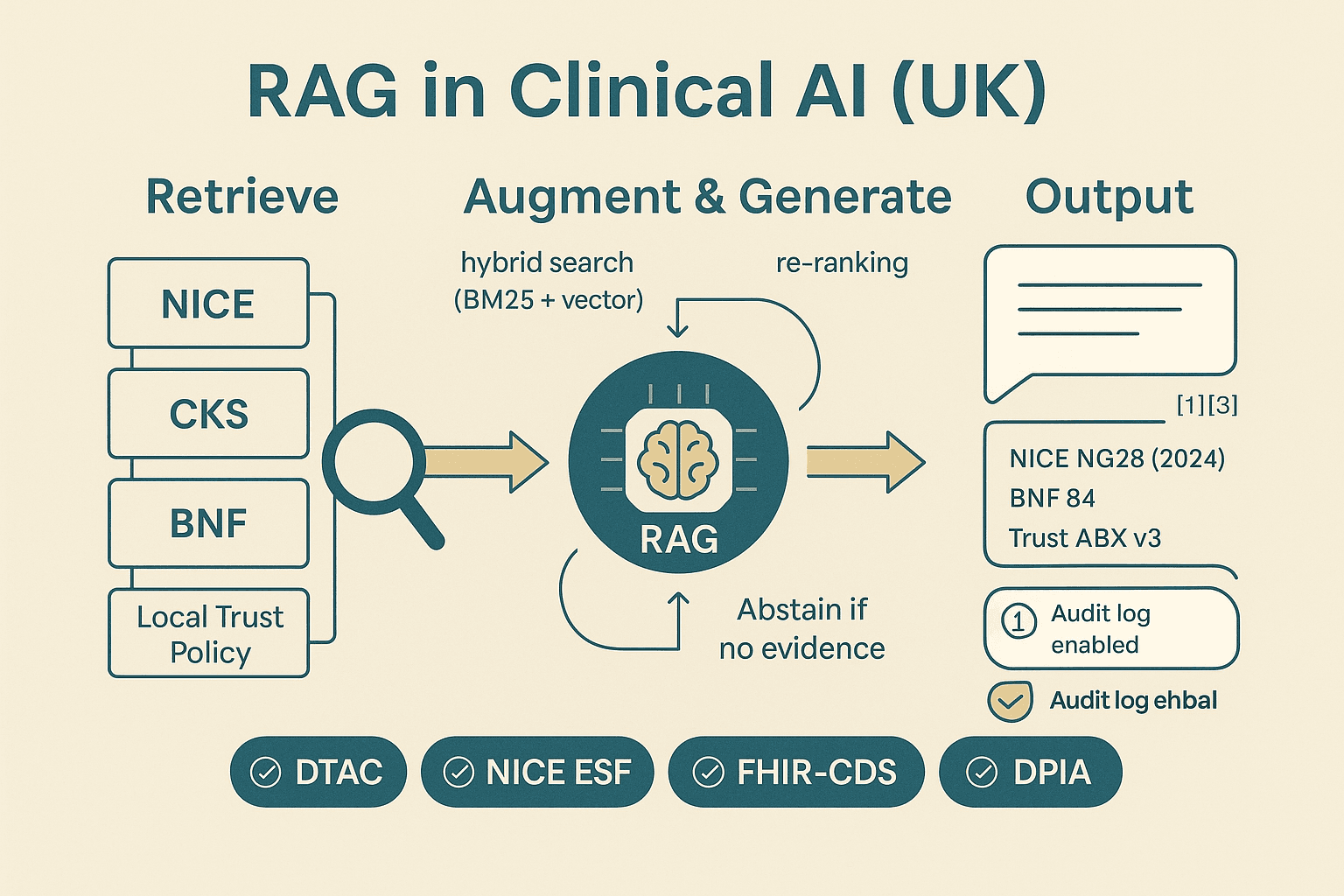
In simple terms, Retrieval-Augmented Generation is a "show your work" architecture for AI. Unlike a standard "LLM only" approach which generates answers based solely on its internal, static training data, RAG follows a two-step process:
- Retrieve: First, it searches a defined, external knowledge index (like a library of NICE guidelines) to find the most relevant, factual information for a given query.
- Generate: It then provides this retrieved information to the LLM with a strict instruction: "Use these facts to generate your answer."
In a clinical setting, RAG can improve provenance by retrieving relevant material before generation and attaching citations to the result. It can also make source maintenance more manageable because the retrieval library can be updated independently of the language model. Neither citations nor a newer library guarantee that every answer is correct, current or supported by the retrieved passage.
The RAG stack for clinical use (architecture at a glance)
A high-quality clinical RAG system is built on a sophisticated technical pipeline:
- Data sources: The system’s reliability is entirely dependent on its knowledge library, or “corpus.” Its value rises with the quality of its sources, which for UK healthcare should include NICE CKS and guidelines, local Trust policies, local and national medicines-reference data, peer-reviewed articles, and established care pathways.
- Pipelines: The process involves ingesting and "chunking" these documents into manageable pieces, then creating embeddings for hybrid retrieval (using both dense vector search for semantic meaning and keyword search like BM25 for precision). A re-ranking algorithm then prioritises the most relevant chunks before they are passed to the generator to create an answer with inline citations (arXiv).
- Output controls: Crucially, safety requires strict output controls, such as a mandatory citation for every key point, the ability to abstain from answering when no relevant evidence is found, and the option to output structured JSON data for seamless integration with EHRs and other clinical decision support systems (NHS England).
What “good” looks like in the NHS (governance & assurance)
For any RAG tool to be used in the NHS, it must meet the UK's clear governance and assurance standards:
- NICE ESF: The Evidence Standards Framework sets out the evidence tiers required to prove a digital health technology's clinical and economic value (NICE).
- NHS DTAC: This is the national baseline for procurement, ensuring any new tool meets stringent criteria for clinical safety, data privacy, cybersecurity, interoperability, and usability. Vendors should provide a completed DTAC pack on request (NHS Transformation Directorate).
- NHS CDS guidance: This framework outlines best practices for designing clinical decision support, focusing on clinical safety, benefits realisation, and a problem-oriented approach (NHS England).
- NHS AI knowledge repository & IG guidance: These resources provide practical advice for responsible AI adoption, including how to complete Data Protection Impact Assessments (DPIAs) (NHS England Digital, NHS Transformation Directorate).
Real products already using (or analogous to) RAG
Several major clinical information providers are already deploying RAG-based technology:
- EBSCO Dyna AI: Explicitly states its use of RAG to provide natural-language answers grounded in its curated medical databases, with a strong emphasis on transparent sourcing (more.ebsco.com).
- UpToDate AI Labs / AI-enhanced search: Is evolving its search capabilities to provide rapid, succinct access over the vast UpToDate corpus, moving towards more explicitly grounded and cited outputs (Wolters Kluwer).
- Trip Database – AskTrip: A powerful AI Q&A tool that returns answers linked directly to evidence and allows users to filter results by study type and guideline quality (tripdatabase.com).
- Medwise AI: A UK-focused tool that specialises in retrieving information from local NHS Trust guidelines alongside national sources (PMC).
These platforms, along with iatroX's own citation-first Q&A architecture, demonstrate that RAG is rapidly becoming the industry standard for trustworthy clinical AI.
Implementation patterns (for providers & vendors)
- Corpus build: Prioritise version-controlled and watermarked NICE and local Trust documents.
- Indexing: Use hybrid retrieval to capture both clinical synonyms and exact policy wording. Ensure frequent re-embedding of content after major guideline updates.
- Guardrails: Enforce mandatory citations, a refusal to answer when off-corpus, confidence flags for the user, and a non-negotiable human sign-off loop.
- Integration: Expose results to clinicians via modern, secure standards like FHIR-CDS or CDS Hooks, typically within EHR side-panels (EMIS, SystmOne, Epic), and ensure comprehensive audit logging (developer.nhs.uk).
Measuring quality (how to evaluate clinical RAG)
Evaluating a clinical RAG system requires a multi-layered approach:
- Retrieval quality: Measured with metrics like recall@k, MRR, and nDCG against curated clinical test sets.
- Generation quality: Assessed using frameworks like RAGAS or Evidently AI to measure faithfulness (is the answer grounded in the retrieved context?), relevance, and citation correctness.
- Clinical benchmarks: New healthcare-specific evaluation frameworks like MedRGB and ASTRID are emerging to provide safety-oriented metrics (arXiv, ACL Anthology).
- Operational KPIs: The ultimate test is real-world performance: time-to-answer, guideline concordance, user satisfaction, and the rate at which clinicians override AI suggestions.
Risks & mitigations
- Residual errors / omissions: Enforce an "abstain-and-cite" policy where the AI only summarises what it finds in its sources. Require human verification before any clinical action.
- Out-of-date guidance: Implement nightly pipeline rebuilds and document validity windows. The document version and publication date must be surfaced in the user interface.
- Privacy & IG: A DPIA is mandatory. Enforce data minimisation and ensure no Patient Health Information (PHI) is sent to consumer-grade endpoints.
- Adoption risk: Any tool must pass DTAC. A comprehensive clinical safety case must be documented and the tool's performance must be monitored post-deployment.
Case-study section (templates)
- Primary care: A GP queries a local antibiotic policy. A RAG tool returns the Trust's specific guidance alongside the national NICE advice, with clear citations for both, exposed via a CDS alert during prescribing.
- Secondary care: A surgeon has a query about peri-operative anticoagulation. The RAG system shows the relevant Trust SOP and the NICE guideline, complete with version dates, and logs the clinician’s acknowledgement for their audit trail.
- Education: Trainees use a RAG tool like AskTrip or Medwise AI to build a rapid, referenced evidence summary for a journal club presentation.
Build-or-buy checklist (for CIOs/CCIOs)
- Do we have the legal rights to use our desired corpus (NICE, Trust documents, formulary)?
- Is the vendor’s DTAC pack complete, current, and satisfactory?
- Can the vendor prove the "faithfulness" of their model with both automated testing and human review?
- How will we integrate this tool via FHIR-CDS and capture the necessary audit trails for governance?
Conclusion & call-to-action
For UK healthcare, Retrieval-Augmented Generation represents the most practical and secure route to trustworthy, cited clinical AI available today. However, its power is only unlocked when the technology is paired with robust UK governance frameworks like the NICE ESF and NHS DTAC, integrated thoughtfully via CDS-grade standards, and subjected to rigorous, continuous evaluation.
The next step for healthcare organisations is to begin piloting a citation-first RAG tool—whether from a vendor like Dyna AI, AskTrip, or Medwise AI, or an internally developed solution—in a single, well-defined service line. Measure faithfulness and time-to-answer, gather clinician feedback, and then plan for a wider, safer scale-up using FHIR-CDS.