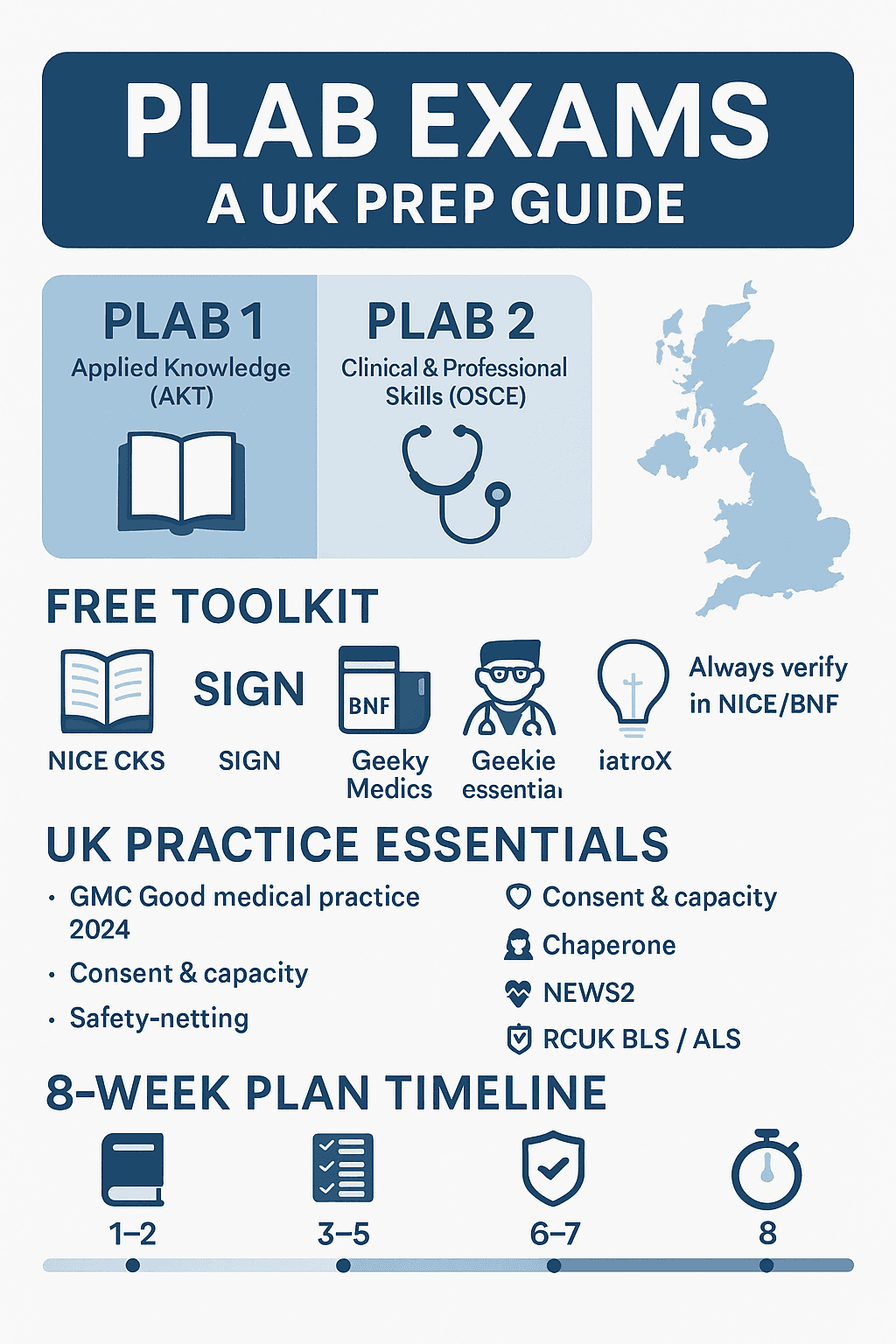
Executive summary
For international medical graduates (IMGs), preparing for the PLAB exams is about more than just revising medicine; it’s about learning to practise "the UK way." The exam is now aligned with the UK's new Medical Licensing Assessment (MLA) content map, with PLAB 1 testing your applied knowledge (AKT) and PLAB 2 assessing your clinical and professional skills (CPSA/OSCE). This guide provides a definitive stack of free, UK-aligned resources to help you prepare effectively, even from overseas.
This guide maps free NICE CKS and SIGN guidance, relevant SmPCs on eMC for product-specific licensed information, and OSCE resources from Geeky Medics. It also shows how iatroX can help candidates retrieve cited material and use adaptive questions alongside the official exam blueprint and candidate guidance.
PLAB at a glance
- PLAB 1: This is a written, single-best-answer (SBA) exam. It is now aligned with the GMC's MLA Content Map, which is your core syllabus. You can find official sample questions here.
- PLAB 2: This is a practical, OSCE-style exam (a Clinical and Professional Skills Assessment, or CPSA) that typically consists of 16 scenarios, each lasting 8 minutes. It is only held in the UK, in Manchester.
“The UK way” of practising: core standards examiners expect
A high score in PLAB 2, in particular, depends on demonstrating your understanding of the professional and ethical standards specific to UK practice.
- Good medical practice (2024): This is the GMC's core guidance. You must read it. It outlines the professional behaviours, documentation standards, and values expected of all UK doctors.
- Consent & capacity: Understand the principles of shared decision-making and the basics of the Mental Capacity Act.
- Chaperones for intimate examinations: Know when and how to offer a chaperone and how to document it. This is a common and easily failed OSCE station.
- Safety-netting: A core concept in UK practice. You must be able to clearly communicate uncertainty, red flags, and specific follow-up plans to patients.
- Early warning & resus basics: Familiarise yourself with the NEWS2 score as the common language for escalating a deteriorating patient, and the Resuscitation Council UK (RCUK) algorithms for ALS/BLS.
The free core toolkit (globally accessible, UK-centric)
- NICE Clinical Knowledge Summaries (CKS): The single most useful free resource. CKS provides over 370 concise, evidence-based summaries on how to manage common conditions in a UK primary care setting. This is ideal for both PLAB 1 stems and PLAB 2 reasoning.
- NICE Guidance: The full, in-depth guidelines that CKS is based on. Use these for deeper understanding of major topics.
- SIGN (Scotland) Guidelines: An excellent alternative to NICE, SIGN guidelines are highly respected, evidence-based, and often available as free-to-download PDFs.
- NHS.UK Conditions A–Z: The official patient-facing NHS website. You should read this to learn the correct, simple, plain-English language to use when explaining conditions to patients in your PLAB 2 stations.
- Medicines information: Follow the current PLAB or MLA candidate guidance and use the revision resources it specifies. For clinical learning, check applicable NICE guidance and relevant SmPCs on eMC rather than relying on an unnamed “definitive” guide.
- Specialist Pharmacy Service (SPS): A free-to-access NHS website with expert Q&As, monitoring advice, and guidance on supply issues.
Free question practice & mocking the exam
- GMC PLAB 1 sample SBAs: These are your gold-standard. Use them as a blueprint for question style and depth.
- Geeky Medics: Known for its OSCE guides, it also has a large library of free PLAB-style SBA taster questions.
- Other free tasters: Many paid platforms (like Medic Mind) offer a set of free PLAB 1 practice questions to let you sample their content.
What about paid question banks? While this guide focuses on free resources, many IMGs choose to buy a subscription to a dedicated question bank like Passmedicine, Pastest, or Plabable. These can be valuable for the sheer volume of questions and their specific platform features. The best strategy is often to build your foundation with the free resources listed here, and then, if you choose, add a short-term paid subscription for intensive exam-style practice closer to your test date.
PLAB 2 / OSCE skills without paying
- Step-by-step guides from Geeky Medics: This is the definitive free resource for OSCEs. It provides detailed, step-by-step guides for hundreds of clinical examinations and communication skills.
- Resuscitation Council UK: The official BLS and ALS algorithms are free to access and are essential to memorise.
- NEWS2 score: The RCP's page on the NEWS2 score is the official source for understanding the escalation thresholds used in all UK hospitals.
- GMC guidance: The official guides on consent and chaperones are all you need for these "ethics" stations.
AI that’s actually free (and UK-aligned): iatroX
iatroX is a free AI platform designed for UK clinicians and trainees, making it an ideal study co-pilot for IMGs.
- What it is: It offers a free AI-powered Q&A tool (Ask iatroX), a Brainstorm tool for differential diagnoses, and an adaptive Quiz engine, all without ads or subscriptions.
- Why it helps IMGs: Its primary value is helping you understand the UK context. You can ask it questions in natural language and get fast sourcing to NICE, CKS, SIGN, and SmPC pages on eMC. This helps you quickly bridge the gap between your existing medical knowledge and the specific UK pathways you will be tested on.
- Study modes: The iatroX Quiz feature includes adaptive and spaced-repetition modes mapped to UK curricula (including UKMLA/PLAB-relevant topics), helping you to retain information more effectively.
- Practical prompts:
- "You are a UK GP. What are the NICE CKS red flags for a patient presenting with a headache?"
- "Summarise the key principles of the UK Mental Capacity Act for a PLAB 2 candidate."
- "What is the SDCEP guidance for a dental abscess, and what does the relevant SmPC on eMC say about the first-line antibiotic?" (Then, always cross-check the cited sources).
Building a free, 8-week PLAB plan
- Weeks 1–2: UK foundation. Read GMC Good Medical Practice. Skim the top 30 topics on NICE CKS. Start daily practice with the official GMC sample SBAs and Geeky Medics questions.
- Weeks 3–5: Systems-based revision. Work through each clinical system. For each topic (e.g., cardiology), read the CKS summary, use iatroX Ask/Brainstorm to clarify pathways, and do all the relevant practice SBAs. Start your OSCE drills using Geeky Medics guides.
- Weeks 6–7: Mock rhythm. Use free taster banks. Rehearse RCUK algorithms and NEWS2 escalation. Practice OSCE stations against the clock and develop clear safety-netting scripts.
- Week 8: Consolidate & specify. Focus on your error log. Use the iatroX Quiz spaced repetition mode to lock in your weakest topics. Do a final review of UK-specific administrative and prescribing policies.
Living the UK practice style
In PLAB 2, examiners are listening for specific communication habits:
- Clear safety-netting (e.g., "If the pain gets worse, or you develop a fever, you must come back immediately...")
- Shared decision-making ("Here are the options, what matters most to you?")
- Acknowledging patient concerns (ICE: Ideas, Concerns, Expectations)
- Appropriate escalation (e.g., "I will need to discuss this with my senior registrar.")
Frequently asked questions
- Can I access suitable medicines information from overseas?
- Access to some official UK medicines-information services from outside the UK may vary. Use a UK-centric tool like iatroX that can source medicines information from and link directly to individual SmPC pages on eMC, or use the official GMC PLAB 1 sample questions, which reflect the level of prescribing knowledge required.
- Are there official PLAB 1 questions?
- Yes, the GMC publishes a set of sample SBAs on its website, which are your most reliable guide to question style.
- How many PLAB 2 stations & timing?
- The exam consists of 16 scenarios (stations), each lasting 8 minutes, with 2 rest stations.