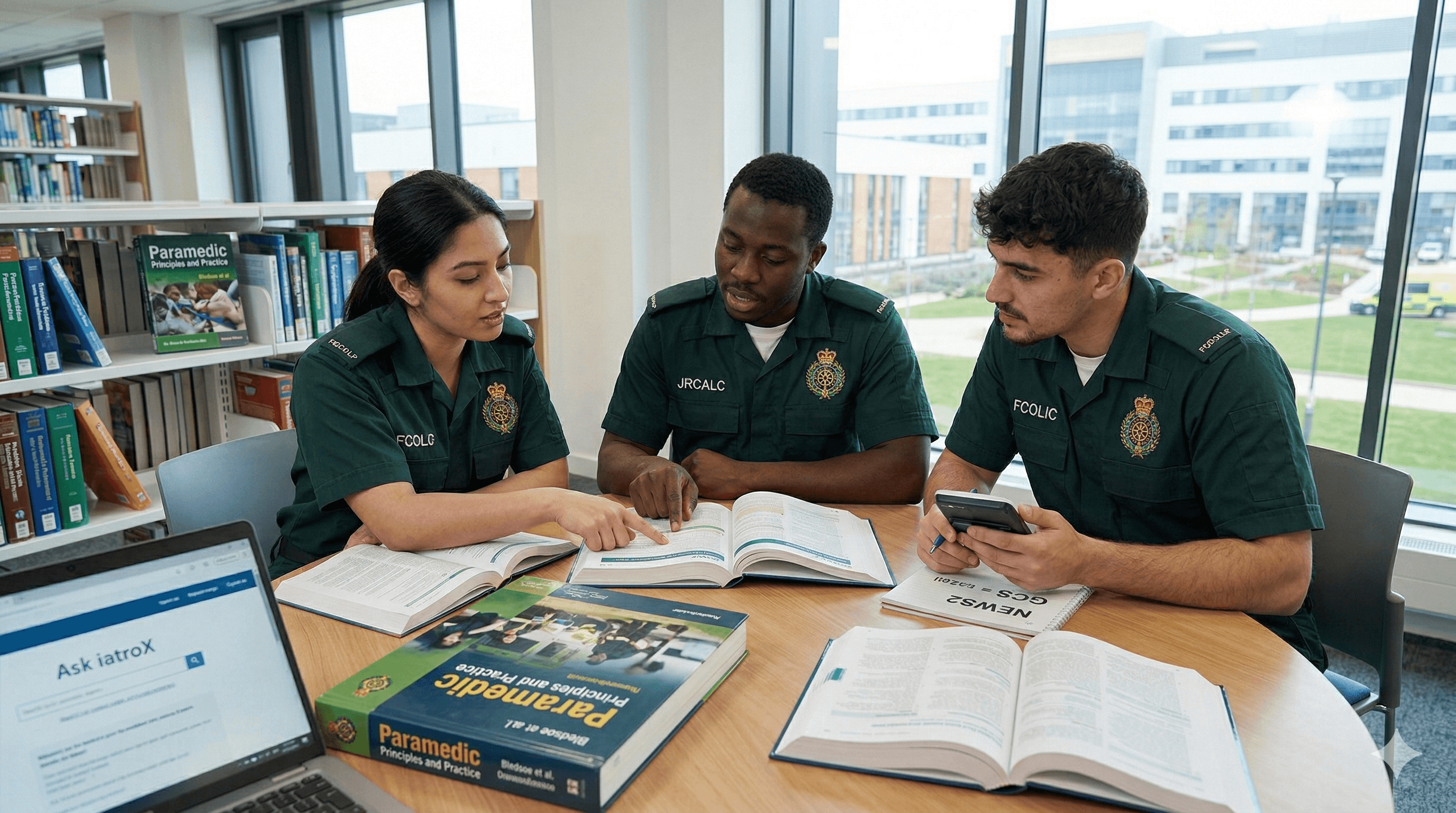
Paramedic science students and qualified paramedics pursuing advanced practice or the College of Paramedics Fellowship (FCOLP) face a revision resource gap that is genuinely striking compared to other healthcare professions. Doctors have Passmedicine, Pastest, iatroX, and Quesmed. Pharmacists now have iatroX, Coditioning, and Pre-Reg Shortcuts. Nurses have CBT preparation courses. Paramedics have almost nothing in the adaptive digital Q-bank space.
The Registration Pathway
HCPC registration is required for all practising paramedics in the UK. Registration follows completion of a HCPC-approved paramedic science degree (BSc or MSc) — which includes clinical placements, academic assessments, and a practice portfolio. The assessments are university-administered, not a national licensing exam — meaning there is no single "paramedic registration assessment" equivalent to the GPhC CRA or UKMLA.
The College of Paramedics is the professional body. The FCOLP (Fellowship of the College of Paramedics) is the advanced practice credential for experienced paramedics pursuing clinical leadership, education, or research roles.
What Revision Resources Exist
JRCALC Clinical Guidelines. The Joint Royal Colleges Ambulance Liaison Committee guidelines are the primary clinical reference for UK paramedic practice. Every paramedic should have access (typically through employer subscription). JRCALC covers drug protocols, clinical algorithms, patient assessment frameworks, and scope of practice guidance.
University course materials. Each paramedic science programme provides its own teaching materials, clinical skills guides, and assessment preparation. Quality varies. No standardised national Q-bank.
Textbooks. "Paramedic Principles and Practice" (Bledsoe et al.), "Emergency Care in the Streets" (AAOS), and "Nancy Caroline's Emergency Care in the Streets" (UK Edition) are standard texts. UK-specific content varies — ensure any US-origin text has been adapted for UK practice.
BASICS courses. Practical pre-hospital care courses — relevant for advanced paramedic practice and DipIMC preparation. Not Q-bank based.
The Gap
There is no adaptive, UK-focused, guideline-integrated Q-bank for paramedic science assessments. The closest equivalent is university-provided question banks — which are programme-specific and not adaptively targeted.
Where iatroX Helps Now
While iatroX does not currently provide a dedicated paramedic registration Q-bank, several tools are directly relevant to paramedic clinical practice and CPD:
Ask iatroX provides instant NICE/emc-grounded answers to clinical questions — useful for pre-hospital clinical queries, CPD, and advanced practice development.
iatroX Calculators includes NEWS2, Glasgow Coma Scale, NIHSS, CURB-65, Wells PE, and other scores paramedics use daily — with UK-contextualised interpretation.
The DipIMC Q-Bank (700+ adaptive questions) is directly relevant for paramedics pursuing the Diploma in Immediate Medical Care — one of the few postgraduate qualifications explicitly designed for pre-hospital practitioners across professional backgrounds.
For paramedic science students, the clinical knowledge tested in university assessments overlaps significantly with the content in iatroX's medical Q-banks — anatomy, physiology, pharmacology, and clinical assessment skills are foundational across all healthcare professions.