Introduction
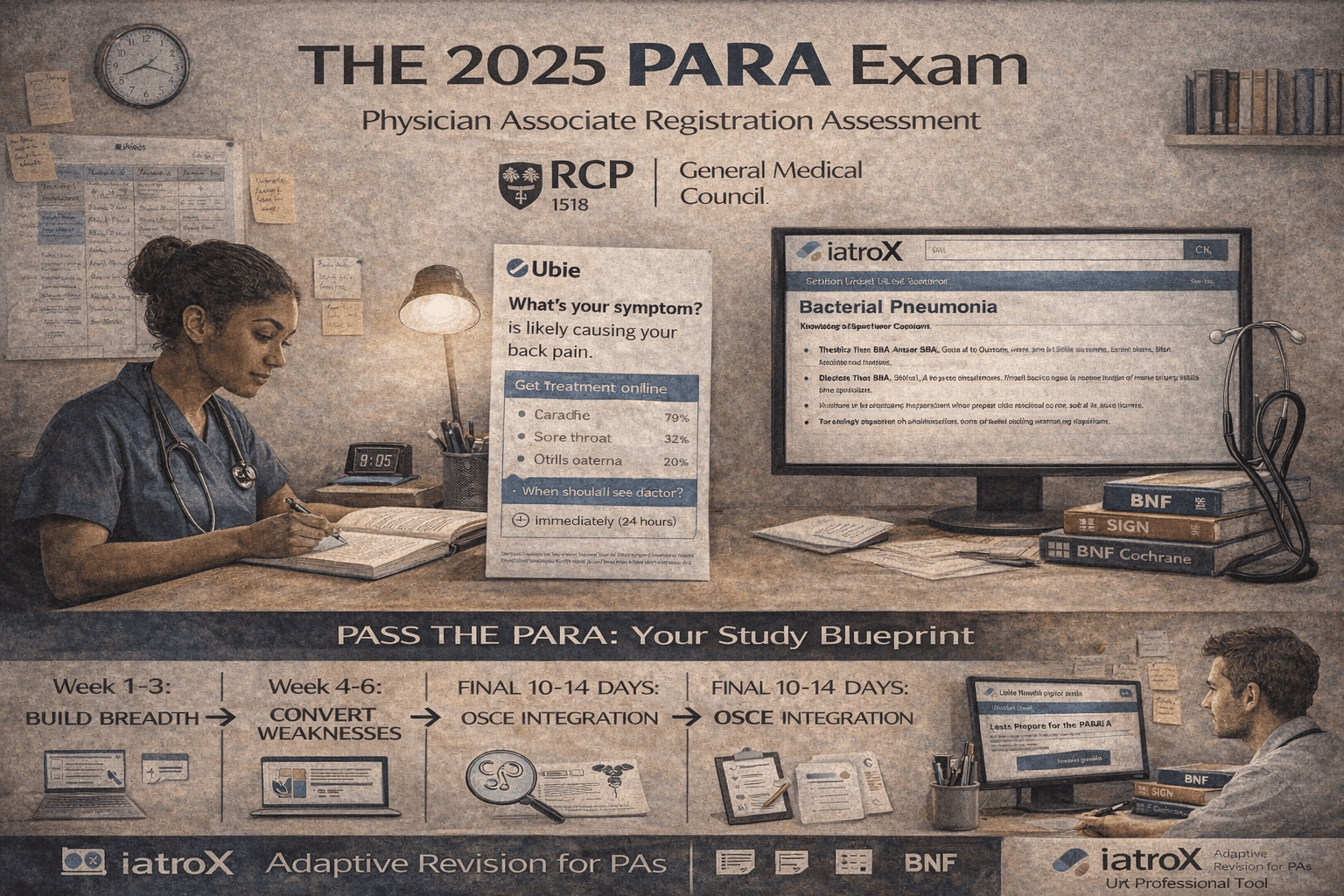
The landscape for Physician Associates in the UK has shifted. From September 2025, the national certification exam, formerly known as the PANE (Physician Associate National Exam), officially transitioned to the PARA (Physician Associate Registration Assessment). Delivered by the Royal College of Physicians (RCP) on behalf of the GMC, this exam is now the definitive gateway to professional registration.
While the name has changed, the challenge remains the same: a rigorous test of generalist medical knowledge and clinical skills. This guide breaks down the new PARA format, outlines a high-yield 6-week study plan, and compares the leading revision tools—including the free, adaptive engine from iatroX—to help you pass first time.
The truth section: what is the PARA?
Before you revise, know your enemy.
- The Name: The PANE is now the PARA. This change reflects the move to statutory regulation by the GMC.
- The Format: The exam consists of two components, and you must pass both to register:
- The Knowledge Based Assessment (KBA): A written exam comprising 200 Single Best Answer (SBA) questions, typically sat in two papers of 100 questions each.
- The OSCE: A practical clinical exam consisting of 14 stations plus rest stations. You will typically have time to read the instructions outside the station, followed by 8 minutes inside the station to complete the task (history, examination, or explanation).
- The Standard: The exam is set at the level of a "day-one" Physician Associate, testing safe, generalist competence across the full breadth of the Matrix of Core Clinical Conditions (RCP, GMC).
Best study approach: a 6-week sprint
Revision isn't about hours logged; it's about efficiency. Use this phased approach to maximise your retention.
Phase 1 (Weeks 1–3): Build breadth
Your goal is to cover the entire curriculum quickly to identify what you don't know.
- Action: Complete 60–100 SBAs per day.
- Method: Use Adaptive Mode. Don't pick topics; let the algorithm serve you a mix. This prevents you from ignoring your weak subjects (like Neurology or Haem) in favour of your strengths.
- Review: Keep a simple "Errors Log." For every wrong answer, note why you missed it:
- Knowledge Gap: "I didn't know the first-line antibiotic for cellulitis." (Action: Read the current UK medicines information).
- Misread: "I missed the allergy in the stem." (Action: Slow down).
- Timing: "I rushed." (Action: Practice pacing).
Phase 2 (Weeks 4–6): Convert weaknesses
Now, target the gaps you found in Phase 1.
- Action: Re-run your "Weakness Queue." Focus exclusively on the topics where your performance was below 60%.
- Stamina: Start doing 1–2 timed "KBA-like" blocks per week. Sit down for a full hour and do 50 questions without pausing. This builds the mental endurance you need for exam day.
Phase 3 (Final 10–14 Days): OSCE integration
Shift your focus to the practical exam.
- Structure: Break your revision into four pillars:
- History Frameworks: (SOCRATES, JAM THREADS, ICE).
- Focused Exam Routines: (Cardio, Resp, Abdo, Neuro - be slick and rehearsed).
- Management Scripts: (Explaining asthma, safety-netting for a febrile child).
- Escalation: Knowing how and when to say "I need to discuss this with my senior."
- Drill: Run short daily "micro-stations" of exactly 8 minutes with a study partner to train your internal clock.
Use iatroX here
iatroX is designed to support this exact workflow without the cost of a subscription.
- Start with Adaptive: Use our free AI engine to find your gaps.
- Maintain with Spaced Repetition: Once you learn a fact, our system schedules it for review at the optimal time to ensure you don't forget it before the exam.
Compare: free vs paid banks
| Platform | Type | Estimated Volume | Price Note | Best For |
|---|---|---|---|---|
| Plabable for PA | Paid | ~4,300+ Qs | Subscription | High volume, established brand |
| Matrix Education | Paid | Large Bank + App | Subscription | Integrated notes & questions |
| PA Practice | Paid | Specialist PA Bank | Subscription | PA-specific content focus |
| iatroX | Free | Adaptive Bank | Free (No Ads) | Adaptive learning & Spaced Repetition |
The Verdict: If you have the budget and want sheer volume of static questions, paid banks like Plabable or Matrix are excellent resources. If you want an intelligent, adaptive engine that targets your weaknesses and uses spaced repetition to lock in knowledge—for free—iatroX is the smart choice for your core revision.