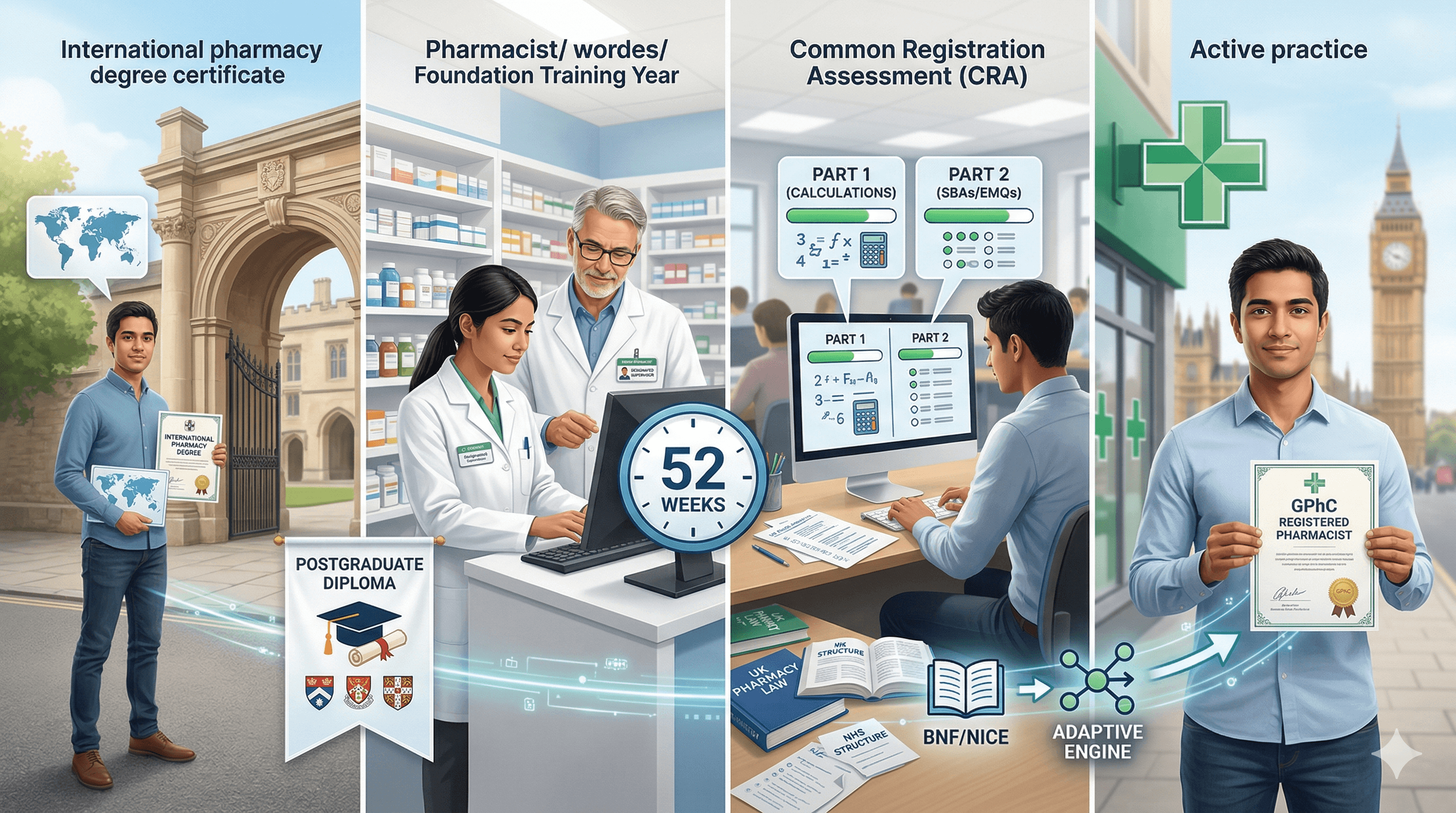
If you qualified as a pharmacist outside the UK and want to practise in the UK, the Overseas Pharmacists Assessment Programme (OSPAP) is your pathway. It is a postgraduate diploma that bridges the gap between your international qualification and UK pharmacy practice — covering UK pharmacy law, NHS structure, clinical governance, and British pharmaceutical sciences.
But OSPAP is just one step. The full journey from international qualification to GPhC registration involves multiple stages — and each has its own requirements, timelines, and potential pitfalls.
The Pathway
Step 1 — OSPAP. A postgraduate diploma (typically 1 year) at a GPhC-accredited UK university (Aston, Brighton, De Montfort, Kingston, Medway, Robert Gordon, Sunderland — check current providers). Entry requirements: a recognised pharmacy degree, IELTS 7.0 overall (minimum 6.5 in each component), and documentary evidence of your pharmacy qualification.
Step 2 — Foundation Training Year (FTY). 52 weeks of supervised practice in a UK pharmacy setting (community or hospital). Same requirements as UK MPharm graduates. Must be supervised by a GPhC-registered designated supervisor. Complete competency portfolio and learning outcomes.
Step 3 — Common Registration Assessment (CRA). Part 1 (40 calculations) + Part 2 (120 SBAs/EMQs). Must pass both parts in the same sitting. Maximum 3 lifetime attempts. Two sittings per year (June and November).
Step 4 — GPhC Registration. Apply to the GPhC with evidence of OSPAP completion, FTY completion, CRA pass, fitness to practise declaration, and character references.
Common OSPAP-Specific Challenges at the CRA
UK pharmacy law. OSPAP graduates often find pharmacy law the hardest CRA domain — because the legislative framework (Medicines Act 1968, Misuse of Drugs Act 1971, Human Medicines Regulations 2012, Responsible Pharmacist Regulations) is entirely UK-specific. No international pharmacy qualification covers UK law. This must be learned from scratch during OSPAP and reinforced through focused CRA preparation.
NHS structure and referral pathways. Understanding the GP-as-gatekeeper model, Pharmacy First consultations, the NHS medicines supply chain, and the clinical governance structures of UK pharmacy practice — all of which are tested in Part 2 scenarios.
UK prescribing conventions. Drug naming (generic names standard in UK; brand names more common in some international systems), current official dosing information conventions, MHRA safety alerts, and NICE-specific treatment recommendations.
How iatroX Helps OSPAP Graduates
iatroX is particularly valuable for OSPAP graduates because of the integration with NICE guidance and medicines information from SmPCs via eMC. Every Part 2 explanation references the relevant UK guideline — teaching UK-specific management pathways alongside the clinical content. For graduates whose pharmacy training used different guidelines (WHO, FDA, local formularies), this alignment is essential.
The adaptive engine identifies where your international training diverges from UK practice — if you consistently answer cardiovascular questions using non-NICE thresholds, the engine flags cardiovascular as a weak area and serves more questions with explanations grounded in NICE guidance and medicines information from SmPCs via eMC.
The pharmacy law questions are scenario-based and adaptive — concentrating practice on the specific law topics you struggle with rather than rotating through a fixed set.
Pricing: £29/month or £99/year. Available at iatrox.com/quiz-landing?exam=uk-gphc.
Start your CRA preparation with an adaptive iatroX GPhC Q-bank that incorporates medicines information from relevant SmPCs on eMC.