Introduction
The promise of AI for clinicians is simple: an instant answer to a complex question, backed by real evidence. OpenEvidence is one of the most prominent tools delivering on this promise. With slick marketing and a "free for healthcare professionals" model, it has gained significant traction.
But for a doctor, nurse, or pharmacist working in the NHS, is it the right tool? This review unpacks what OpenEvidence is, why its US-centric model creates friction for UK practice, and what alternatives (like iatroX) might fit your workflow better.
What OpenEvidence is (and the NPI/US-HCP gating reality)
OpenEvidence is an AI-powered medical search engine. It is designed to synthesise answers from peer-reviewed medical literature.
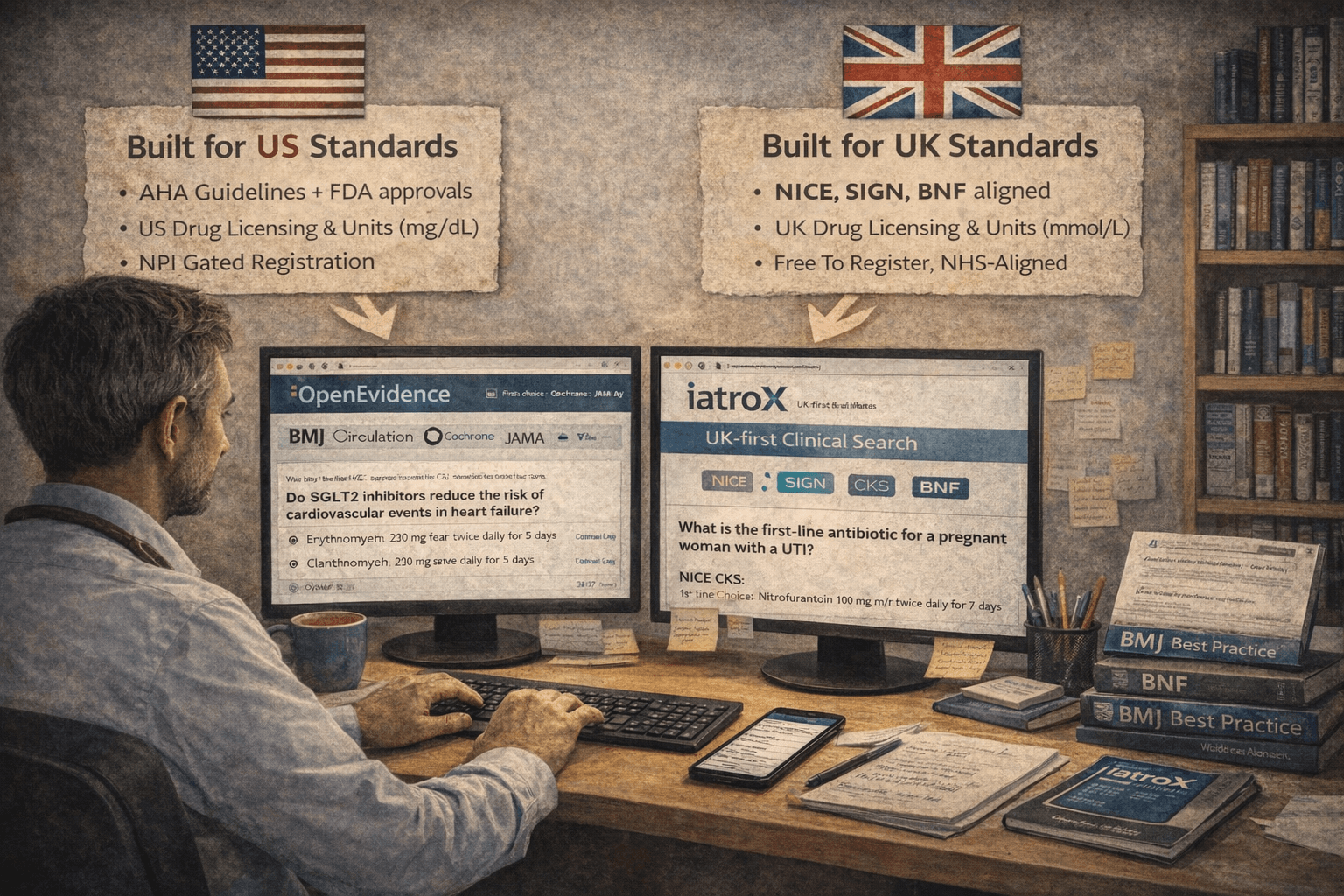
- The "Free" Catch: It is marketed as free for healthcare professionals. However, the registration process is heavily geared towards the US market, often requiring an NPI (National Provider Identifier) number for verification.
- UK Access: While some UK clinicians have successfully registered, the process is not seamless, and the platform's primary audience is clearly the American healthcare workforce (App Store, Google Play).
Evidence model: cited answers grounded in peer-reviewed literature
The core strength of OpenEvidence is its "grounding." Unlike ChatGPT, which predicts text, OpenEvidence retrieves relevant abstracts from high-quality journals (NEJM, JAMA, The Lancet) and synthesises an answer based only on those papers.
- The Pros: It provides inline citations. You can click a number and see the abstract. It reduces the risk of "hallucination" compared to a general LLM.
- The Cons: It relies heavily on academic literature. This is great for a research question ("What is the latest trial data on drug X?"), but less useful for a practical management question ("What is the first-line antibiotic for a UTI in pregnancy?"), where you need a guideline, not a trial.
Strengths for GPs (speed, citations, journal depth)
For a GP or hospital specialist, OpenEvidence shines in specific scenarios:
- Rare Diseases: Finding case reports or evidence for conditions that aren't covered by standard guidelines.
- "Off-Label" Queries: Finding evidence for using a drug outside its licence when standard resources are silent.
- Academic Interest: Quickly getting up to speed on the "state of the art" for a condition.
Limitations & safety framing
Like all current AI tools, OpenEvidence carries disclaimers: it is not medical advice and the clinician remains responsible.
- Interpretation Risk: It summarises abstracts. It does not necessarily interpret the quality or bias of a study in the way a systematic review (like Cochrane) does.
- Context Blindness: It doesn't know your patient. It provides general evidence, which may not apply to a multimorbid, frail elderly patient in your clinic (openevidence.com, PMC).
UK reality check: why “US evidence engines” can misalign with UK pathways
This is the critical issue for NHS staff. OpenEvidence is built on a US-centric corpus.
- Guideline Mismatch: It may cite the American Heart Association (AHA) or FDA approvals, which often differ from NICE recommendations or the current UK medicines information.
- Drug Availability: It might suggest drugs that are licensed in the US but not the UK, or are not cost-effective for NHS prescribing.
- Unit Confusion: US lab units (mg/dL) differ from UK units (mmol/L), creating a potential safety risk if you aren't vigilant.
What to use in the UK instead
For a UK clinician, the "best" tool is one that speaks the language of the NHS.
1. iatroX (UK-First & Free)
iatroX is designed specifically for the UK workflow.
- Clinical-source grounding: Its answers prioritise NICE, CKS and SIGN guidance, with medicines information from SmPCs via eMC. It aligns with what you are actually expected to do.
- Citation-First: Like OpenEvidence, it provides citations, but they link to the UK national guidance you need to follow.
- Access: It is free and open to all, with no NPI gating.
2. BMJ Best Practice (via OpenAthens)
For structured, peer-reviewed summaries that are updated daily and align with UK practice, this remains a gold standard.
FAQ
Is OpenEvidence available in the UK? Technically yes, but the verification process prioritises US clinicians with an NPI number. UK doctors may face hurdles in registering for the "Pro" features.
Do I need an NPI? For the full professional tier, usually yes.
Is it free? It operates on a freemium model for verified professionals, but unverified users may hit usage limits.