Introduction
For clinicians outside the United States, OpenEvidence has become a subject of significant interest. Marketed as a powerful, AI-driven medical search engine that is "free for healthcare professionals," it promises to revolutionise how doctors interact with medical literature.
However, for many in the UK, Europe, and beyond, the reality of signing up has been a point of friction. The platform's verification system, designed primarily for the US market, creates a barrier that can leave international clinicians locked out of the "Pro" features. This article explains why this verification exists, what it blocks, and what practical alternatives are available for UK clinicians right now.
Why verification exists (and what it blocks)
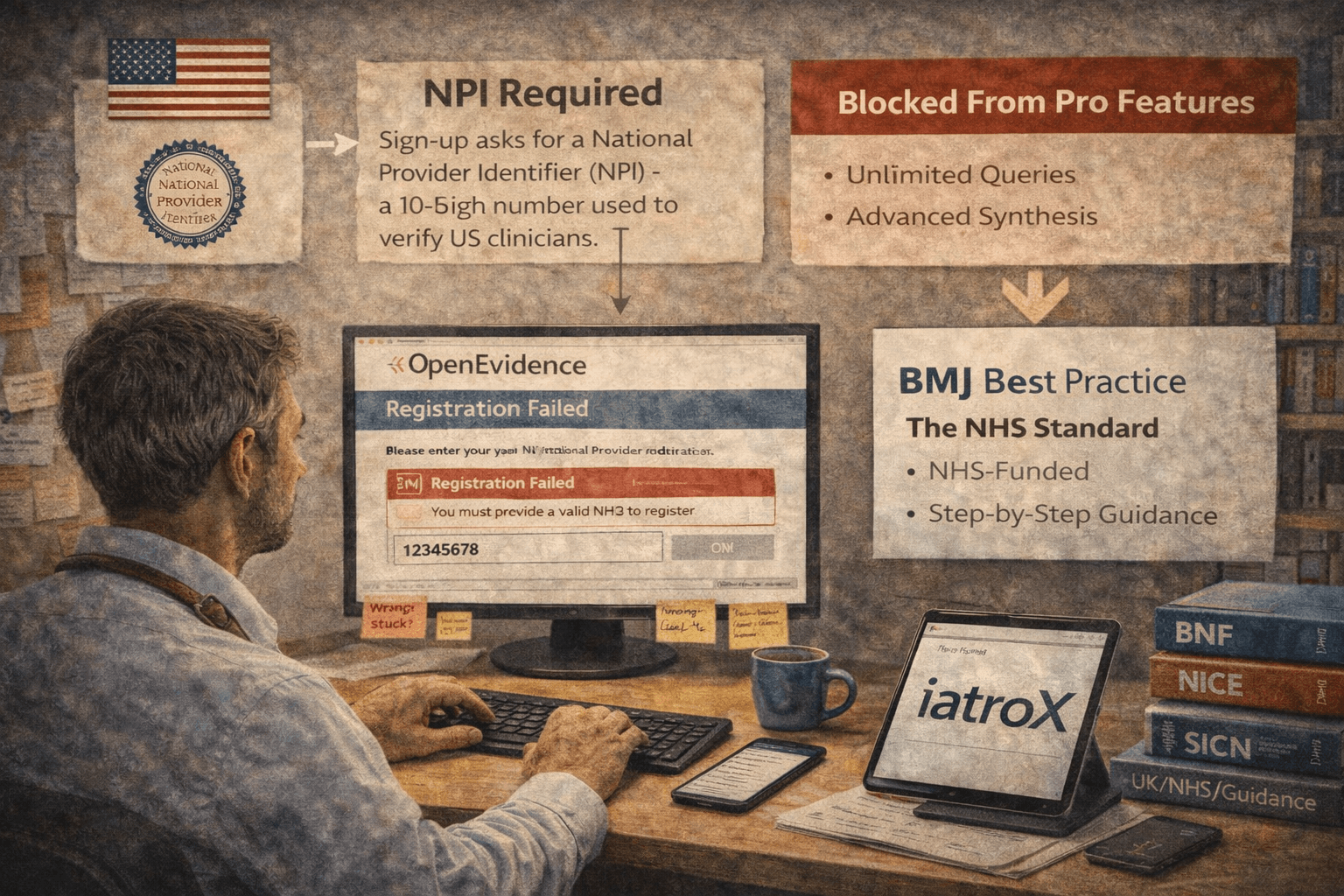
OpenEvidence uses a verification model to ensure its tool is used by qualified professionals. In the US, this is streamlined using the NPI (National Provider Identifier) system—a unique 10-digit identification number issued to US health care providers.
- The US Advantage: For a US doctor, verification is often instant. The system checks their NPI against a database, and they are in.
- The International Friction: For UK or EU clinicians, who do not hold an NPI, the automated pathway often fails or is non-existent. While there may be manual workarounds or waiting lists, many users report being unable to access the full "Pro" suite of features, which typically includes unlimited queries and advanced synthesis capabilities (App Store).
- The Rationale: This gating allows OpenEvidence to maintain a high-trust user base and potentially tailor its outputs to a professional audience, but it inadvertently marginalises the global medical community.
What UK clinicians can use today
If you are stuck at the verification screen, you don't need to wait. There are high-quality, accessible alternatives designed for the UK ecosystem.
1. BMJ Best Practice (The NHS Standard)
You likely already have free access to a world-class clinical decision support tool.
- Access: BMJ Best Practice is nationally funded for all NHS staff in England, Scotland, and Wales. You can access it for free using your NHS OpenAthens login.
- The Benefit: Unlike a US-centric tool, it is written for the UK context. It aligns with UK guidelines and prescribing practices. It offers structured, step-by-step guidance on diagnosis and management, and its mobile app works offline—a crucial feature for hospital "black spots" that cloud-based AI tools can't match.
2. iatroX (The Free, UK-Centric AI)
If you are looking for the speed and conversational interface of an AI, iatroX is the direct alternative.
- Access: It is completely free for all users, with no NPI or complex verification required.
- The Benefit: It is built on a "walled garden" of UK-accepted guidance. When you ask a question, it retrieves answers from NICE, CKS, SIGN, and the SmPC/emc, providing direct citations. It offers the AI-powered synthesis you want from OpenEvidence, but with the local relevance you need for safe UK practice.
Conclusion
While OpenEvidence is a powerful tool for those who can access it, UK clinicians do not need to feel left behind. By combining the deep, verified content of BMJ Best Practice with the fast, AI-powered synthesis of iatroX, you can build a digital toolkit that is not only accessible but also safer and more relevant to your daily work in the NHS.